
PayPal vs Stripe is a question about how your customers like to pay. Stripe is built around the card form on your own checkout page, and it’s priced and documented for businesses with a website, an app or a developer. PayPal is built around the PayPal button: buyers log in, pay from their balance, card, bank or Venmo, and never type a card number. Both are pay-as-you-go with no monthly fee on standard pricing, both deposit to a US bank account, and both add 1.5% for international buyers. The gaps show up in the rate for each payment type, in invoices and bank payments, in how fast you get paid and in what a dispute costs.
Quick answer: Pick Stripe if you take card payments on your own site or run subscriptions. It charges 2.9% + 30¢ per online card payment, against 2.99% + 49¢ for a card through PayPal. Pick PayPal if your buyers expect a PayPal or Venmo button, or if you bill by invoice. PayPal Checkout costs 3.49% + 49¢, and PayPal invoices skip Stripe’s 0.4% invoicing fee.
All fees are for US businesses on standard pricing, taken from Stripe’s pricing page and PayPal’s business fees page (last updated November 4, 2026) in November 2026. Both companies change rates from time to time, so check the linked pages before you set prices.
PayPal vs Stripe: which one fits your business?
Start with your main way of getting paid. The processor with the lower headline rate can still cost more if it handles your main channel badly.
| Your business | Better fit | Why |
|---|---|---|
| Online store or digital products with your own checkout | Stripe | 2.9% + 30¢ per card payment vs 3.49% + 49¢ for PayPal Checkout |
| SaaS, memberships, subscriptions | Stripe | Billing and subscription tools built for recurring card payments |
| Buyers who expect a PayPal or Venmo button | PayPal | Buyers pay without entering a card; Venmo at the same 3.49% + 49¢ |
| Freelancer or agency billing by invoice | PayPal | No invoicing fee; cards 2.99% + 49¢, bank 1% capped at $10 |
| Recurring billing on autopay | Stripe | Saved cards and bank debits, ACH capped at $5 |
| Market stall or pop-up | PayPal | In-person card rate of 2.29% + 9¢ vs Stripe Terminal’s 2.7% + 5¢ |
| Store that wants both checkouts | Both | Stripe card form plus a PayPal button |
In our experience setting up payments for small shops, the expensive mistake is choosing on the card rate alone. A store whose buyers mostly click the PayPal button pays PayPal Checkout rates regardless of how cheap the card form is.
PayPal vs Stripe fees side by side (US, 2026)
PayPal has several rates depending on how the buyer pays. Stripe has one main card rate with add-ons.
| Payment type | Stripe | PayPal |
|---|---|---|
| Online card payment | 2.9% + 30¢ | 2.99% + 49¢ (standard card); 2.89% + 29¢ (advanced card processing) |
| PayPal or Venmo wallet checkout | Through your PayPal account (see below) | 3.49% + 49¢ |
| Pay Later | Varies by method | 4.99% + 49¢ |
| In-person card | 2.7% + 5¢ (Terminal) | 2.29% + 9¢ card present; 3.49% + 9¢ keyed in |
| Manually entered card online | +0.5% | Not separately listed |
| Invoice paid by card | Card rate + 0.4% per paid invoice | 2.99% + 49¢ (cards); 3.49% + 49¢ (PayPal or Venmo) |
| Invoice paid by bank | 0.8%, $5 cap, + 0.4% invoicing | 1%, capped at $10 |
| ACH bank payment (online) | 0.8%, $5 cap | 0.80%, capped at $5 |
| International buyer | +1.5% | +1.5% |
| Currency conversion | +1% | 3% to 4% spread |
| Instant payout | 1.5%, 50¢ minimum | 1.5%, $0.50 minimum |
| Dispute or chargeback | $15 per dispute + $15 if you counter (refunded if you win) | $15 dispute fee ($30 at high volume); $20 card chargeback fee |
| Monthly fee | None on standard pricing | None for a standard business account |
Stripe says it charges no setup fees, monthly fees or closure fees on standard pricing. PayPal’s fixed fee for US dollar commercial payments is $0.49, and its 1.50% international fee applies to all commercial transactions from buyers outside the US.
Stripe’s US standard rate is 2.9% + 30¢ per successful domestic card payment online, per its pricing page. PayPal’s business fees page lists 3.49% + $0.49 for PayPal Checkout and 2.99% + $0.49 for standard credit and debit card payments. On card payments the 19-cent difference in the fixed fee matters most on small orders.
PayPal vs Stripe on a $20, $100, $1,000 and $5,000 sale
Here’s the math for a US buyer paying online, rounded to the cent. Run your own amounts in our PayPal fee calculator.
| Sale | Stripe (card) | PayPal standard card | PayPal Checkout (wallet) |
|---|---|---|---|
| $20 | $0.88 | $1.09 | $1.19 |
| $100 | $3.20 | $3.48 | $3.98 |
| $1,000 | $29.30 | $30.39 | $35.39 |
| $5,000 | $145.30 | $149.99 | $174.99 |
On card payments, Stripe is cheaper at every amount, by 21 cents on a $20 sale and $4.69 on $5,000. PayPal Checkout costs more again, because the buyer pays from their PayPal wallet and PayPal charges 0.5 points more for that.
PayPal’s advanced card processing rate of 2.89% + 29¢ is the one exception. It costs $0.87 on $20 and $29.19 on $1,000, a few cents under Stripe. It belongs to PayPal’s advanced checkout setup, which takes more integration work than the standard PayPal button.
To find what to charge so you receive a set amount after Stripe’s cut, our Stripe fee calculator works it backwards.
Invoices and bank payments: where PayPal can win
Invoicing flips the picture on large amounts. Stripe adds 0.4% per paid invoice on top of its payment rate. PayPal invoices carry no extra invoicing fee, and its Pay by Bank option on invoices is 1% capped at $10.
| Invoice amount | Stripe, paid by card | Stripe, paid by bank | PayPal, paid by card | PayPal, paid by bank |
|---|---|---|---|---|
| $500 | $16.80 | $6.00 | $15.44 | $5.00 |
| $1,000 | $33.30 | $9.00 | $30.39 | $10.00 |
| $5,000 | $165.30 | $25.00 | $149.99 | $10.00 |
Stripe’s bank cost is its ACH Direct Debit fee (0.8%, capped at $5) plus 0.4% of the invoice. PayPal’s is a flat 1% until it reaches its $10 cap. Stripe comes out ahead only between about $834 and $1,250, and by a dollar at most. Above $1,250, the 0.4% keeps growing while PayPal’s fee stays at $10, so a $5,000 bank-paid invoice costs $25 on Stripe and $10 on PayPal.
For card-paid invoices, PayPal’s 2.99% + 49¢ comes in under Stripe’s 3.3% + 30¢ on any invoice above about $62. A freelancer billing $5,000 a month by card keeps about $15 more each month through PayPal.
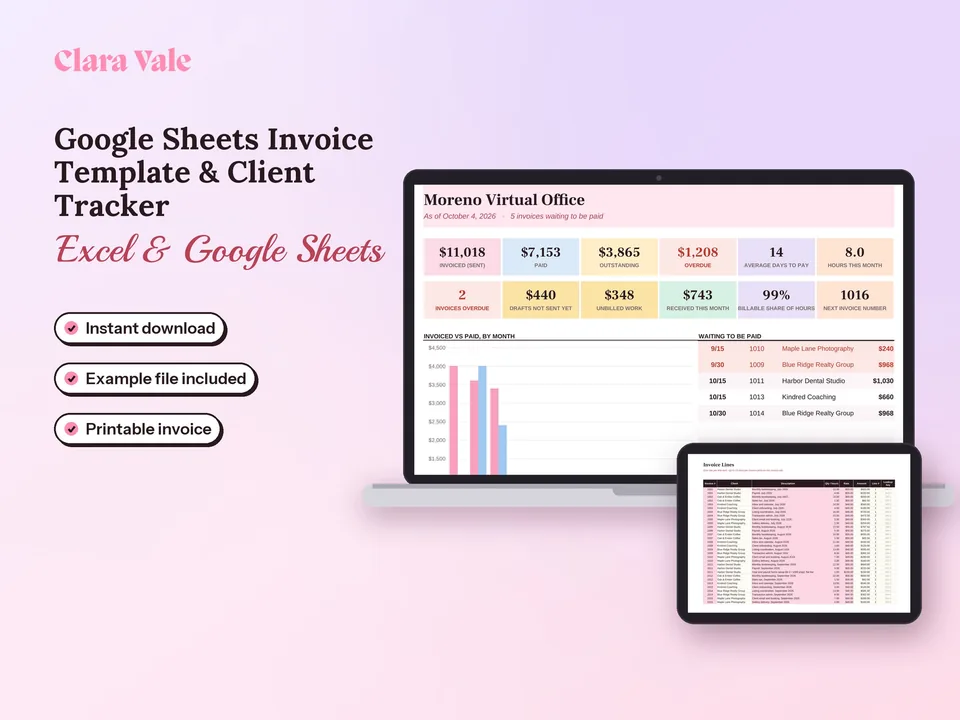
Whichever processor you invoice through, one record of who owes what keeps payments from slipping. Our Google Sheets invoice template prints a one-page invoice and tracks Draft, Sent, Paid and Overdue status alongside your hours and clients.
PayPal vs Stripe payouts: how fast you get paid
PayPal payments land in your PayPal balance, and a standard withdrawal to a linked bank account is free when no currency conversion is involved. Instant transfers to a bank or debit card cost 1.5% of the amount, with a $0.50 minimum. New sellers should plan for holds: PayPal says it may hold the initial payments a new seller receives for up to 21 days, per its help article on payments on hold for new sellers.
Stripe pays out to your bank on a schedule. Its payouts documentation lists two-business-day settlement for US accounts and says the first payout typically completes within 7 to 14 days of your first live payment. Instant Payouts cost 1.5%, with a 50¢ minimum, and new accounts become eligible after a while rather than on day one.
So both charge the same 1.5% for speed. The real difference is the start: a new PayPal seller can see money held for up to three weeks, and a new Stripe account waits one to two weeks for its first payout. After that, both settle into a steady rhythm.
Disputes, refunds and the disadvantages of Stripe
Stripe charges a $15 dispute fee each time a cardholder disputes a payment, plus a $15 countered fee if you respond, and returns only the countered fee when you win, per Stripe’s dispute pricing note. A lost $20 order can cost the sale, the processing fee and $30.
PayPal splits it in two. Its $15 dispute fee ($30 for high-volume sellers) applies to disputes on payments made through a buyer’s PayPal account or PayPal checkout. A $20 chargeback fee applies to card chargebacks on payments processed outside those flows, such as advanced card processing. PayPal also keeps the fees you paid on a payment when you refund it.
Other Stripe drawbacks worth weighing:
- International buyers cost more. Cards issued outside the US add 1.5%, and currency conversion adds another 1%. PayPal adds the same 1.5%, with a 3% to 4% conversion spread.
- The first payout takes a while. Seven to 14 days is typical for a new account.
- Custom checkouts need code. Payment Links and hosted invoices work without a developer, but a fully custom checkout leans on Stripe’s API.
- Invoices cost extra. The 0.4% per paid invoice adds $4 on every $1,000 billed.
PayPal has its own trade-offs: PayPal Checkout costs about 0.6 points more than Stripe’s card rate, new-seller holds can tie up cash for weeks, and the currency conversion spread is wider.
Using PayPal and Stripe together
Plenty of online stores run both: a Stripe card form for buyers who type a card number, and a PayPal button for buyers who’d rather pay from their PayPal or Venmo account. Each payment pays the rate of the processor that handled it.
Stripe processes PayPal payments directly for businesses in supported European countries. For US Stripe accounts, its PayPal payments guide points to adding PayPal as a custom payment method that runs through your own PayPal account, so PayPal’s rates and payouts still apply to those sales.
Running two processors means two dashboards, two payout schedules and two sets of fees to match against your bank deposits. Record each payout and its fees on its own line so income lines up with what actually arrives. If you also take payments in person, our Stripe vs Square comparison covers the counter side.
The PayPal vs Stripe verdict
Stripe wins for card payments on your own site and for subscriptions, where 2.9% + 30¢ beats PayPal’s 2.99% + 49¢ card rate and 3.49% + 49¢ wallet rate. PayPal wins when your buyers expect a PayPal or Venmo button, for in-person sales above about $10, and for invoices, where it skips Stripe’s 0.4% invoicing fee and caps bank payments at $10. Many businesses offer both and let buyers choose. Before you commit, plug your average order into our PayPal fee calculator and compare it with Stripe’s 2.9% + 30¢.
Questions people ask
How much is the Stripe fee for $1000?
A $1,000 online payment with a US card costs $29.30 on Stripe (2.9% of $1,000 is $29, plus 30¢), so you receive $970.70. Paid by ACH Direct Debit, it costs $5.00, because Stripe charges 0.8% with a $5 cap. On a Stripe invoice, add the 0.4% invoicing fee, which is $4.
How much does PayPal charge for a $5000 transaction?
Through PayPal Checkout, a $5,000 US payment costs $174.99 (3.49% plus $0.49), so you receive $4,825.01. Paid by card through PayPal's standard card processing, it costs $149.99 (2.99% plus $0.49). A PayPal invoice paid by bank (ACH) costs 1% capped at $10, so $10 on $5,000. A buyer outside the US adds 1.5%.
What are the disadvantages of Stripe?
Stripe charges $15 for each dispute you receive and another $15 if you counter it, with the second fee returned only if you win. International cards add 1.5% and currency conversion adds 1%. Your first payout usually takes 7 to 14 days, custom checkouts lean on a developer, and Stripe invoices add 0.4% on top of the card rate.
Who is Stripe's biggest competitor?
PayPal is the competitor most often compared with Stripe, along with PayPal's Braintree gateway. Square competes for in-person and small-shop payments, and Adyen for large enterprises. For most small online businesses, the real choice is between Stripe's card-first checkout and PayPal's wallet checkout, and many sites offer both at once.
Is PayPal or Stripe cheaper?
For a US card payment online, Stripe is cheaper: 2.9% + 30¢ against PayPal's 2.99% + 49¢ standard card rate and 3.49% + 49¢ for PayPal Checkout. On a $100 sale that's $3.20 on Stripe, $3.48 for a card through PayPal and $3.98 through PayPal Checkout. PayPal is cheaper for in-person sales above about $10 and for most invoices.
Can I use PayPal and Stripe together?
Yes. Many online stores show a Stripe card form and a PayPal button side by side, so buyers pick the way they like to pay. Stripe processes PayPal directly for businesses in supported European countries, and US Stripe accounts can add PayPal as a custom payment method linked to their own PayPal business account, where PayPal's rates apply.
Is Stripe or PayPal better for freelancers?
For invoicing, PayPal usually costs less. A PayPal invoice paid by card costs 2.99% + 49¢, and one paid by bank costs 1% capped at $10. Stripe adds 0.4% per paid invoice to its 2.9% + 30¢ card rate and its $5-capped ACH fee. Stripe comes out ahead for freelancers who sell subscriptions, retainers on autopay or checkout links on their own site.