
A landlord, a lender or a partner will ask to see it before they say yes: your salon business plan. It’s where you show what services you’ll offer, who will book them, how many chairs you’ll run and whether the numbers add up. Most of it is plain writing. The financial section decides the answer, so that’s where we spend the most time, with a filled example for a 4-chair hair salon.
A salon business plan has nine sections: executive summary, company description, market analysis, services and pricing, staffing and pay model, marketing, management, financial projections and funding request. The financial projections rest on one formula: chairs × clients per chair per day × average ticket × days open. That gives revenue, break-even and profit.
This post is educational and is not financial, legal or tax advice. All numbers in the example are assumptions for illustration, not industry benchmarks.
What goes in a salon business plan
The structure below follows the traditional business plan sections from the U.S. Small Business Administration, adapted for a salon. It works for a hair salon, barbershop, nail salon or lash and brow studio. Only the service menu and the chair count change.
| # | Section | The question it answers |
|---|---|---|
| 1 | Executive summary | What is this salon, and why will it work? |
| 2 | Company description | What kind of salon, for which clients? |
| 3 | Market analysis | Who lives and works nearby, and who serves them now? |
| 4 | Services and pricing | What do you sell, how long does it take, what does it cost? |
| 5 | Staffing and pay model | Who works the chairs, and how are they paid? |
| 6 | Marketing | How do new clients find you, and why do they rebook? |
| 7 | Management | Who runs it, and what have they done before? |
| 8 | Financial projections | How many appointments, what profit, when? |
| 9 | Funding request | How much money, for what, on what terms? |
Write section 8 before section 1. The services, staffing and location sections feed its numbers, and the executive summary is a short version of them.
1. Executive summary
The SBA says this section should “briefly tell your reader what your company is and why it will be successful.” Keep it to one page: the concept, the location, the team, the money you need and the headline numbers.
Example: “Fern & Shear is a 4-chair hair salon opening in a busy neighborhood retail strip. The owner, a stylist with 9 years behind the chair and a full client book, will work one chair and hire three commission stylists. We expect 6 clients per chair per day at a $75 average service ticket. We break even at 233 appointments a month. We’re asking for a $60,000 loan alongside $25,550 of owner equity.”
2. Company description
Say what kind of salon this is and who it’s for. Full-service hair, color specialist, barbershop, nail bar, or a mix? Name your hours, the feel of the space and your core client.
Example: “A color-and-cut salon for working professionals, open Tuesday to Saturday, 9 a.m. to 7 p.m., with two late evenings. Color, balayage and cuts make up most of the menu. We sell a small retail range of the professional products used at the bowl.”
3. Market analysis
Show who lives and works within a short drive, and who already does their hair. List each competing salon with its prices for a cut and for single-process color, its hours and its online rating. Then explain your gap: evening appointments, a specialty, parking, or a price point no one nearby fills.
Example: “Three salons sit within two miles. Two close at 6 p.m. and none offer Sunday or late-evening color. Our two late evenings target clients who work standard office hours.”
Your own competitor price list beats any general statistic here, because it’s the price your future clients compare you against.
4. Services and pricing
List your service menu with three numbers for each service: the price, the time it takes, and the back-bar product it uses (color, developer, shampoo, foils). Time matters as much as price, because a salon sells hours in a chair.
| Service | Price | Chair time | Product cost |
|---|---|---|---|
| Women’s cut and style | $65 | 60 min | $3 |
| Men’s cut | $40 | 30 min | $1 |
| Single-process color | $95 | 90 min | $12 |
| Balayage | $180 | 180 min | $25 |
Divide each price by its chair time to get revenue per chair hour. In the table, the men’s cut earns $80 an hour and balayage $60 an hour, even though balayage has the biggest ticket. That’s the kind of insight a lender likes to see. Before you set prices, check each service’s margin with our profit margin calculator so the margin you plan is the one you’ll get.
If you mix up markup and margin at this step, every later number is off, so our guide to markup vs margin is worth a read before you print the menu.
Example: “Our average service ticket is $75 across the menu, with back-bar product at 8% of service sales.”
5. Staffing and pay model
Name every role (stylists, assistant, front desk), the hours each works and how each is paid. The pay model is the biggest choice in a salon business plan, because it decides what shows up as revenue. In a commission salon, the owner takes every booking and pays stylists a share. In a booth rental salon, stylists rent the chair, keep what they charge and run their own book. Many salons mix the two.
Check your commission rate against what stylists can earn elsewhere. Median pay for hairdressers, hairstylists and cosmetologists was $17.21 an hour ($35,790 a year) in 2025, per Bureau of Labor Statistics wage data shown on O*NET OnLine. In our example, a stylist doing 6 clients a day at $75 for 22 days earns $9,900 × 45% = $4,455 a month, or about $25 an hour across a 176-hour month. That’s a pay offer you can recruit with.
If you rent booths, write down how the arrangement works in practice. The IRS looks at behavioral control, financial control and the type of relationship when it decides whether someone is an employee or an independent contractor. A booth renter who sets their own hours, prices and products fits the contractor side; ask an accountant to check your setup.
Example: “The owner works one chair. Three stylists are employees on 45% commission of service sales. A part-time front-desk assistant handles booking and retail.”
6. Marketing
Show how new clients find you and why existing clients come back. In a salon, the second part matters more: a full diary comes from rebooking at the chair, not from a steady flow of first visits. List your channels (booking app listing, Google Business Profile, Instagram, referrals, a local opening event) and set a rebooking target.
Example: “Each stylist offers to book the next appointment before the client leaves. We’ll track the rebooking rate weekly and give a referral credit on the next service.”
7. Management
Introduce the people running the salon and what they’ve done before. For a stylist opening their first salon, the strongest evidence is a client book: how many regular clients follow you, how often they visit and what they spend. Add any manager or partner, and who handles payroll, ordering and bookkeeping for the business.
Example: “The owner has 9 years of experience and 180 regular clients visiting every 6 to 8 weeks. Bookkeeping is handled by an outside accountant monthly.”
8. Financial projections
Lenders read this section first. It needs a revenue forecast, costs split into variable and fixed, a monthly profit figure and your break-even point. The SBA says the goal is to “convince the reader that your business is stable and will be a financial success.”
The revenue formula
Monthly service revenue = chairs × clients per chair per day × average ticket × days open.
Clients per chair per day comes from the diary. A chair open 8 hours with one-hour average appointments has 8 slots a day. Plan for gaps, late arrivals and no-shows: filling 75% of slots gives 6 clients per chair per day. Add retail sales as a share of service revenue.
Worked example: a 4-chair salon
Every input below is an assumption you’d replace with your own quotes, prices and diary.
Revenue. 4 chairs × 6 clients × $75 × 22 days = $39,600 a month in services, from 528 appointments. Retail at 10% of service sales adds $3,960, for $43,560 total.
Variable costs (rise and fall with appointments):
| Cost | Calculation | Monthly |
|---|---|---|
| Stylist commission | 3 chairs’ service sales $29,700 × 45% | $13,365 |
| Payroll taxes on commission | $13,365 × 10% (assumed) | $1,337 |
| Back-bar product | $39,600 × 8% | $3,168 |
| Retail product cost | $3,960 × 50% | $1,980 |
| Card processing (assumed rate) | $43,560 × 3% | $1,307 |
| Total variable | 48.6% of sales | $21,157 |
Fixed costs (the same every month):
| Cost | Calculation | Monthly |
|---|---|---|
| Rent and common-area charges | Lease quote | $4,000 |
| Front desk, part-time | Hours × wage | $2,400 |
| Utilities, insurance, booking software, laundry, marketing | Quotes | $2,200 |
| Loan payment | Lender’s quote on $60,000 | $1,250 |
| Total fixed | $9,850 |
Profit at 6 clients per chair. $43,560 − $21,157 − $9,850 = $12,553 a month, before owner pay and income tax. The owner works a chair, so this figure also has to pay the owner’s own wage.
Break-even. Each appointment brings in $82.50 ($75 service plus $7.50 retail) and costs $40.07 in variable costs, averaged across all four chairs. That leaves $42.43 per appointment. Divide fixed costs by it: $9,850 ÷ $42.43 = 232.1, so you need 233 appointments a month, or about 2.6 clients per chair per day.
That’s the line a lender remembers. “We need 2.6 clients per chair per day, and the owner’s own book already fills one chair.”
Stress-test it
Fixed costs stay put when your ticket falls, but the money each appointment leaves behind shrinks. Drop the average ticket from $75 to $65 and contribution falls to $36.77 an appointment. Break-even rises to $9,850 ÷ $36.77 = 267.9, so 268 appointments a month, and profit at 6 clients per chair falls to about $9,567. A $10 change in ticket moves break-even by 35 appointments.
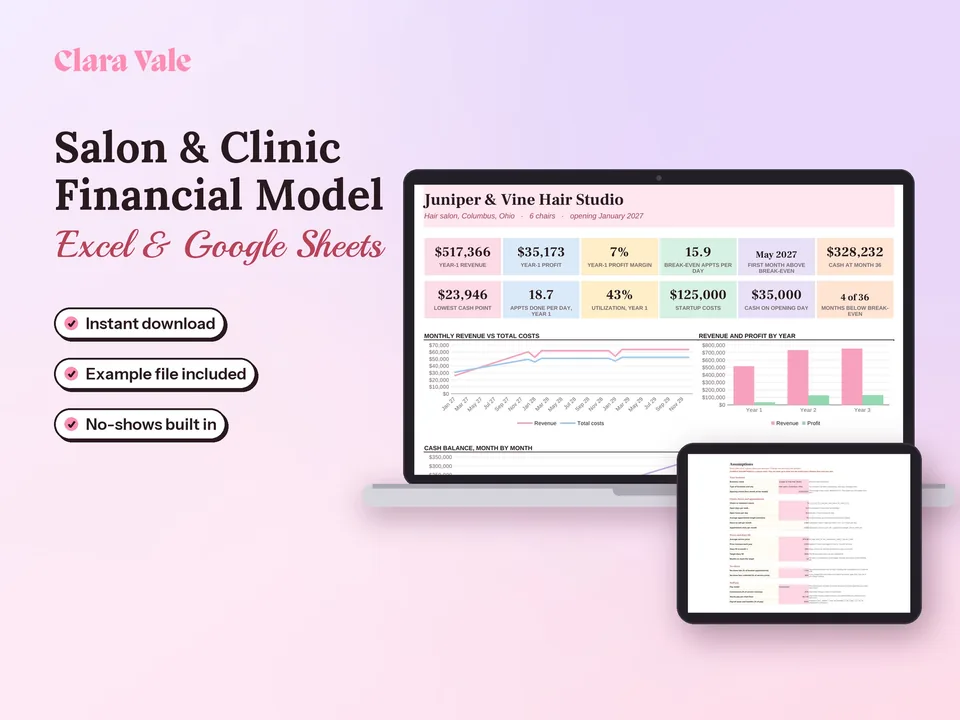
Run the same test on no-shows, rent and the number of chairs filled in your first months. New stylists rarely start with a full diary, so model a ramp. Our Salon Business Plan & Financial Model builds that ramp over 36 months from chairs, hours, diary fill and no-shows, and shows break-even in appointments a month and your lowest cash point.
9. Funding request
The SBA says this section should “clearly explain how much funding you’ll need over the next five years and what you’ll use it for.” List the one-time costs line by line, then add a cash reserve for the months before the diary fills.
Example startup costs:
| Item | Amount |
|---|---|
| 4 styling stations and chairs | $6,000 |
| 2 shampoo bowls with chairs | $5,000 |
| Dryers, tools, reception furniture | $6,000 |
| Build-out (plumbing for bowls, electrical, paint, lighting) | $25,000 |
| Deposits, salon license and permits | $5,000 |
| Opening back-bar and retail stock | $6,000 |
| Booking software and POS setup | $1,000 |
| Opening marketing | $2,000 |
| Cash reserve: 3 months of fixed costs (3 × $9,850) | $29,550 |
| Total | $85,550 |
“We’re contributing $25,550 of owner equity and request a $60,000 term loan.” The loan payment from section 8 should match the lender’s quote here. Licensing for salons and cosmetologists is set by each state board, so price your own state’s license and inspection fees.
Booth rental vs commission in the numbers
Here’s how the pay model changes the plan for the same three stylist chairs. Under commission, those chairs bring in $32,670 a month (services plus retail) and cost $19,543 in commission, payroll taxes, product and card fees. That leaves the salon $13,127 a month, or $33.15 per appointment.
Now rent the three chairs instead at an assumed $250 a week each. That’s 3 × $250 × 52 ÷ 12 = $3,250 a month, paid whether the stylists are busy or not. The renters buy their own product and take their own card payments.
| Commission (3 chairs) | Booth rental (3 chairs) | |
|---|---|---|
| Salon income from the chairs | $13,127 a month at 6 clients/day | $3,250 a month, fixed |
| Depends on the diary? | Yes, fully | No |
| Who buys product | Salon | Stylist |
| Who controls prices and hours | Salon | Stylist |
| Break-even point vs booth rent | 99 appointments a month (1.5 per chair per day) | — |
Divide the booth rent by the commission contribution: $3,250 ÷ $33.15 = 98.0, so at 99 appointments a month across those three chairs, commission pays the salon more than rent. Below that, booth rental wins. The trade-off is risk: commission earns more when the diary is full and less in a slow month, while booth rent arrives every week. A salon opening with new stylists and an empty diary often starts with booth rental and moves chairs to commission as demand builds.
Common mistakes in a salon business plan
- Full diaries from day one. Model a ramp from your real client book, chair by chair.
- Ignoring chair time. A high ticket that takes three hours can earn less per hour than a quick cut.
- Leaving out back-bar product. Color and developer are a real cost on every color service.
- Free owner labor. If the plan only works because the owner earns nothing, pay yourself in the model.
- No card fees or payroll taxes. Both rise with sales and belong in variable costs.
- No cash reserve. Fund the slow first months up front.
Start with break-even
Write your salon business plan around one number: how many appointments a month this salon needs, and whether the chairs and diary can deliver them. Work that out in section 8 first, then let the services, staffing and funding sections explain how you’ll get there. If you’d rather start from a filled example than a blank sheet, our Salon Business Plan & Financial Model comes with a sample 6-chair salon already worked through.
Questions people ask
Is a hair salon a profitable business?
A hair salon is profitable when its appointments a month sit well above break-even and below what the chairs can physically serve. Work out break-even from your fixed costs and what each appointment leaves after commission, product and card fees. In our 4-chair example that's 233 appointments a month against a capacity of 528 at six clients per chair per day.
How do I start my own salon business?
Start with the numbers before you sign a lease. Choose a concept and pay model, price your service menu, estimate clients per chair per day and your average ticket, then work out break-even appointments a month. If the location supports that comfortably, write the full plan, arrange funding, and then handle your state's salon license, build-out, equipment and hiring.
How to make $100,000 as a hairstylist?
Work backward from the target. $100,000 over 48 working weeks is about $2,083 a week. At a $75 average ticket and a 45% commission, that takes about 62 services a week; as a booth renter keeping your full ticket, about 28 services a week plus enough extra to cover rent and product. Rebooking, color and retail move the number fastest.
How much does it cost to open a salon?
It depends on your space, build-out and number of chairs. Add the one-time costs (stations, shampoo bowls, dryers, plumbing and electrical work, deposits, licenses, opening stock) to a cash reserve of at least three months of fixed costs. Our worked 4-chair example comes to $85,550, and your own quotes will set your figure.
What is the difference between booth rental and commission?
In a booth rental salon, stylists pay the owner a fixed weekly rent for a chair and keep what they charge, buying their own product. In a commission salon, the owner takes the bookings and revenue, supplies the product and pays stylists a share of their service sales. Booth rent gives steady income; commission gives a larger share when the diary is full.
How do I write a nail salon business plan?
Use the same nine sections and the same revenue formula, with nail stations in place of chairs. Nail services are usually shorter, so clients per station per day rise while the average ticket falls. Plan your ventilation, product cost per service and any separate pedicure stations, since each one changes your startup costs and capacity.
What should a salon business plan template include?
An executive summary, company description, market analysis, service menu with prices, staffing and pay model, marketing, management, financial projections and a funding request. The projections should show chairs, clients per chair per day, average ticket, break-even appointments a month and three years of profit and cash, so a lender can check every number back to an assumption.