
A lender, a co-owner or a landlord who has to approve subletting will want to see it: your Airbnb business plan. It’s where you show what you’ll rent, who will book it, what your city allows and whether the numbers work through the slow season. Most of it is short writing. The financial section decides the answer, so that’s where we spend the most time, with a worked example for a two-bedroom home.
An Airbnb business plan has eight sections: executive summary, property and concept, market analysis, local rules and permits, operations, marketing and pricing, financial projections and funding request. The projections rest on one formula: nights available × occupancy × average daily rate (ADR), plus cleaning fees, minus Airbnb’s fee, cleaning and fixed costs.
This post is educational and is not financial, legal or tax advice. Fees come from Airbnb’s Help Center pages linked below and apply to US listings as of November 2026; Airbnb can change them, so check your own account. All other numbers are assumptions for illustration.
What goes in an Airbnb business plan
The structure below adapts the traditional business plan sections from the U.S. Small Business Administration to a short-term rental. It works for a single Airbnb, a Vrbo listing, a guest house or a few units on one site.
| # | Section | The question it answers |
|---|---|---|
| 1 | Executive summary | What are you renting, and why will it work? |
| 2 | Property and concept | What kind of stay, for which guests? |
| 3 | Market analysis | What do similar listings nearby charge and book? |
| 4 | Local rules and permits | Is hosting allowed here, and on what terms? |
| 5 | Operations | Who cleans, restocks, answers guests and fixes things? |
| 6 | Marketing and pricing | How do guests find you, and how do prices move by season? |
| 7 | Financial projections | What occupancy, what profit, which months lose money? |
| 8 | Funding request | How much money, for what, on what terms? |
Do section 4 before you spend anything, and write section 7 before section 1. Local rules decide whether the plan exists at all, and the executive summary is a short version of the numbers.
1. Executive summary
The SBA describes this section as a brief explanation of “what your company is and why it will be successful.” Keep it to a page: the property, the guest, the location, the money needed and the headline numbers.
Example: “Birch Lane House is a two-bedroom home 10 minutes from a lake and state park, rented as a whole-home stay for families and couples. We expect 65% annual occupancy at a $180 average nightly rate with 3-night average stays. We break even at 51% occupancy. We need $24,200 to furnish, equip and open, with a three-month cash reserve.”
2. Property and concept
Describe the property and the stay you’re selling. Whole home or private room? How many guests does it sleep? What makes it worth booking: a view, a hot tub, walking distance to a venue, space for a remote worker? Name your target guest, because it decides your furniture, your amenities and your minimum stay.
Example: “Sleeps 6 (a queen, two twins and a sofa bed). Fast Wi-Fi and a desk for weekday remote workers; a fire pit and kayak storage for weekend lake guests.”
3. Market analysis
Find 8 to 10 listings near you with the same bedrooms and guest count. For each, note the nightly rate on weekends and weekdays, the cleaning fee, the minimum stay, the rating and how booked the calendar looks across the next few months. That gives you a realistic ADR range and a feel for seasonality.
Example: “Comparable two-bedroom homes list at $150 to $220 a night, with higher rates June to August and over holiday weekends. Several sit mostly empty from January to March, which we plan for in section 7.”
Your own list of comparable listings beats any national average, because those are the exact homes your guests will compare you with.
4. Local rules, permits and taxes
This is a step, not a footnote. Short-term rental rules are set by cities, counties and sometimes states, and they differ street by street: permits, registration numbers, caps on nights, owner-occupancy rules, safety inspections and zoning. Check before you sign a lease or buy furniture.
Airbnb’s responsible hosting page for the United States tells hosts to “look up any permitting, zoning, safety, and health regulations that may apply,” and to check HOA or co-op rules for any “prohibition against subletting.” It also suggests talking to an insurance agent about the coverage your situation needs.
Put these items in your plan as a checklist with a status and a cost:
- City and county rules. Read the short-term rental page on your city and county websites, or call the planning office.
- Permit or registration. Note the fee, the renewal date and any number you must show on the listing.
- HOA, co-op or lease. Get written approval if you rent or live under an HOA.
- Occupancy or lodging tax. Airbnb says that in areas where it handles tax collection, “we automatically collect and pay occupancy taxes on behalf of hosts”; elsewhere, “hosts generally need to collect taxes manually.” Hosts still own their other tax obligations.
- Insurance. A quote for a policy that covers short-term rental use.
Your city office or a local attorney is the right source for what your address allows.
5. Operations
Explain who does what between guests. Cleaning is the biggest job: every stay means a full turnover, laundry and restocking. Name your cleaner or service, what they charge per turnover, how long it takes and who checks the home after. Then cover check-in (smart lock or lockbox), guest messages, maintenance and an emergency contact nearby.
Price the turnover carefully, because it drives both your cleaning fee and your costs. Our guide to the Airbnb cleaning fee walks through turning one turnover’s cost into a fee, including Airbnb’s November 2026 change to what hosts can ask guests to do at checkout.
Example: “A local cleaner charges $100 per turnover, including laundry. Supplies and restocking average $15 a stay. Check-in is by smart lock; the owner answers messages and lives 20 minutes away.”
6. Marketing and pricing
Show how guests will find you and how your price moves through the year. Cover listing photos, the title and description, your minimum stay, a weekly or monthly discount, and any direct bookings from repeat guests. Then set a rate plan by season: peak, shoulder and low.
Example: “Professional photos before launch. Weekend minimum of 2 nights, with a 10% weekly discount aimed at off-season remote workers. Peak rate $220, shoulder $180, low $140.”
7. Financial projections
The SBA says the goal of this section is to “convince the reader that your business is stable and will be a financial success.” For a rental, that means a monthly forecast of occupancy, revenue, Airbnb’s fee, cleaning and fixed costs, and the occupancy you need to break even.
The revenue formula
Monthly revenue = nights available × occupancy × ADR + stays × cleaning fee.
Nights available for one unit is 365 ÷ 12 = 30.4 a month on average. Occupancy turns those into booked nights. Your average stay turns booked nights into stays, and stays drive cleaning costs. ADR × occupancy is your RevPAR (revenue per available night), a quick way to compare listings with different prices.
Airbnb’s fee
As of November 2026, Airbnb’s service fees page says most hosts on the single host-only fee pay 15.5% of the booking, with remaining hosts typically paying 14% to 16% (16% in Brazil and Mexico). Airbnb is moving all home hosts to this structure. The fee is a percentage of the nightly price plus any host-charged fees, such as cleaning, and excludes taxes. On the older split fee, most hosts pay 3% and guests pay a separate service fee of 14.1% to 16.5%. Use the fee shown in your own account.
Worked example: a two-bedroom home
Every input is an assumption you’d replace with your own comparable listings and quotes.
Revenue. 30.4 nights × 65% occupancy = 19.8 booked nights a month. At 3-night stays, that’s 6.6 stays.
| Line | Calculation | Monthly |
|---|---|---|
| Nightly revenue | 19.8 nights × $180 | $3,559 |
| Cleaning fees charged | 6.6 stays × $120 | $791 |
| Total revenue | $4,350 |
Variable costs (rise and fall with bookings):
| Cost | Calculation | Monthly |
|---|---|---|
| Airbnb host fee | $4,350 × 15.5% | $674 |
| Cleaner | 6.6 stays × $100 | $659 |
| Supplies and restocking | 6.6 stays × $15 | $99 |
| Total variable | $1,432 |
Fixed costs (the same every month):
| Cost | Monthly |
|---|---|
| Rent or mortgage payment | $1,600 |
| Utilities and internet | $300 |
| Insurance | $150 |
| Smart lock, pricing and booking software | $50 |
| Maintenance and replacement reserve | $200 |
| Total fixed | $2,300 |
Profit at 65% occupancy. $4,350 − $1,432 − $2,300 = $618 a month, before income tax.
Break-even occupancy. Each booked night keeps $180 × 0.845 = $152.10 after Airbnb’s fee. Each stay’s cleaning fee, after the fee, is $101.40 against $115 of cleaning and supplies, so cleaning costs $4.53 a night over a 3-night stay. That leaves $147.57 per booked night. Divide fixed costs by it: $2,300 ÷ $147.57 = 15.6 nights a month, or 51.2% occupancy.
That’s the line that matters in an Airbnb business plan: “We need 51% occupancy, and comparable homes book 65% across the year.”
Stress-test the slow season
A yearly average hides the months that lose money. Rerun the example at 45% occupancy for a January and the same home makes −$280 that month. At 55% it makes about $169. Shorter stays push break-even up too: at 2-night stays, each booked night carries more cleaning cost and break-even rises to 52.0%.
Run your own version with our Airbnb calculator. Enter your nightly rate, occupancy, stay length, cleaning and fixed costs to see monthly profit, RevPAR and break-even occupancy in one place.
8. Funding request
The SBA says this section should “clearly explain how much funding you’ll need over the next five years and what you’ll use it for.” List one-time costs, then add a reserve for the slow months.
Example startup costs (home already leased or owned):
| Item | Amount |
|---|---|
| Furniture, beds, kitchenware, décor | $15,000 |
| Smoke and CO detectors, fire extinguisher, first-aid kit, smart lock | $600 |
| Linens and towels (3 sets) | $800 |
| Professional listing photos | $500 |
| Permit, registration and inspection fees (check your city) | $400 |
| Cash reserve: 3 months of fixed costs (3 × $2,300) | $6,900 |
| Total | $24,200 |
If you’re buying the property, add the down payment, closing costs and your lender’s mortgage quote, and check that the mortgage in section 7 matches the loan here.
Common mistakes in an Airbnb business plan
- One occupancy rate for the whole year. Model each month; the slow season decides your cash reserve.
- Forgetting the fee on cleaning. Airbnb’s host fee also applies to the cleaning fee you charge.
- Counting occupancy tax as revenue. It’s collected from guests and passed on.
- Permits last. Check local rules before you furnish anything.
- Free owner labor. If you clean or manage it yourself, put a cost on that time.
- No replacement budget. Linens, mattresses and appliances wear out faster with guests.
Start with break-even occupancy
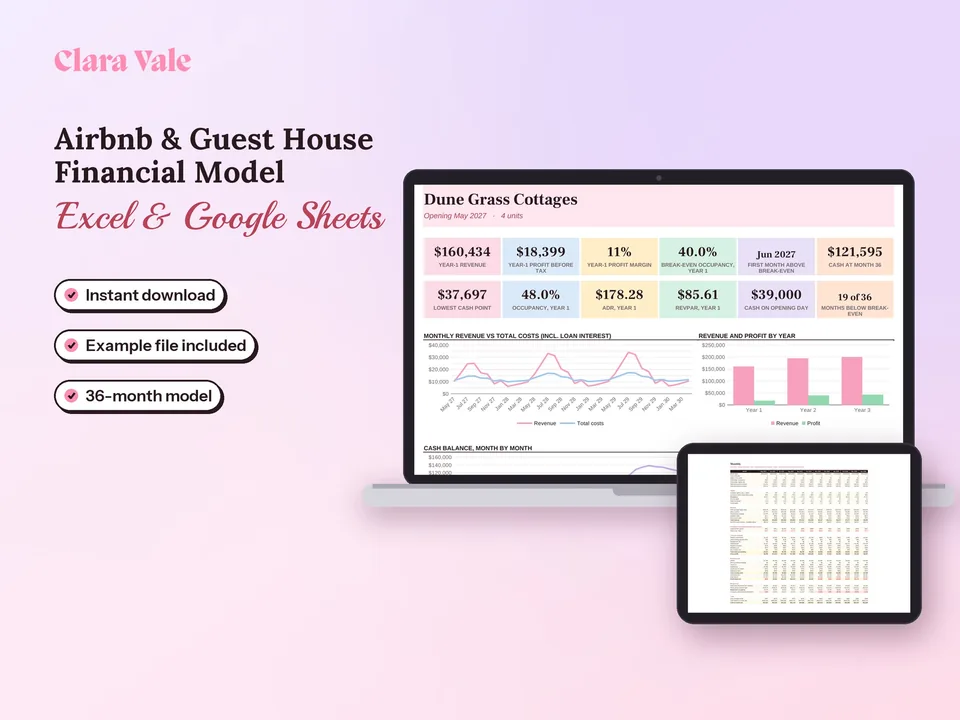
Write your Airbnb business plan around one number: the occupancy this property needs to cover its costs, month by month. Work it out in section 7 first, then let the market, operations and funding sections explain how you’ll beat it. For a full 36-month plan with seasons, an occupancy ramp and Airbnb’s fee built in, our Airbnb Business Plan & Financial Model comes with a filled example for a 4-unit lake-town rental.
Questions people ask
Do I need an LLC to run an Airbnb?
An LLC is a choice you make, separate from listing on Airbnb, which accepts individual hosts. Some hosts form one to keep the rental apart from personal assets and finances; others host in their own name with the right insurance. The answer depends on your state, lender and tax situation, so ask a local attorney or accountant before you decide.
What is the 80/20 rule for Airbnb?
It's an informal host rule of thumb based on the Pareto principle: a small share of your effort tends to produce most of your bookings. In a business plan, it points you to the few inputs that move profit most, usually nightly rate, occupancy in your slow season, cleaning cost per stay and listing photos. It's a planning habit hosts share, separate from Airbnb's own policies.
How much money do I need to start an Airbnb business?
Add your one-time costs (furniture, linens, safety equipment, photos, permit and registration fees) to a cash reserve of at least three months of fixed costs. In our worked example for a two-bedroom home the owner already controls, that comes to $24,200. Buying a property adds the down payment and closing costs on top, so your own quotes set the figure.
Is Airbnb profitable?
A listing is profitable when its occupancy sits comfortably above break-even occupancy through the whole year, including the slow season. Work out break-even from your fixed costs and what each booked night leaves after Airbnb's fee and cleaning. In our example it's 51.2%, so a 65% year makes about $618 a month, and a 45% month loses money.
How much do Airbnb hosts make?
It depends on nightly rate, occupancy and costs, so start from your own numbers. Revenue is ADR × booked nights plus cleaning fees; profit is what's left after Airbnb's service fee, cleaning, supplies and fixed costs. In our example a $180-a-night home at 65% occupancy brings in about $4,350 a month and keeps about $618 after costs, before income tax.
What fees does Airbnb charge hosts?
As of November 2026, Airbnb's service fees page says most hosts on the single host-only fee pay 15.5%, with others typically at 14% to 16% and 16% in Brazil and Mexico. Split-fee hosts mostly pay 3%, with guests paying their own service fee. The host fee applies to the nightly price plus host-charged fees such as cleaning, excluding taxes.
Do I need a permit to Airbnb my house?
Many cities and counties require a short-term rental permit, registration number or business license, and some limit which homes or how many nights can be rented. The rules are local and change often. Check your city and county websites, your HOA or lease, and Airbnb's responsible hosting page for your area before you commit money to the plan.
What should an Airbnb business plan template include?
An executive summary, property and concept, market analysis with nearby comparable listings, local rules and permits, operations and cleaning, marketing and pricing, financial projections and a funding request. The projections should show ADR, occupancy by month, Airbnb's fee, cleaning cost per stay, fixed costs and break-even occupancy, so a lender can trace each number to an assumption.