
Most small business owners find out how their books are doing at the worst possible moment: a lender asks for a profit and loss statement, a quarterly tax payment is due, or it’s March and Schedule C needs numbers. Bookkeeping for small business doesn’t have to be a once-a-year scramble through a mixed bank account and a box of receipts. It comes down to ten basics, and once they’re set up, the weekly upkeep is short.
Bookkeeping for a small business means recording every dollar that comes in and goes out of the business, sorting it into categories, and checking it against the bank. The 10 basics: separate accounts, choose cash or accrual, set up Schedule C categories, record weekly, keep receipts, reconcile monthly, log mileage, handle sales tax, pay quarterly estimates, and pick the right tool.
The 10 small business bookkeeping basics at a glance
Here’s the whole system on one screen. The first three are one-time setup jobs; the rest are a routine.
| # | Basic | How often | Why it matters |
|---|---|---|---|
| 1 | Separate business and personal money | Once | Clean records, easier audits |
| 2 | Choose cash or accrual basis | Once | Decides when income and expenses count |
| 3 | Categories that match Schedule C | Once | Your year-end totals map straight to the tax form |
| 4 | Record income and expenses | Weekly | Nothing gets lost or forgotten |
| 5 | Keep receipts and records | Every purchase | Proof for each deduction |
| 6 | Reconcile your bank account | Monthly | Catches missing and duplicate entries |
| 7 | Log business miles | Every trip | The mileage deduction needs a dated log |
| 8 | Sales tax | Per your state’s schedule | Collected tax isn’t your money |
| 9 | Quarterly estimated taxes | 4 times a year | No withholding on business income |
| 10 | Spreadsheet, software or bookkeeper | Review yearly | The tool should match your volume |
The ordering is deliberate. Small business bookkeeping is built backward from the tax return, so the setup steps make sure every later entry already lands where your tax preparer needs it.
Bookkeeping vs accounting: where the line sits
Bookkeeping is the recording side: entering transactions, categorizing them, keeping receipts and reconciling accounts. Accounting is the interpreting side: reading the financial statements, planning taxes, choosing a business structure and filing the return. A bookkeeper makes sure the numbers are complete and correct. An accountant or CPA uses those numbers to give advice.
In bookkeeping for small business, the two roles often sit with different people. As a sole proprietor, you’ll usually do the bookkeeping yourself and hand the results to a tax preparer once a year. The better your books, the shorter (and cheaper) that handoff is.
1. Separate business and personal money
Open a business checking account and, if you use credit, a card that’s only for business. Run every business sale and every business purchase through them. If a personal expense slips onto the business card, record it as an owner’s draw rather than an expense, and pay yourself by transfer instead of spending straight from the business account.
This is the single change that makes the rest of small business bookkeeping easy. When one account holds only business activity, your bank statement becomes a near-complete list of what needs recording, and reconciling it each month actually means something. It also matters for LLCs, where mixing funds can weaken the liability protection you formed the LLC to get.
2. Choose cash or accrual basis
IRS Publication 538 defines the two methods plainly. Under the cash method, you generally report income in the tax year you receive it and deduct expenses in the year you pay them. Under the accrual method, you report income in the year you earn it and deduct expenses in the year you incur them, regardless of when money moves.
In bookkeeping for small business, cash basis is the common default because it matches the bank account and is simpler to keep. Accrual gives a truer picture when you invoice clients on 30-day terms or carry inventory, and Pub 538 notes that businesses that need inventory to account for income generally must use accrual for purchases and sales, though a small business taxpayer exception exists. Whichever you choose, you’ll tick it on line F of Schedule C, and you should stay consistent; changing methods later generally needs IRS approval.
3. Set up categories that match Schedule C
The most useful thing you can do on day one is name your expense categories after the lines on Schedule C (Form 1040). Then year-end totals copy straight onto the form instead of being re-sorted from scratch.
| Schedule C line | Category | Typical examples |
|---|---|---|
| 1 | Gross receipts or sales | Client payments, product sales |
| 8 | Advertising | Ads, promoted listings, business cards |
| 9 | Car and truck expenses | Standard mileage or actual costs |
| 10 | Commissions and fees | Marketplace and payment processing fees |
| 11 | Contract labor | Freelancers you pay |
| 15 | Insurance (other than health) | Liability insurance |
| 17 | Legal and professional services | Tax prep, legal fees |
| 18 | Office expense | Software subscriptions, postage |
| 22 | Supplies | Materials not in cost of goods sold |
| 23 | Taxes and licenses | Business licenses, permits |
| 24a / 24b | Travel / Deductible meals | Business trips, client meals |
| 25 | Utilities | Business phone line, internet share |
| 27b | Other expenses | Anything that doesn’t fit above |
| 30 | Business use of home | Home office (Form 8829 or simplified method) |
If you sell physical products, add cost of goods sold, which Schedule C handles in Part III (lines 33 to 42). When we built our own income and expense tracker, this mapping was the part we spent longest on, because a category like “shipping” can belong to supplies, office expense or cost of goods sold depending on what you sell. Pick one home for each recurring expense and write it down so you file it the same way all year. For what counts as deductible in the first place, our guide to self-employed tax deductions goes line by line.
4. Record income and expenses every week
The weekly entry session is the heart of small business bookkeeping. Set a fixed slot, 20 to 30 minutes, and enter everything since the last session. Each entry needs the date, who paid you or whom you paid, the amount, the category and a note on the business purpose. For income, record the gross amount and log platform fees separately as an expense; recording only the net payout understates your gross receipts and hides what the fees cost you.
Weekly beats monthly for one practical reason: memory. A $14 charge from last Tuesday is easy to explain. The same charge found in a statement three months later often isn’t, and an unexplained charge tends to get left out, which means a missed deduction.
5. Keep receipts as long as the IRS can ask for them
Photograph or save every receipt the day you get it and store it in one folder per year, named with the date and vendor. Bank statements show that you paid; receipts show what you bought, which is what proves the business purpose.
How long to keep them is set by the period of limitations. The IRS page How long should I keep records? gives a 3-year general rule, 6 years if you fail to report income over 25% of the gross income on your return, 7 years for a bad debt or worthless securities claim, and at least 4 years for employment tax records. Property records stay until the limitations period ends for the year you dispose of the property. Many owners simply keep seven years of everything, which covers most of these cases.
6. Reconcile your bank account every month
Bank reconciliation is how you prove your small business bookkeeping is complete. Once a month, when the statement arrives:
- Start with the statement’s ending balance.
- Match each transaction on the statement to an entry in your books.
- Add deposits you recorded that haven’t cleared yet.
- Subtract checks or payments you recorded that haven’t cleared.
- Compare the adjusted bank balance to your book balance.
If they match, the month is done. If they don’t, the gap is usually a missed entry, a duplicate, or two digits typed backward. A useful check for the last one: a transposition error makes the difference divisible by 9. Reconciling monthly keeps any error inside a 30-day window instead of a whole year.
7. Log business miles as you drive
If you drive for the business, keep a log with the date, starting point, destination, business purpose and miles for every trip. Schedule C (Part IV, line 44) asks for business miles separately from commuting miles, and commuting from home to a regular workplace isn’t deductible.
According to the IRS standard mileage rates page, the 2026 business rate is 72.5 cents per mile from January 1 to June 30 and 76 cents per mile from July 1 to December 31, 2026. That mid-year change means a 2026 log needs the trip date, not just a total, so each trip gets the right rate. At 76 cents, 400 business miles in a month is worth a $304 deduction.
8. Find out whether you owe sales tax
Sales tax is set state by state, and sometimes city by city, so there isn’t a single national rule to follow. The questions to answer for your business are whether what you sell is taxable in your state, whether you need a seller’s permit, and how often you have to file. Since the Supreme Court’s 2018 South Dakota v. Wayfair decision, states can also require out-of-state sellers to collect once they pass that state’s economic nexus threshold.
In your books, treat sales tax you collect as money held for the state, not income. Record it in its own account and set it aside until the return is due. The Schedule C instructions treat sales tax imposed on the buyer, which you collect and pay over to the state, as neither gross receipts nor a deductible expense, so keeping it separate from the start saves untangling it later. If you sell through a marketplace such as Etsy or eBay, the marketplace usually collects and remits for those orders under state marketplace facilitator laws, but sales from your own website or in person are still your job. Your state department of revenue’s website is the source to check.
9. Set aside money for quarterly estimated taxes
Nobody withholds tax from business income, so the IRS expects individuals, including sole proprietors, to pay estimated tax during the year if they expect to owe $1,000 or more when they file. The payment periods and due dates are April 15, June 15, September 15 and January 15 of the following year, moving to the next business day when a date falls on a weekend or holiday.
Good bookkeeping for a small business makes this simple: net profit to date is the number that drives the estimate. Per the IRS, self-employment tax for 2026 is 15.3% on 92.35% of net earnings, with the Social Security part capped at the $184,500 wage base, and that comes on top of income tax. Plug your year-to-date profit into our self-employed tax calculator each quarter and move the result into a separate savings account the day the money lands.
10. Decide between a spreadsheet, software or a bookkeeper
There’s no single right tool for bookkeeping for small business. What matters is your volume and complexity.
| Option | Works well when | Watch for |
|---|---|---|
| Spreadsheet (Excel or Google Sheets) | One business account, a few dozen transactions a month, no employees | Manual entry and matching; reconcile every month |
| Bookkeeping software | Bank feeds, invoicing, a few hundred transactions a month, more than one account | Monthly subscription; categories and auto-rules still need checking |
| A bookkeeper | Payroll, inventory, sales tax in several states, or you’re always behind | Monthly cost; you still need to answer their questions and supply receipts |
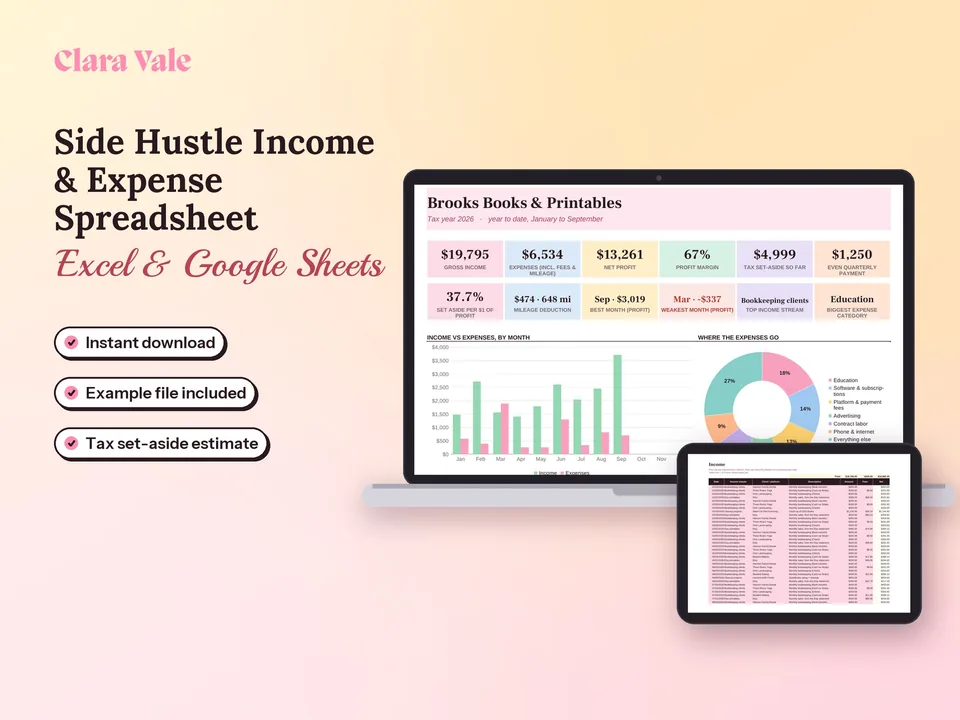
A spreadsheet is enough for many sole proprietors, freelancers and makers, and it has the advantage that nothing is hidden: every formula is visible. Software earns its subscription once matching bank transactions by hand takes more than an hour a week. A bookkeeper earns their fee when your time is worth more than the fee, or when mistakes would be expensive, as with payroll. For a sense of the labor cost involved, the Bureau of Labor Statistics puts the median wage for bookkeeping, accounting and auditing clerks at $24.36 an hour as of May 2025. Many businesses move through all three as they grow. For a side hustle with one or two income streams, a simpler income and expense spreadsheet covers basics 3, 4, 7 and 9 without much setup.
Start your small business bookkeeping this week
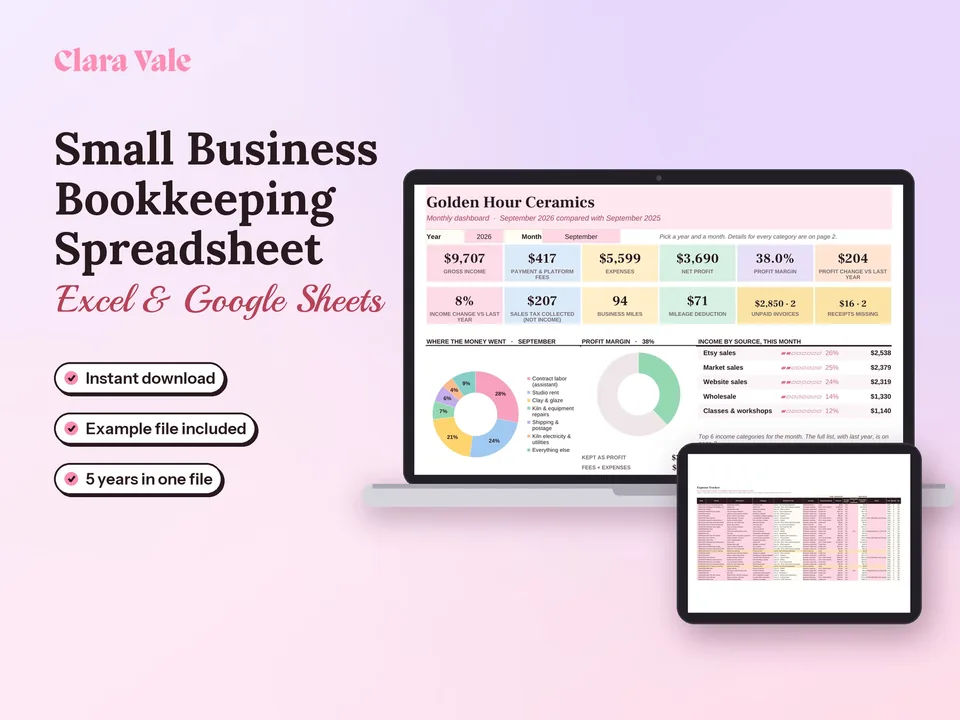
Do the three setup steps first: open the separate account, choose cash or accrual, and name your categories after Schedule C lines. Then put a weekly 30-minute slot and a monthly reconciliation on your calendar, and the rest is routine. If you’d rather start from a ready-made system than a blank sheet, our small business bookkeeping spreadsheet gives you that structure ready to fill in.
Questions people ask
What is an easy way to do bookkeeping for a small business?
Open a separate business bank account, set up categories that match the IRS Schedule C expense lines, and log every transaction once a week in a spreadsheet or bookkeeping app. Snap a photo of each receipt as you go. Once a month, reconcile your records against the bank statement. Keeping the habit weekly is what makes it easy.
Can I do my own bookkeeping for my small business?
Yes. Many sole proprietors and single-member LLCs keep their own books, especially with one bank account and a few dozen transactions a month. The skills are consistency, not accounting theory: record everything, keep receipts, reconcile monthly. Bring in a bookkeeper or CPA when you hire employees, carry inventory, or find you're always months behind.
How much do bookkeepers typically charge?
It depends on transaction volume, how messy the books are, and whether payroll or sales tax is included. Freelancers and firms usually quote a monthly fee or an hourly rate. As one reference point, the BLS reports a median wage of $24.36 an hour for employed bookkeeping clerks in May 2025; an independent bookkeeper's rate covers their own overhead too, so expect quotes above that.
What are the three golden rules of bookkeeping?
The traditional golden rules of double-entry bookkeeping are: debit the receiver and credit the giver (personal accounts); debit what comes in and credit what goes out (real accounts); and debit all expenses and losses, credit all incomes and gains (nominal accounts). Single-entry spreadsheets used by most sole proprietors don't need them day to day.
What is the best bookkeeping system for small business?
The best system is the one you'll update every week. A spreadsheet suits a sole proprietor with one account and simple income. Bookkeeping software fits once you have bank feeds to match, invoices to send, or a few hundred transactions a month. Payroll, inventory or multiple entities usually call for software plus a bookkeeper.
Can I do my own bookkeeping with Excel?
Yes. Excel or Google Sheets works well for a small business with straightforward income and expenses. Use one row per transaction with date, payee, amount, category and a receipt link, then total by category each month. The weak spots are manual bank matching and human error, so reconcile against your bank statement every month.
How to do a simple bank reconciliation?
Start with the ending balance on your bank statement. Tick off each transaction that appears in both the bank statement and your records. Add deposits you recorded that haven't cleared, subtract outstanding checks or payments, and compare the result to your book balance. If the two don't match, look for missing entries, duplicates or typos.