
Every receipt you didn’t keep is money you hand back to the IRS. Self-employed tax deductions work the same way whether you’re a full-time freelancer, a 1099 contractor or someone with an Etsy shop on the side: you report what you earned on Schedule C, subtract the costs of earning it, and pay tax only on what’s left. The catch is that each deduction needs a specific kind of proof, and most people find that out in April.
The main self-employed tax deductions for 2026 are half of self-employment tax, the home office, business use of your car, supplies and equipment, software, the business share of phone and internet, work-related education, health insurance premiums, retirement contributions, 50% of business meals, travel, contract labor, fees, advertising and the 20% QBI deduction. Each needs a record that proves it.
This is general information, not tax advice. Rules change and your situation matters, so check with a tax professional before you file.
What expenses can self-employed people deduct?
The IRS test behind all self-employed tax deductions is simple to say and harder to apply. An expense is deductible if it’s ordinary (“common and accepted in your field of business”) and necessary (“helpful and appropriate for your business”), in the words of IRS Publication 334, Tax Guide for Small Business. It doesn’t have to be indispensable. A $40 ring light is ordinary and necessary for a UGC creator; it isn’t for a bookkeeper.
Tax deductions for self-employed people land in two places, and the difference matters. Business expenses go on Schedule C, so they cut your profit, and that lowers both income tax and self-employment tax. A few personal-side deductions (half of SE tax, health insurance, retirement contributions) go on Schedule 1 and only lower income tax.
| Deduction | Where it goes | Record to keep |
|---|---|---|
| Half of SE tax | Schedule 1 | Schedule SE (it’s calculated for you) |
| Home office | Schedule C | Floor plan or measurements, photos, home bills |
| Car | Schedule C | Mileage log with date, miles, purpose |
| Supplies, equipment, software | Schedule C | Receipts, invoices |
| Phone and internet | Schedule C | Bills plus how you set the business % |
| Education | Schedule C | Receipts, course description |
| Health insurance | Schedule 1 | Premium statements |
| Retirement contributions | Schedule 1 | Plan statements |
| Meals and travel | Schedule C | Receipt plus who, where, business purpose |
| Contract labor, fees, ads | Schedule C | Invoices, platform statements, W-9s |
| QBI deduction | Form 1040 | Your Schedule C profit |
1. Half of self-employment tax
Self-employment tax is the Social Security and Medicare tax an employer would normally split with you. You owe it once net earnings reach $400, at 15.3% on 92.35% of your net profit (the Social Security part stops at the 2026 wage base of $184,500). Publication 334 lets you “deduct one-half of your SE tax” on line 15 of Schedule 1.
On $40,000 of net profit, SE tax is about $5,652 ($40,000 × 92.35% × 15.3%), and the deduction is about $2,826. You don’t need extra records; Schedule SE does the math for you.
2. Home office (regular or simplified method)
The home office is one of the best-known self-employed tax deductions. You can deduct part of your home if a specific area is used regularly and exclusively for business. A desk in the guest room that also hosts visitors fails the exclusive-use test. The space doesn’t need a wall around it, but it can’t double as personal space.
There are two ways to figure it. The IRS simplified method is $5 per square foot, capped at 300 square feet, so the maximum is $1,500. A 120-square-foot office is worth $600. The regular method uses actual costs (rent or mortgage interest, utilities, insurance, repairs, depreciation) multiplied by the office’s share of your home. It’s more work, but it can beat the simplified figure if your housing costs are high. With the simplified method there’s no depreciation and no carryover of any amount above your business income.
Records: measurements of the office and the whole home, a few photos, and, for the regular method, a full year of home bills.
3. Business use of your car (mileage or actual expenses)
For anyone who drives for work, mileage is often the largest of the self-employed tax deductions. You can deduct miles driven for business, such as client visits, supply runs and post office trips for orders. Commuting from home to a regular workplace isn’t deductible.
The IRS standard mileage rates for business in 2026 are 72.5 cents a mile for January 1 to June 30 and 76 cents a mile for July 1 to December 31, after a midyear increase for higher fuel prices. Driving 3,000 business miles in each half of 2026 gives $2,175 + $2,280 = $4,455.
The alternative is actual expenses (gas, insurance, repairs, depreciation) times your business-use percentage. If you drive 20,000 miles and 16,000 are for business, you deduct 80% of the costs. One rule catches people out: to use the standard rate for a car you own, you must choose it in the first year the car is used for business. After that, you can switch between methods year by year.
Records: a mileage log with date, start and end point, miles and purpose. It’s the record people most often reconstruct in a panic, so keep it as you go.
4. Supplies and equipment
Supplies (packaging, printer ink, craft materials not sold as inventory) are deducted in the year you buy them. Equipment that lasts longer, such as a laptop or camera, is normally depreciated, but two shortcuts let small businesses deduct it at once.
The de minimis safe harbor lets you deduct items costing up to $2,500 per item or invoice if you don’t have an audited financial statement, and you make an election to use it. Section 179 lets you expense larger purchases; Publication 334 puts the maximum at $2.5 million for 2025, far beyond what most solo businesses spend. If equipment is also used personally, only the business share counts.
Records: receipts or invoices showing the date, item and price.
5. Software and subscriptions
Design tools, accounting apps, scheduling software, cloud storage, stock photo plans and website hosting are all deductible when you use them for the business. A Canva Pro or Adobe plan used only for client work is 100% deductible; a streaming service you watch for fun isn’t.
Records: the subscription invoice or the card statement line. Annual plans are easy to forget, so add them to your tracker when they renew.
6. Phone and internet (business-use percentage)
Your phone and home internet are mixed-use, so you deduct the business share. If about 40% of your phone time is business, deduct 40% of the bill. A second line used only for business is fully deductible.
There’s one specific rule in the IRS Schedule C instructions: you can’t deduct the base rate of the first landline into your home, though extra business charges on it are deductible.
Records: monthly bills and a note on how you set the percentage, such as one sample month of call and data logs. We keep a business-use % column in our own expense sheets for exactly this reason.
7. Education related to your current business
Courses, workshops, books and conferences are deductible if they maintain or improve skills in the work you already do. IRS Publication 970 (chapter 11) excludes education needed to meet the minimum requirements of your trade, and study that qualifies you for a new trade or business. A freelance photographer’s lighting workshop qualifies; a nursing degree for that same photographer doesn’t.
For the self-employed, Publication 970 notes the deduction comes directly off self-employment income, so it reduces both income tax and SE tax.
Records: the receipt and the course outline showing how it relates to your work.
8. Self-employed health insurance premiums
If you pay for medical, dental or qualified long-term care insurance for yourself, your spouse and dependents, you may deduct the premiums on Schedule 1. The conditions, from the IRS instructions for Form 7206:
- You had a net profit from self-employment for the year.
- The plan is established under your business (a policy in your own name counts for sole proprietors).
- You can’t count any month in which you were eligible for a subsidized employer plan, including through your spouse’s job, even if you didn’t enroll.
- The deduction is capped by your net earnings from that business.
Records: premium statements and, if you bought a Marketplace plan, Form 1095-A.
9. Retirement contributions (SEP IRA and solo 401(k))
Self-employed people can set up a SEP plan, a SIMPLE plan or a qualified plan (which includes the plan commonly called a solo 401(k)). Per Publication 334, sole proprietors deduct contributions for themselves on line 16 of Schedule 1, not on Schedule C. Annual limits depend on the plan and your net earnings, so check the current figures with your plan provider or a tax professional before you contribute.
Records: year-end plan statements and contribution confirmations.
10. Business meals (50%)
A meal with a client, or a meal while traveling for business, is generally deductible at 50%. IRS Publication 463 covers the details and the exceptions. The meal can’t be lavish, and you (or an employee) have to be there. Entertainment like concert or game tickets isn’t deductible at all.
Records: the receipt plus who you ate with and what business you discussed. Writing it on the back of the receipt is enough.
11. Business travel
When a trip takes you away from your tax home long enough to need sleep or rest, Publication 334 lets you deduct the cost of getting there, lodging, baggage, local transport, laundry, business calls and tips. Meals on the trip fall under the 50% limit. Mixing in vacation days makes things trickier, so keep the business days clearly documented.
Records: tickets, hotel folios, and an itinerary or calendar showing the business purpose.
12. Contract labor
Payments to people who aren’t employees, such as a virtual assistant, a freelance editor or a photographer you hire for product shots, go on line 11 of Schedule C. Collect a Form W-9 before you pay anyone, since you may need to issue a Form 1099-NEC if payments reach the reporting threshold.
Records: invoices, payment confirmations and W-9s.
13. Fees and commissions
These are some of the most overlooked 1099 tax deductions, and they quietly add up for online sellers and gig workers. Marketplace commissions, payment processing fees, booking platform cuts and agent commissions are deductible business costs. On a busy shop they can run to several percent of every sale. If a platform reports your gross sales on a 1099-K, the fees it kept are still yours to deduct.
Records: the platform’s annual or monthly statements, which list fees separately.
14. Advertising and marketing
Paid ads, sponsored listings, business cards, a website, promotional samples and the cost of a booth at a market all count. Etsy Offsite Ads and Instagram boosts are advertising too.
Records: ad platform invoices and receipts.
15. Qualified business income (QBI) deduction
The QBI deduction lets many sole proprietors deduct up to 20% of their qualified business income. It isn’t an expense, so you don’t spend anything to get it; it’s figured on Form 8995 or 8995-A and taken on Form 1040. Publication 334 notes that the 2025 tax law (P.L. 119-21) made the 20% QBI deduction permanent and raised the income thresholds where limits begin. It’s one of the largest 1099 deductions available, and it’s easy to miss if you file by hand.
Records: none beyond your Schedule C, but income above the thresholds brings extra rules, which is a good reason to talk to a preparer.
Records to keep for 1099 deductions
Self-employed tax deductions only hold up if you can prove them. Publication 463 lists what a good record shows: the amount, date, place and business purpose. For travel and car-related expenses under $75 (other than lodging), a written log can stand in for the receipt, but the log still has to exist.
IRS Publication 583 sets how long to keep them: generally three years from filing, which is the normal window for the IRS to assess more tax, and for property you depreciate, until that window closes for the year you sell or dispose of it. Our guide to bookkeeping for small business covers setting up the system itself.
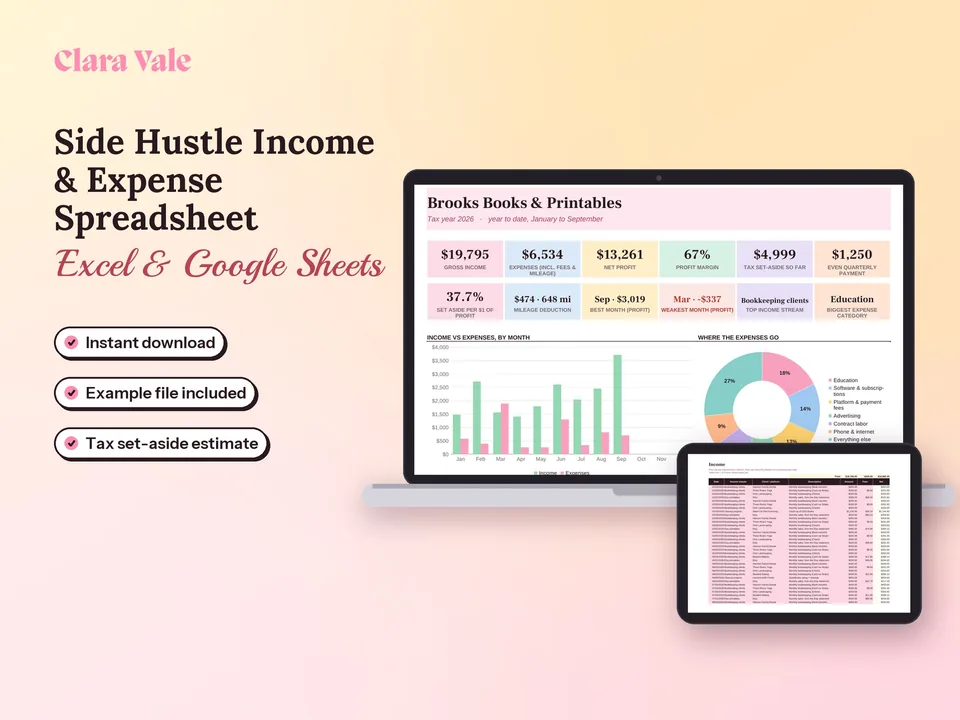
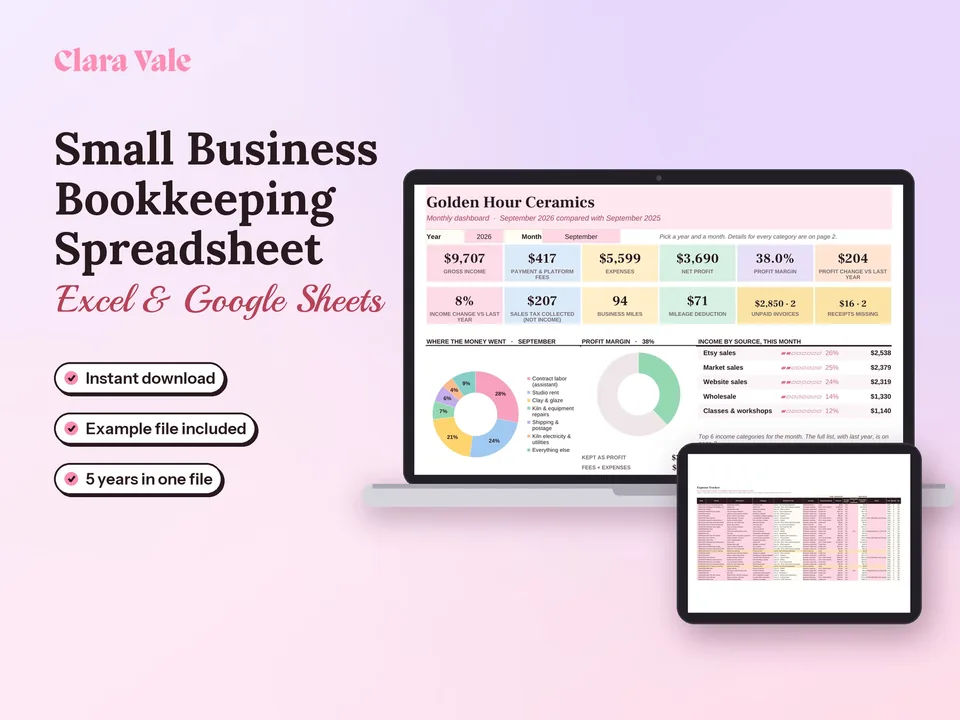
The simplest system is a single sheet where every expense gets a date, amount, category, business-use percentage and a link to the receipt. Our Income & Expense Spreadsheet works as a tax deduction tracker for side hustles, with categories that line up with Schedule C. If you’re running a bigger operation with several income streams, the small business bookkeeping spreadsheet adds monthly profit and loss views.
Which self-employed tax deductions to start with
Start with the three that most people under-claim: half of SE tax, mileage logged as you drive, and the business share of your phone and internet. Then check whether you qualify for the home office, health insurance and QBI deductions, since those are often the largest. Every one of these 1099 tax deductions depends on records kept during the year, not rebuilt in April. To see how deductions change what you owe, run your profit before and after expenses through our self-employed tax calculator.
Questions people ask
What expenses can self-employed deduct?
Self-employed people can deduct business expenses that are ordinary (common in their field) and necessary (helpful and appropriate for the business). Common ones are home office costs, business mileage, supplies, software, the business share of phone and internet, advertising, contract labor and fees. Half of self-employment tax, health insurance premiums and retirement contributions are deducted separately on Schedule 1.
What are the 10 most overlooked tax deductions?
For self-employed people, the ones most often missed are: half of self-employment tax, the simplified home office deduction, business miles driven in your own car, the business share of your phone and internet, software subscriptions, platform and payment processing fees, self-employed health insurance premiums, retirement contributions, education that improves skills in your current work, and the 20% qualified business income deduction.
How does the new $6000 tax deduction work?
It's an extra deduction for people aged 65 or older, created by the 2025 tax law for tax years 2025 through 2028. Each eligible person can deduct $6,000 ($12,000 for a married couple where both qualify), whether or not they itemize. It phases out above $75,000 of modified AGI ($150,000 joint) and is claimed on Schedule 1-A. It isn't a business deduction.
What deduction can I claim without receipts?
The simplified home office deduction and the standard mileage rate don't need receipts for each expense. You still need proof: square footage and regular, exclusive use for the home office, and a mileage log for the car. IRS Publication 463 also lets you skip receipts for travel and similar expenses under $75 (except lodging), but you still need a written record of each one.
How can I reduce taxes on my 1099 income?
Claim every business expense on Schedule C, since each dollar lowers both income tax and self-employment tax. Then take the adjustments off Schedule C: half of self-employment tax, self-employed health insurance and SEP or solo 401(k) contributions. Check whether you qualify for the 20% QBI deduction, and pay estimated tax during the year to avoid penalties. A tax professional can confirm what fits.
What expenses can I deduct as an independent contractor?
Independent contractors deduct the same business expenses as any sole proprietor: the costs that are ordinary and necessary for the work. That usually means tools and supplies, software, the business share of phone and internet, business mileage, a qualifying home office, travel, half of business meals, advertising, fees and payments to subcontractors. Keep a receipt or record for each one.
What is the $75 rule for receipts?
IRS Publication 463 says documentary evidence such as a receipt isn't needed for a travel, gift or car-related expense under $75, other than lodging. It isn't a free pass: you still need a written record showing the amount, date, place and business purpose. Lodging always needs a receipt, whatever the amount.
Can you write off 100% of business expenses?
Only expenses used 100% for the business. Mixed-use costs like a car, phone or internet plan are deductible only for the business share, and most business meals are limited to 50%. Personal expenses, commuting and entertainment aren't deductible at all. Large equipment may be deducted at once under Section 179 or the de minimis safe harbor, or depreciated over several years.