
Money gets tight in a predictable way: one surprise bill, a few months of higher groceries, a paycheck that doesn’t stretch like it used to. Most people who want to make extra money from home need two things at once: some cash this month, and something steadier for the months after. Those come from different places, and mixing them up is how people end up stuck.
The realistic way to make extra money from home is to start with what pays fastest. Sell things you already own this week, then offer a skill people already ask you for, then make products to sell, and treat online income like digital products or content as a slower build. Set a monthly target, track every dollar, and never pay to get a job.
This post is educational and is not financial or tax advice. Rules and figures are as of October 2026.
The 4 realistic ways to make extra money from home
Here, extra money from home means income you earn on your own schedule, from your own home, alongside a job or caregiving, without paying anyone for the right to start. Every option on any list of home side gigs falls into one of four routes. What separates them is how soon the first dollar arrives and how high the ceiling goes.
| Route | First money | Startup cost | Ceiling |
|---|---|---|---|
| 1. Sell what you already own | This week | Close to $0 | Ends when the closet is empty |
| 2. Sell a skill as a service | Within a few weeks | Close to $0 | Your hours × your rate |
| 3. Make something and sell it | Weeks to months | Materials | Your production time |
| 4. Build online income | Months | Low, mostly time | Can grow beyond your hours |
The order matters when you make extra money from home. Routes 1 and 2 pay soon but stop when you stop. Route 4 can keep earning after the work is done, but it pays last. So the plan that works for most households is to earn quick money with the first two while you test whether the last two are worth building.
1. Sell what you already own
This is the fastest way to make extra money from home, because the inventory is already in your closets. Electronics, furniture, kids’ gear, tools, and brand-name clothing tend to move fastest. Price from sold listings, not from what you paid or what other sellers are asking.
Every marketplace takes a fee, and the rate varies by platform and changes often, so check each one’s current fee page before you price. A local pickup sale through a neighborhood group usually costs nothing but your time.
Two limits to keep in mind. First, this route runs out. Once the spare room is clear, the income stops. Second, it can still count as income. A personal item that sells for more than you paid, like a vintage jacket that has gone up in value, is a gain you have to report. If buying to resell starts to appeal, you’ve moved into a business, and that’s a different set of numbers.
2. Sell a skill as a service
Your second route to extra income from home is renting out what you already know how to do. The best clue is what friends already ask you for: fixing a spreadsheet, checking a résumé, helping a kid with algebra, catching up on someone’s bookkeeping, walking a dog while they travel.
Service work pays quickly because there’s nothing to build. You agree on a price, do the job, and send an invoice. Start with people who already trust you, then move to local groups or freelance marketplaces once you have a couple of happy clients to mention. For a wider list of service ideas you can run from your kitchen table, see our guide to side hustles from home.
The ceiling here is simple math: hours times rate. At $25 an hour, 10 hours a week is roughly $1,000 a month before costs and taxes. To earn more, you raise the rate or package the work, such as a monthly bookkeeping fee instead of hourly billing. Working more hours is the third option, and it’s the one people regret.
3. Make something and sell it
Making things is the third way to earn extra money from home. Handmade goods, baked goods, printed art, sewing, and refurbished furniture all fit here. You need materials and some time to make your first batch, so the first sale usually takes longer than a service gig. In exchange, you’re selling a thing rather than an hour, and a good product can sell to strangers who have never met you.
The mistake almost everyone makes is pricing from what feels fair rather than from cost. A price has to cover materials, your time, packaging, platform fees, and a profit margin, or every sale quietly costs you money. Our guide on how to price handmade items walks through that formula with worked examples.
Check local rules before you sell food. Many states have cottage food laws that allow some home-baked goods and not others, and some require a permit or label.
4. Build online income that grows slowly
The slower ways to make extra money from home online include digital products (templates, planners, printables), a blog or newsletter, a YouTube channel, print-on-demand designs, and user-generated content for brands. These are the routes most often sold as “passive income.”
They can grow beyond your hours, because one template can sell a thousand times. But the effort comes first, not never. You build the product, write the listing, take the photos, and market it for weeks or months before sales become steady. Treat this as a project you build in the background while routes 1 and 2 pay the bills, not as this month’s rent.
Online surveys and microtask apps belong here only as a footnote. They’re real, but they pay pocket change for the time they take.
Set a monthly income target before you pick
A vague goal like “some extra money from home” makes every option look equally good. A number makes the choice obvious. Start with what the money is for (a $300 car repair fund, $500 a month toward debt, $1,000 a month to replace a lost shift) and work backward.
For a service, divide your target by your hourly rate to get the hours you need each month, then see whether those hours fit your week. For products, divide the target by what you keep per sale. Our Monthly Income Goal Calculator does this for you: a $500 monthly goal with a $25 product and 10% in fees means you keep $22.50 a sale, so you need 23 sales a month, about 6 a week. At a 2% conversion rate, that’s 1,150 shop visitors a month.
That last number is the reality check. If your shop gets 100 visitors a month today, route 4 won’t hit your target this quarter, and a service probably will.
Your first 30 days, week by week
A month is long enough to earn real extra money from home and short enough to stay focused. Here’s a plan that combines the fast routes with a small test of a slower one.
- Week 1: Sell. Walk through the house and list 10 items you won’t miss. Write down your monthly target and the date you need the money.
- Week 2: Offer one service. Pick the skill people already ask you for, set a price, and tell 10 people who might pay for it or know someone who would.
- Week 3: Deliver and ask. Do the first jobs well, then ask each client for a short review or a referral.
- Week 4: Test something slower. Make one product, one listing, or one piece of content. Count the hours it took, and compare your income to your target.
At the end of the month, keep the route that earned the most per hour and drop the rest. Most people find that one route clearly beats the others for them.
Work-from-home scams to avoid
Scams cluster around ways to make extra money from home because it attracts people who need money quickly, and pressure makes red flags easier to miss. The FTC’s guidance on job scams is blunt: honest employers, including the federal government, will never ask you to pay to get a job. If someone says you can make a lot of money in a short time with little work, the FTC calls that almost certainly a scam.
Watch for these patterns, all named by the FTC:
- Starter kits and paid training. Promises of thousands a month working from home that require you to buy a kit or course first.
- Fake checks. You’re sent a check, asked to deposit it, and told to send part of the money back. The check bounces, and the bank wants you to repay the full amount.
- Reshipping. You receive packages, repackage them, and ship them on, often overseas. The goods are usually bought with stolen credit cards.
The FTC recommends reporting job scams at ReportFraud.ftc.gov or to your state attorney general. A good rule of thumb: when money is supposed to flow to you, any request for money to flow the other way is the warning sign.
Track income and set aside taxes from day one
Extra income from home is taxable even when nobody sends you a form. The IRS gig economy tax center says you must report it even if it isn’t on a Form 1099-K, 1099-NEC, or other statement, and whether you were paid in cash, property, or digital currency.
Once your net earnings from self-employment reach $400 for the year, you also owe self-employment tax. Per the IRS self-employment tax page, the rate is 15.3% (12.4% for Social Security and 2.9% for Medicare), and it applies to 92.35% of net profit. That comes to roughly 14% of what you clear, before any income tax.
Three habits keep that from becoming a surprise in April:
- Log every sale and every expense the week it happens, with receipts.
- Move a set share of each payment into a separate savings account for taxes.
- Keep business and personal spending apart, even if it’s just a second card.
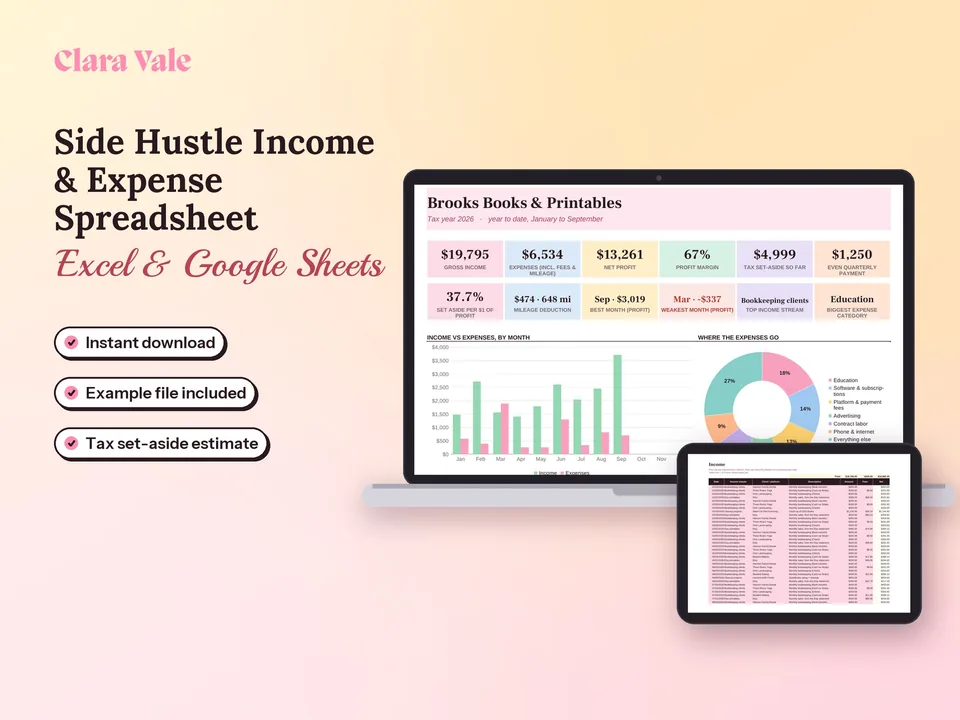
A simple sheet is enough. Our Side Hustle Income, Expense & Tax Tracker logs income and costs as they come in and estimates a monthly tax set-aside automatically.
Start with the fastest route you have
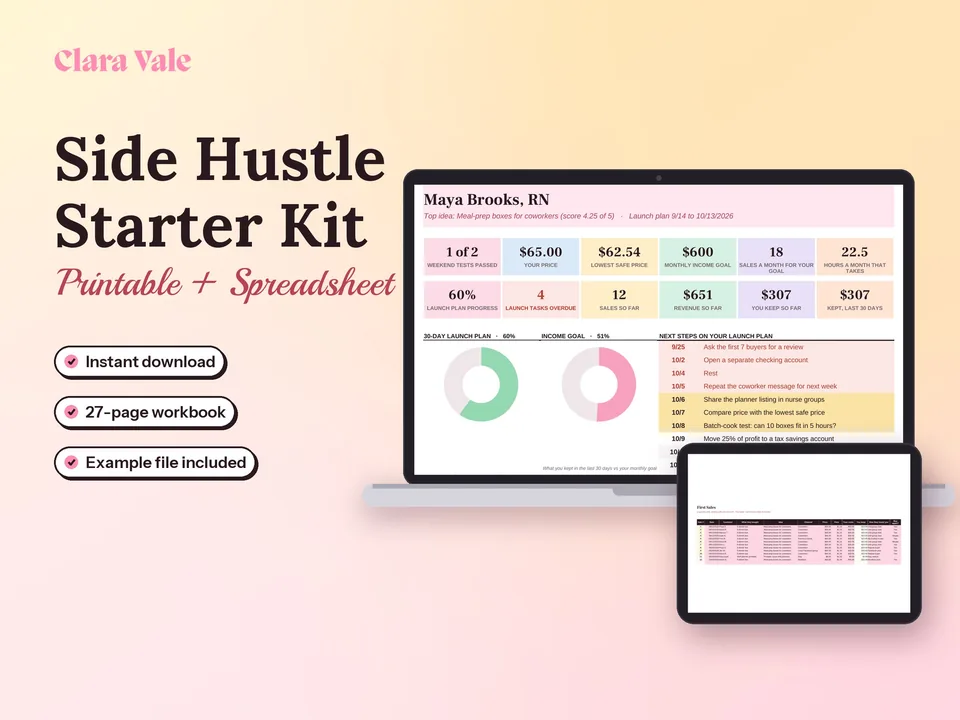
The best way to make extra money from home is the one you can start this week. Sell what you own for quick cash, sell a skill for steady money, and give products or online income a fair test once the bills are covered. Set a number, track it, and walk away from any offer that asks you to pay first. If you’d like a guided way to choose one idea, test it in a weekend, and plan your first 30 days, the Side Hustle Planner & Business Idea Workbook is built for exactly that.
Questions people ask
How can I make an extra $1000 a month from home?
Sell a skill by the hour or the project. At $25 an hour, $1,000 a month is 40 paid hours, or about 10 hours a week, before taxes and costs. Selling things you own can bridge the first month while you find clients. Keep about a quarter of each payment aside for taxes until you know your real rate.
How to make an extra $100 per day?
A steady $100 a day adds up to roughly $3,000 a month, so it usually takes a paid service rather than small online tasks. Four hours at $25 an hour gets there. For a single day, selling a few items you no longer use, or taking one tutoring, editing, or pet-sitting job, is the most realistic route.
How can I realistically make money from home?
Start with what pays fastest. Sell things you already own this week, then offer a skill people already ask you for, then make products, and treat online income like digital products or content as a slower build. Set a monthly target, track every dollar, and never pay anyone to get a job.
How can I make an extra $1000 this month?
Combine two fast routes. List items you don't use, such as electronics, furniture, or brand-name clothes, and line up short paid jobs from people you know: tutoring, editing, bookkeeping catch-up, or pet care. Skip anything that promises a lot of money for little work. The FTC says offers like that are almost certainly a scam.
How to make money online for beginners?
Begin with a service you can already do, like writing, proofreading, data cleanup, or admin help, because clients pay for it right away. Building a blog, channel, or digital product shop is possible for beginners too, but expect months before steady income. Run one online route at a time so you can see what is actually working.
How to avoid job scams?
Never pay to get a job, never deposit a check and send part of the money back, and never agree to receive and reship packages. The FTC lists all three as job scam patterns. Look up the company yourself instead of trusting the contact details in the message, and report scams at ReportFraud.ftc.gov.
What happens if you deposit a fake check from a scammer?
The money can show up in your account before the check clears, but the FTC warns it can take weeks for a bank to figure out a check is fake. When it bounces, the bank takes the amount back, and you have to repay any money you already spent or sent to the scammer.
How can I make an extra $2000 a month from home?
At $2,000 a month, your hours matter more than the idea. At $25 an hour you'd need 80 paid hours a month, about 20 a week, before taxes. At $50 an hour, it's about 10 hours a week. That usually points to skilled services like bookkeeping, consulting, or editing rather than gig apps.