
The 50/30/20 rule is the simplest budget most people can stick with: split your take-home pay into needs, wants and savings, and stop worrying about tracking forty little categories. It’s simple enough to do on the back of a receipt, yet the details trip people up. Is a car payment a need? Does your 401(k) count? What if rent alone takes 45% of your paycheck? Below, we walk through a real US paycheck from salary to the last dollar, then cover where the 50/30/20 rule bends and when to pick a different split.
The 50/30/20 rule is a budgeting guideline that splits your after-tax income into three buckets: 50% for needs, 30% for wants, and 20% for savings and extra debt payments. On $4,534 of monthly take-home pay, that’s $2,267 for needs, $1,360 for wants and $907 for savings.
This post is educational and is not financial or tax advice. Tax figures are for the 2026 tax year, as of October 2026.
What is the 50/30/20 rule?
Put simply, the 50/30/20 rule is a budget with three buckets instead of thirty categories. It splits your after-tax income into 50% for needs, 30% for wants, and 20% for savings and extra debt payments. The idea is that you don’t need to budget every coffee. If each bucket stays within its share, your budget is in balance.
Here’s what each bucket means:
- Needs (50%): bills you’d have to pay even in a tight month. Rent or mortgage, utilities, basic groceries, insurance, transportation to work and minimum payments on loans.
- Wants (30%): spending you could pause without real harm. Dining out, streaming, travel, hobbies, clothes beyond the basics.
- Savings (20%): money for your future self. Emergency fund, retirement, and any debt payment above the minimum.
The rule was popularized by Elizabeth Warren and her daughter, Amelia Warren Tyagi, in their book All Your Worth: The Ultimate Lifetime Money Plan. Open Library’s record lists the first edition as published by Free Press on March 1, 2005. Keeping needs at half your pay is the heart of their plan, because those bills don’t shrink when your income does.
Elizabeth Warren and Amelia Warren Tyagi introduced the 50/30/20 rule in All Your Worth, first published by Free Press in March 2005. The rule caps must-have costs at half of after-tax pay, because fixed bills are the hardest to cut when income drops. The needs share is the number to watch, more than the wants.
How the 50/30/20 rule works on a real paycheck
Percentages only mean something once you put a real paycheck behind them. So let’s build one from scratch: a single person earning a $65,000 salary in Texas, which has no state income tax, taking the standard deduction.
Step 1: Work out take-home pay. The IRS set the 2026 standard deduction for single filers at $16,100, with a 10% rate on the first $12,400 of taxable income and 12% up to $50,400.
| Line | Math | Amount |
|---|---|---|
| Gross salary | $65,000.00 | |
| Taxable income | $65,000 − $16,100 | $48,900.00 |
| Federal income tax | 10% × $12,400 + 12% × $36,500 | $5,620.00 |
| Social Security + Medicare | 7.65% × $65,000 | $4,972.50 |
| Yearly take-home | $65,000 − $5,620 − $4,972.50 | $54,407.50 |
| Monthly take-home | $54,407.50 ÷ 12 | $4,533.96 |
Real paychecks will differ a little because of withholding, health insurance premiums and any pre-tax 401(k) contributions. But $4,534 a month is the right ballpark for that salary.
For a single filer on a $65,000 salary in a state with no income tax, 2026 take-home pay is about $54,408 a year, or $4,534 a month. That uses the IRS’s $16,100 standard deduction, 10% and 12% federal brackets, and 7.65% for Social Security and Medicare.
Step 2: Apply the 50/30/20 rule.
| Bucket | Share | Monthly target |
|---|---|---|
| Needs | 50% | $2,267 |
| Wants | 30% | $1,360 |
| Savings and extra debt | 20% | $907 |
| Total | 100% | $4,534 |
Step 3: Fill the needs bucket. Here’s a realistic month for our example:
| Need | Monthly cost |
|---|---|
| Rent | $1,300 |
| Utilities | $170 |
| Phone and internet | $120 |
| Groceries | $380 |
| Gas | $130 |
| Car insurance | $140 |
| Total needs | $2,240 |
That’s $27 under the $2,267 target. Groceries are the line most people guess wrong, so it’s worth checking yours with our grocery budget calculator before you lock in a number.
Step 4: Fill savings first, then wants. Of the $907 savings target, this budget sends $400 to an emergency fund, $400 to a Roth IRA and $107 as an extra payment on a credit card. The $27 left over from needs goes to savings too, so the real savings total is $934. The $1,360 for wants covers dining out, streaming, a gym, clothes and a small travel fund.
What counts as needs, wants and savings
The gray areas cause most of the arguments about the 50/30/20 rule. A simple test helps: if you stopped paying it next month, would something bad happen? If yes, it’s a need. If you’d just be a bit less comfortable, it’s a want.
| Expense | Bucket | Why |
|---|---|---|
| Rent or mortgage | Needs | You can’t skip it |
| Minimum loan and card payments | Needs | Missing them costs fees and credit damage |
| Extra payments above the minimum | Savings | They improve your net worth |
| Basic groceries | Needs | Food at home |
| Takeout and restaurants | Wants | Food you could make at home |
| Car payment on a basic car | Needs | If you need it to get to work |
| Upgrade to a nicer car | Wants (the difference) | The extra cost over a basic option |
| Phone plan | Needs | A basic plan is needed for work and life |
| Streaming and subscriptions | Wants | Nice, not required |
| Emergency fund deposits | Savings | Protects you from the next surprise |
| Retirement contributions | Savings | Even when they come out pre-tax |
Two lines catch people out when they first try the 50/30/20 rule. First, minimum debt payments go in needs, not savings. Only the extra you pay on top counts toward the 20%. Second, if your employer takes 401(k) money out before your paycheck lands, that savings is already invisible. Add it back to your take-home figure and count it in the savings bucket, or you’ll undercount how much you really save.
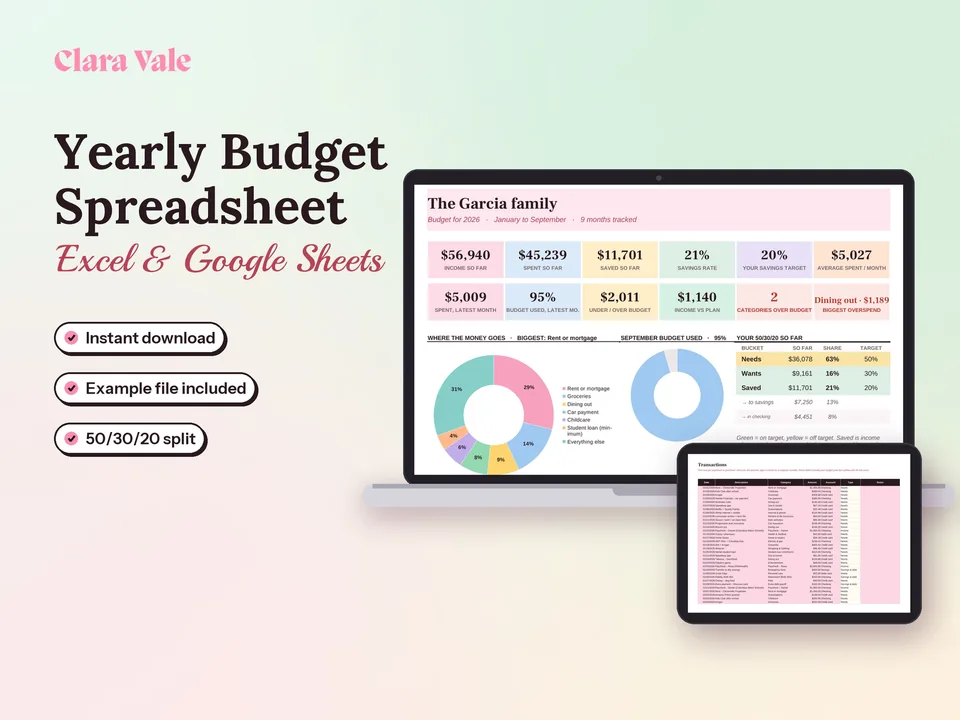
When we built the 50/30/20 split into our Yearly Budget Spreadsheet, we tagged every category as Needs, Wants or Savings & debt, and the student loan minimum sat under Needs. That one choice changed the dashboard more than any other line. Households with big minimum payments look “over” on needs, which is exactly the warning the rule is meant to give.
How to calculate a 50/30/20 budget
You don’t need a dedicated 50/30/20 budget calculator. The 50/30/20 rule comes down to three multiplications:
- Find your monthly take-home pay (what hits your bank account, plus any pre-tax retirement savings).
- Multiply it by 0.50 for needs, 0.30 for wants and 0.20 for savings.
- Total last month’s actual spending in each bucket and compare it with the targets.
In Google Sheets or Excel, put take-home pay in cell B1, then use =B1*0.5, =B1*0.3 and =B1*0.2. To see your real split, divide each bucket’s actual spending by B1 and format the result as a percentage.
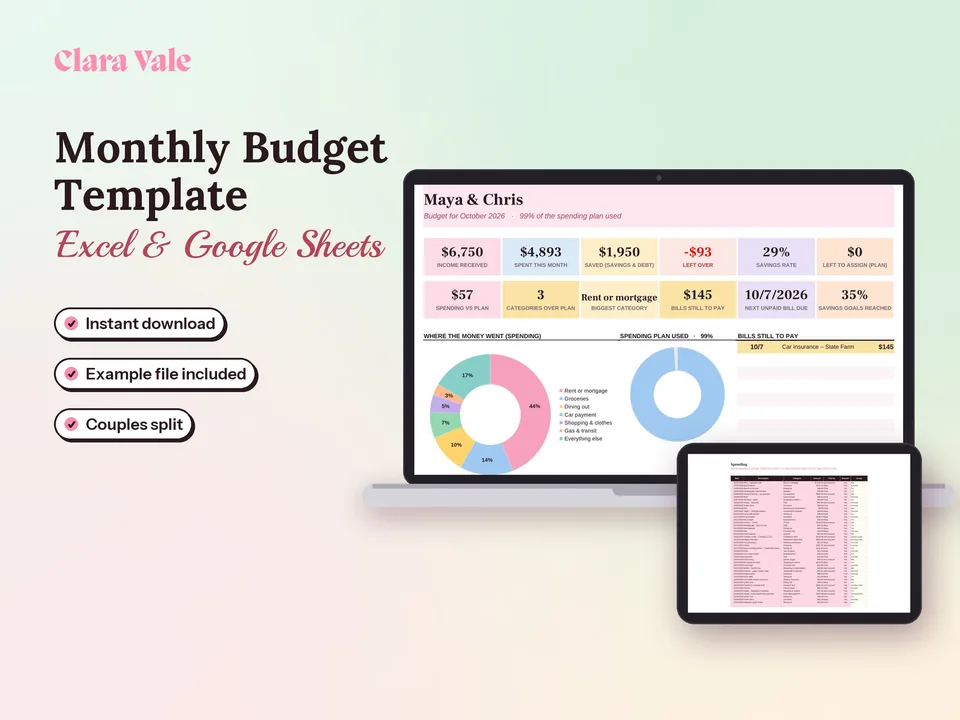
Step 3 is the one that makes a 50/30/20 budget useful. The targets are easy. The comparison is where you learn that dining out is really $520, not the $250 you guessed. Track at least one full month before you change anything. Our Google Sheets Budget Template & Spending Tracker groups spending into bills, everyday costs, fun, and savings and debt, which maps neatly onto the three 50/30/20 buckets.
When the 50/30/20 rule doesn’t fit
The 50/30/20 rule assumes your fixed costs are reasonable for your income. For many people in 2026, they aren’t. Here are the three most common cases and what to do.
High rent or high cost of living
Say our example earner moves to a city where rent is $2,000. Rent alone is now 44% of take-home pay ($2,000 ÷ $4,534). Add the other needs from the table ($940) and needs hit $2,940, or about 65%.
Don’t cut savings to make room. Squeeze wants instead with a 65/15/20 split: $2,947 for needs, $680 for wants and $907 for savings. That’s tight, but it keeps the emergency fund growing. If even that doesn’t work, the real fix is on the income side. A side income of a few hundred dollars a month can restore the split, and we’ve collected realistic options in our guide on how to make extra money from home.
Paying off high-interest debt
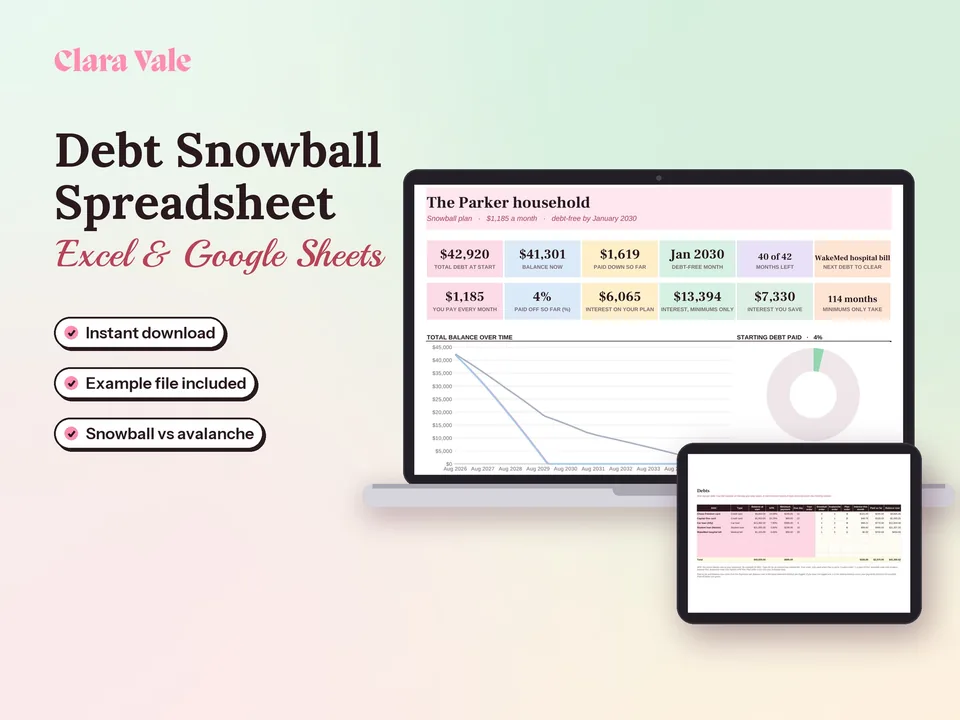
If you carry credit card debt, the 20% bucket in the 50/30/20 rule may be too small. A common tweak is to borrow from wants: run 50/20/30 for a while, with 30% going to savings and extra debt payments. On $4,534, that’s $1,360 a month toward debt and a small emergency fund. Keep a starter emergency fund first, so one car repair doesn’t land back on the card. To see how fast extra payments clear each balance, plug your debts into our debt snowball calculator.
Irregular or low income
Freelancers, gig workers and anyone paid hourly can’t always predict take-home pay. Base your 50/30/20 budget on your lowest typical month, not your average. Anything above that floor goes straight to savings. On a very low income, needs can easily top 70%. The rule still helps as a direction to move in, even if it’s not your budget today.
Variations: 70/20/10, 60/20/20 and other splits
The 50/30/20 rule isn’t the only percentage budget. The others mostly move the lines between buckets:
| Rule | Split | Best for |
|---|---|---|
| 50/30/20 | 50% needs, 30% wants, 20% savings | A balanced default |
| 60/20/20 | 60% needs, 20% wants, 20% savings | Higher-rent areas |
| 70/20/10 | 70% spending, 20% savings, 10% debt or giving | People who don’t want to sort needs from wants |
| 70-10-10-10 | 70% living, 10% savings, 10% investing or debt, 10% giving | Building in charity or tithing |
| 50/40/10 | 50% needs, 40% wants, 10% savings | A gentler first budget |
| 80/20 | 80% spending, 20% savings | Pay-yourself-first savers |
Most of these, like the 50/30/20 rule itself, keep a 20% savings slice for a reason. Saving 20% of take-home pay builds a three-month emergency fund in about a year, since three months of 80% spending equals 2.4 months of pay, and 20% a month gets you there in 12 months. Save 10% and it takes more than twice as long.
If you’re still figuring out where money goes, the 50/30/20 rule’s needs-vs-wants split shows more. If you already know and just want automatic savings, the 80/20 version is the least work.
Making the 50/30/20 rule stick
The 50/30/20 rule works because it’s three numbers, not thirty. Figure out your real take-home pay, set the targets, then compare one full month of spending against them. Protect the savings slice first, let wants flex, and treat a needs share over 50% as a signal to fix fixed costs or income rather than a personal failure.
If you’d like the split worked out for you, our Yearly Budget Spreadsheet & Savings Tracker tags each category as needs, wants or savings and shows your actual 50/30/20 split next to your savings rate, month by month.
Questions people ask
Does the 50/30/20 rule actually work?
It works best as a starting point, not a strict law. The 50/30/20 rule gives you a quick check on whether fixed costs are crowding out savings. If your needs fit inside 50% of take-home pay, it usually holds up well. If rent alone eats 40% or more, shift the split (65/15/20 is common) and keep the 20% for savings as long as you can.
Is 50/30/20 or 70/20/10 better?
Neither is better for everyone. The 50/30/20 rule separates needs from wants, which helps when you're not sure where money leaks. The 70/20/10 rule lumps all spending into one 70% bucket and splits the rest between savings and debt or giving. If you have debt to clear, 70/20/10 makes room for it. If you want more detail on spending, 50/30/20 shows more.
How much should I save if I make $3,000 a month?
Under the 50/30/20 rule, $3,000 of take-home pay means $600 a month for savings and extra debt payments, $1,500 for needs and $900 for wants. If $600 isn't realistic yet, start with a smaller automatic transfer, such as $150, and raise it each time a bill drops off or your pay goes up.
What is the 70-10-10-10 budget rule?
The 70-10-10-10 rule is usually described as 70% of take-home pay for living costs, then 10% each for savings, investing or extra debt payments, and giving. Versions differ on the exact labels. It suits people who want a set slice for charity or tithing, which the 50/30/20 rule doesn't carve out separately.
How do you calculate the 50/30/20 rule?
Start with your monthly take-home pay, the amount that lands in your bank account after taxes. Multiply it by 0.5 for needs, 0.3 for wants and 0.2 for savings and extra debt payments. On $4,534 a month, that's $2,267 for needs, $1,360 for wants and $907 for savings. Then compare those targets with what you actually spent last month.
Is the 50/30/20 rule outdated?
The math isn't outdated, but housing costs have made the 50% needs target hard in many US cities. The rule dates to a 2005 book, and in high-rent areas rent alone can push needs well past 50%. Treat the percentages as a target to work toward. Keep the 20% savings slice and let wants shrink first.
How much do I have to save every month to save $10,000 in a year?
You need to save $833.33 a month, since $10,000 divided by 12 is $833.33. Under the 50/30/20 rule, that savings target matches a take-home pay of about $4,167 a month. On less than that, saving $10,000 in a year means cutting wants below 30% or adding income.
What is the 50/40/10 budget rule?
The 50/40/10 rule is a looser version of the 50/30/20 rule, usually described as 50% for needs, 40% for wants and 10% for savings. It can help people who are just starting to budget, but saving only 10% builds an emergency fund slowly. Many people use it for a few months, then move to 20% savings.