
Most weeknight dinner stress happens around 5 pm. Someone has practice at six, one child won’t eat anything green, the fridge holds half a bag of spinach and some chicken, and the grocery total keeps creeping up. Family meal planning moves those decisions to one calm half hour each week, so dinner is already decided before the busy days start. Below is the routine we use, a sample week of dinners for a family of four, and what that week should cost.
Family meal planning means deciding the week’s meals before you shop. Check the family calendar, give each night a theme, build meals from what you already have, plan leftovers on purpose, write one grocery list sorted by store section, and prep in one or two short blocks. For a family of four, the USDA moderate-cost plan is about $321 a week.
How to plan a week of family meals in 6 steps
This is the whole family meal planning routine. Once you’ve done it twice, it takes about 30 minutes, usually on a Saturday or Sunday before the shopping trip.
1. Check the calendar first
A family meal plan starts with the week, not with recipes. Mark the nights with late practice, work shifts, school events or a parent away. Those nights get the fastest meals or a planned leftover. A slow-cooked stew is a bad fit for the evening everyone gets home at 6:30, and that mismatch is why so many plans get abandoned by Wednesday.
2. Give each night a theme
Themes are the fastest shortcut in family meal planning. They cut the number of choices from “anything” to “which pasta?” Pasta night, taco night, soup night and pizza night are common because they’re flexible. You can rotate recipes inside a theme and still keep the week familiar for the kids.
3. Build from what you already have
Check the fridge, freezer and pantry before you write a single meal. If there’s half a bag of rice and a pound of ground beef in the freezer, two meals are already started. This step does more for the grocery budget than any coupon, because the cheapest ingredient is the one you’ve already paid for.
4. Plan leftovers on purpose
Cook once, eat twice. Roast a bigger chicken on Sunday and Monday’s quesadillas are half done. Double the pasta sauce and freeze half for next week. Planned leftovers work because most of the time in cooking is fixed (chopping, heating the oven, washing up), so making a bigger batch costs very little extra effort.
5. Write one grocery list, sorted by store section
Every meal in the family meal plan feeds one list. Group it the way your store is laid out: produce, meat and fish, dairy, bakery, pantry, frozen. You walk each aisle once, you’re less likely to forget something and make a second trip, and you spend less time passing displays you didn’t plan for. If you shop at two stores, give each store its own column.
6. Prep in one or two blocks
Set aside 45 to 60 minutes after shopping. Wash and cut vegetables, cook a pot of rice or grains, brown the taco meat, and portion snacks for lunchboxes. A second, shorter block midweek can handle anything that won’t keep. You don’t need a full meal prep marathon, just enough that weeknight dinners start halfway done.
A sample one-week family meal plan for four
Here’s a sample family meal plan for one week of dinners, built with the steps above. It assumes two adults, two school-age kids and one busy weeknight (Tuesday).
| Day | Theme | Dinner | Planning note |
|---|---|---|---|
| Sunday | Roast night | Roast chicken, potatoes and carrots | Roast extra chicken for Monday; save the bones for Thursday |
| Monday | Leftover makeover | Chicken quesadillas with peppers and salsa | Uses Sunday’s chicken; 20 minutes |
| Tuesday | Pasta night | Spaghetti with meat sauce, side salad | Busy night; double the sauce and freeze half |
| Wednesday | Meatless night | Black bean and sweet potato tacos | Cheap protein; kids build their own |
| Thursday | Soup and sandwich | Chicken noodle soup from Sunday’s bones, grilled cheese | Stock simmers while homework gets done |
| Friday | Pizza night | Homemade pizza on store-bought dough | Everyone tops their own section |
| Saturday | Use-it-up night | Fried rice or breakfast for dinner | Clears leftover vegetables, rice and eggs |
Two nights are built entirely from earlier cooking, and Saturday clears out whatever’s left. That pattern repeats well. Swap the recipes each week and keep the themes, and the plan stays fresh without starting over.
Breakfasts and lunches still need a short list of their own in any family meal planner. Most families rotate the same three or four breakfasts and pack lunches from the dinner leftovers and the prepped vegetables, which keeps that part of the grocery list short.
What should a family meal plan cost?
A useful benchmark is the USDA Food Plans, which estimate the monthly cost of a healthy diet cooked at home for each age group at several spending levels. Based on the USDA Food Plans monthly cost report for July 2026, a couple aged 19 to 50 with two children aged 6 to 11 would spend about $1,391 a month on the moderate-cost plan. That’s about $321 a week.
The low-cost plan for the same family comes to about $1,128 a month, or roughly $260 a week. Both numbers cover all food eaten at home (breakfasts, packed lunches, snacks and dinners), not just the seven dinners in the plan above. Takeout and restaurant meals sit outside them.
The USDA figures assume a four-person household. For other sizes, the USDA suggests adjusting: add 20% for one person, 10% for two and 5% for three, and subtract 5% for five or six people and 10% for seven or more. Smaller households pay more per person because packages, waste and fixed staples don’t shrink in proportion.
Ages change the total of a family meal plan too. A teenager on the moderate-cost plan costs more than a five-year-old, so a family with two teens will land above the $1,391 example. Our grocery budget calculator uses the same July 2026 USDA figures: enter who lives in your home and it gives you a monthly and weekly number to plan against.
If you already budget with a percentage rule, groceries count as a need. In the 50/30/20 rule they sit in the 50% bucket alongside rent and utilities, while takeout belongs in the 30% for wants.
How to feed picky eaters without cooking two dinners
Picky eating is one of the main reasons a family meal plan falls apart. The fix that works in most families is to plan one dinner and make it flexible, not to cook a separate meal for each child.
- Build-your-own meals. Tacos, rice bowls, pizza and baked potatoes let each person choose toppings from the same ingredients. Three of the seven nights in the sample week work this way.
- One safe side every night. Put at least one food every child usually eats on the table, such as bread, rice, fruit or plain pasta. No one goes hungry, and the main dish doesn’t have to please everyone.
- Serve sauces on the side. Many kids will eat plain chicken and pasta and refuse the same food once it’s mixed together.
- Keep offering new foods. The CDC notes that it may take 8 to 10 exposures before a young child is willing to try a new food, and suggests serving new foods alongside ones children already like. A rejected vegetable this week isn’t a failure. It’s one exposure.
Getting kids involved helps too. Let each child pick one dinner per week from the family’s meal list, or have them wash and sort produce. A child who chose Friday’s pizza toppings has a reason to eat them.
Family meal planning around different schedules
Planning gets harder when everyone eats at different times. A few patterns help:
- Match the meal to the night. Use the calendar from step 1. Slow cooker or sheet pan meals go on nights when no one’s home to cook. Twenty-minute meals go on practice nights.
- Plan meals that hold well. Soups, chili, pasta bakes and rice bowls taste fine an hour later. Fried or crispy food doesn’t.
- Make one “plate it later” night. Cook once, portion it into containers, and let the late arrivals reheat theirs.
- Keep two backup meals in the pantry. Pasta with jarred sauce and frozen vegetables, or eggs and toast, can rescue any night the plan breaks. Backup meals are cheaper than ordering pizza.
How to stretch the grocery budget
Family meal planning already does most of the budget work. Once the plan is in place, these habits usually do the most for the total:
- Shop with the list, and only the list. Planning is where most of the saving happens. Impulse buys and second trips are where it leaks back out.
- Compare unit prices. The shelf tag shows the price per ounce or per count, which is the only fair way to compare a large package with a small one or a store brand with a name brand.
- Build two or three meals a week around cheap proteins. Dried or canned beans, lentils, eggs and whole chickens cost less per serving than most cuts of meat, and the sample week uses all of them.
- Plan around what’s on sale. Check the store’s weekly ad before you choose themes, then fit the recipes to the discounted produce and meat.
- Use your freezer. Freeze the second half of a doubled recipe, bread that won’t get eaten in time, and bananas going brown. Food you freeze is food you don’t throw away.
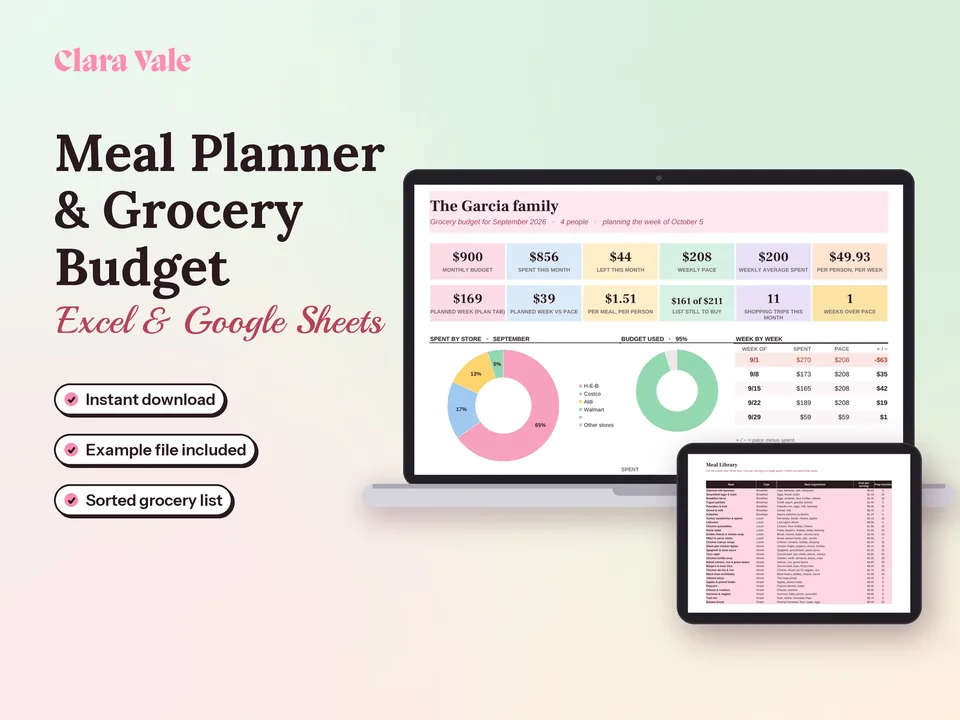
- Track what you actually spend. Log each receipt against your weekly number for a month. In our example file for a family of four on a $900 monthly grocery budget, which is well under the USDA low-cost plan, tracking is what shows whether the plan holds or slips by the third week.
Start your family meal plan this week
Pick a 30-minute slot before your next shopping trip, check the calendar, and plan seven dinners using themes and one planned leftover. Write the list by store section and compare the receipt with your weekly number. After two or three weeks of family meal planning you’ll have a meal list you can reuse, and the half hour gets shorter.
If you’d like the routine set up for you, our Weekly Meal Planner & Grocery Budget keeps a library of your family’s meals, builds the weekly plan, sorts the grocery list by store section, and tracks spending against your monthly budget in Excel or Google Sheets.
Questions people ask
What is the best meal planner for families?
The best family meal planner is the one you'll open every week. Paper works if one person plans and shops. A shared app or spreadsheet works better when two adults split the shopping, because everyone sees the same list. Look for three things: a place for your go-to meals, a weekly grid, and a grocery list sorted by store section.
What is the 3-3-3 rule for meals?
It's an informal meal prep rule, and people use it in slightly different ways. The most common version is to prep three proteins, three vegetables and three carbs at the start of the week, then mix and match them into different meals. It suits families who like simple, build-your-own plates more than set recipes.
What is the 5-4-3-2-1 rule for groceries?
It's a shopping-list shortcut, not an official guideline. A common version is five vegetables, four fruits, three proteins, two sauces or spreads, and one grain, with some people swapping in a treat. It keeps a small household's cart focused. A family of four will usually need larger quantities, but the same proportions can guide the list.
How to feed a family of 4 on $100 a week?
It's very tight. $100 a week is about $433 a month, which is less than half of the USDA's July 2026 low-cost plan for a couple with two kids aged 6 to 11 (about $1,128 a month). Families who manage it lean on dried beans, rice, oats, eggs, frozen vegetables, store brands and planned leftovers, and they cook nearly every meal at home.
What are some good family meal plans for one week?
A simple week gives each night a theme: a roast on Sunday, leftovers turned into quesadillas on Monday, pasta on Tuesday, a meatless night on Wednesday, soup and sandwiches on Thursday, homemade pizza on Friday and breakfast for dinner on Saturday. Themes make picking meals fast and leave room to swap recipes inside each one.
What is a realistic food budget for a family of four?
Using the USDA Food Plans for July 2026, a couple aged 19 to 50 with two children aged 6 to 11 would spend about $1,391 a month, or about $321 a week, on the moderate-cost plan. The low-cost plan comes to about $1,128 a month. Those amounts cover food prepared at home only, not takeout or restaurant meals.
Is $200 a week a lot for groceries?
It depends on who you're feeding. For a couple aged 19 to 50, $200 a week is close to the USDA moderate-cost plan for July 2026, which comes to about $187 a week after the two-person adjustment. For a family of four with two school-age kids, $200 a week is below even the low-cost plan, which is about $260 a week.
How do I make my own meal planner?
Start with a list of 15 to 20 meals your family already eats. Add a seven-day grid with a row for dinners (and lunches if you pack them), a column for notes like late practice nights, and a grocery list split by store section. Keep last week's plan, so you can reuse good weeks instead of starting from a blank page.