
Most parties don’t go wrong on the day. They go wrong six weeks earlier, when the invitations went out late, or two days before, when nobody bought ice. A party planning checklist fixes that by tying every task to a week, so you always know what’s due now and what can wait. The version below starts eight weeks out (twelve for a big or venue-based party) and runs through the morning after, including the parts most lists skip: how much food and drink to buy, and how to settle up when friends chipped in.
A good party planning checklist works backward from the party date. Eight to twelve weeks out, set the budget, guest count, date and venue. Six weeks out, send invitations with an RSVP date. Four weeks out, book vendors and plan the menu. In the final two weeks, buy supplies, confirm numbers, prep food, then send thank-yous and settle costs after.
The party planning checklist at a glance
Here’s the whole party planning checklist in one table. Print it, or copy it into a notes app and tick things off. The sections below explain each step and the numbers behind it.
| When | Tasks | Done |
|---|---|---|
| 8–12 weeks out | Set total budget and per-guest budget; draft guest list; pick date, time and venue; book the venue | ☐ |
| 6–8 weeks out | Choose a theme (if any); book caterer, rentals, entertainment or photographer; send save-the-dates if guests travel | ☐ |
| 4–6 weeks out | Send invitations with an RSVP date; plan the menu; build a music playlist or book a DJ | ☐ |
| 3 weeks out | Order the cake or desserts; order decorations online; ask helpers for specific jobs | ☐ |
| 2 weeks out | RSVP date passes; chase missing replies; give final headcount to the venue and caterer | ☐ |
| 1 week out | Calculate food, drink, ice and supply quantities; shop for non-perishables; confirm every vendor | ☐ |
| 2–3 days before | Shop for perishables; clean the space; plan the fridge and cooler space | ☐ |
| Day before | Prep food; set up tables, decorations and the drinks station; charge speakers; write a run-of-day list | ☐ |
| Party day | Buy ice; finish food; set out food in batches; greet guests; keep an eye on food sitting out | ☐ |
| Day after | Return rentals; send thank-yous; log what you spent; settle shared costs | ☐ |
If your party is small and at home, you can compress the top rows into a single weekend. If it’s a milestone birthday, a graduation or anything with a booked venue, use the full twelve weeks, because good venues and caterers fill their calendars first.
8 to 12 weeks out: budget, guest list, date and venue
These four decisions control everything else on a party planning checklist, so make them in this order.
Budget first. Pick a total you’re comfortable with, then divide it by the number of guests you’d like to invite. A $600 budget for 30 guests is $20 a head, and that one number answers a lot of later questions fast. Twenty dollars a head covers pizza, snacks, a cake and drinks at home. It doesn’t cover a catered dinner at a rented venue. If you want to see how the money splits across food, venue, decor and extras for a specific kind of party, our birthday party budget breakdown walks through it line by line.
Guest list second. Write the full list, then a must-invite list. The gap between the two is your flex if the budget or venue gets tight. For kids’ parties, decide now whether siblings and parents are invited, because that can double your headcount.
Date and time third. Check the calendar for holidays, school events and big games. The time of day sets the food plan: a 2 p.m. party can run on snacks and cake, while a 6 p.m. party needs a meal.
Venue fourth. For a home party, check seating, bathrooms, parking and a rain plan. For a rented space, ask what’s included (tables, chairs, cleaning, setup time) and what the deposit and cancellation terms are.
The lines that blow a party budget are almost never the big ones. They’re the small ones nobody wrote down: ice, tape, batteries, trash bags, a tip for the delivery driver. Putting a “small stuff” line in the budget from day one, even a rough $25–$50, keeps the total honest.
4 to 6 weeks out: invitations with an RSVP date
On almost any party planning checklist, invitations are the first hard deadline. Sending them four to six weeks before the party is common practice for most birthdays and celebrations. Casual get-togethers can go out three weeks ahead. Weddings, holiday-season parties and anything guests need to travel for usually go out earlier, often with a save-the-date first.
Every invitation needs five things: the date, start and end time, address (plus parking notes), what to expect (meal or snacks, dress code, kid-friendly or not), and an RSVP date. Set that date about two weeks before the party. That timing works because caterers and venues usually want a final headcount a week or two ahead, and you need a few days to chase the people who didn’t reply. It’s the step that makes the rest of the plan reliable.
Digital invitations make tracking easy, since replies land in one place. Paper invitations look nicer but need a manual RSVP list. Either way, keep one master guest list with a column for invited, replied, yes, no, and dietary notes.
4 weeks out: vendors, menu and music
The vendor row of the party planning checklist covers anything that depends on someone else’s calendar: caterer, bakery, rentals (tables, chairs, linens, a tent), entertainment, a photographer. Get every quote in writing with the deposit amount and the date the balance is due.
Plan the menu around the time of day and how people will eat. A standing, mingling party works best with food guests can hold in one hand. A seated party can handle plated or family-style dishes. Note any allergies from the RSVPs and label dishes on the day.
For music, a playlist is enough for most home parties. Make it about an hour longer than the party so it never repeats, and test the speaker in the actual room. Book a DJ or band only if dancing is a main event.
1 to 2 weeks out: how much food, drink and supplies to buy
This is where a party planning checklist earns its keep, because quantities are where hosts guess and get it wrong. Work from your confirmed RSVPs, not the invite list. The figures below are common hosting rules of thumb, not fixed rules, so adjust for your crowd.
| Item | Rule of thumb | For 30 guests, 3 hours |
|---|---|---|
| Drinks (all kinds) | About 1 per guest per hour | ~90 drinks |
| Wine | A 750 ml bottle pours about five 5-oz glasses | 6 bottles covers ~30 glasses |
| Appetizers, as the main food | 10–12 pieces per guest | 300–360 pieces |
| Appetizers, before a meal | 4–6 pieces per guest | 120–180 pieces |
| Ice | 1 lb per guest for drinks, more if chilling bottles in coolers | 30–60 lb |
| Plates | 1.5–2 per guest | 45–60 |
| Cups | 2–3 per guest (people set them down and grab new ones) | 60–90 |
| Napkins | 3 per guest | 90 |
The wine math is simple. A standard 750 ml bottle holds about 25 fluid ounces, and the NIAAA defines a standard drink of wine as a 5-ounce glass at 12% alcohol. That puts one bottle at roughly five standard pours, which is why “one bottle per five wine glasses” is a reliable way to size a wine order for any party.
Split the drinks total by your crowd. If about a third of your guests drink wine, a third beer and a third soft drinks, the 90 drinks above become about 30 glasses of wine (6 bottles), 30 beers and 30 soft drinks, plus water for everyone. Buy non-perishables this week: drinks, paper goods, decorations, candles, trash bags, foil and serving utensils.
Decorations and supplies
Decorations are the item on a party planning checklist that’s easiest to overspend on, so decide where people will actually look: the entrance, the food table and the spot where photos will happen. Decorate those three and leave the rest. Order anything online at least three weeks ahead so shipping delays don’t matter.
The supply list that saves the day is the boring one: extension cords, tape, scissors, a lighter for candles, a first-aid kit, spare toilet paper, paper towels, two or three trash bags per 10 guests, a recycling bag, and containers for leftovers. Put them in one box the week before.
The day before and the day of
Day before: this is the busiest row of the party planning checklist. Shop for perishables if you haven’t, prep anything that holds overnight (dips, salads, desserts), set up tables, decorations and the drinks station, chill drinks, and charge speakers and phones. Then write a run-of-day list with times: when food goes in the oven, when ice arrives, when the cake comes out, who’s doing what.
Day of: buy ice that morning, since most home freezers can’t hold 30 pounds of it overnight. Put food out in batches instead of all at once, and keep cold food cold. Party food sits out longer than people realize. The CDC’s food safety guidance says to refrigerate perishable food, including meat, dairy, cut fruit and cooked leftovers, within 2 hours, or within 1 hour if it’s exposed to temperatures above 90°F, like at a summer picnic. For a party, that means the platter set out at 6 p.m. should be swapped or put away by 8 p.m.
Assign one helper to drinks and ice and one to clearing plates. Then step away from the kitchen and actually talk to your guests.
The day after: thank-yous and settling costs
Most versions of a party planning checklist stop when the last guest leaves. The day after is where the loose ends live.
Return rentals on time, since late returns can cost extra or eat into a deposit. Send thank-yous within a week, to guests who brought gifts, to helpers, and to any vendor who did great work (a short review helps small vendors more than you’d think).
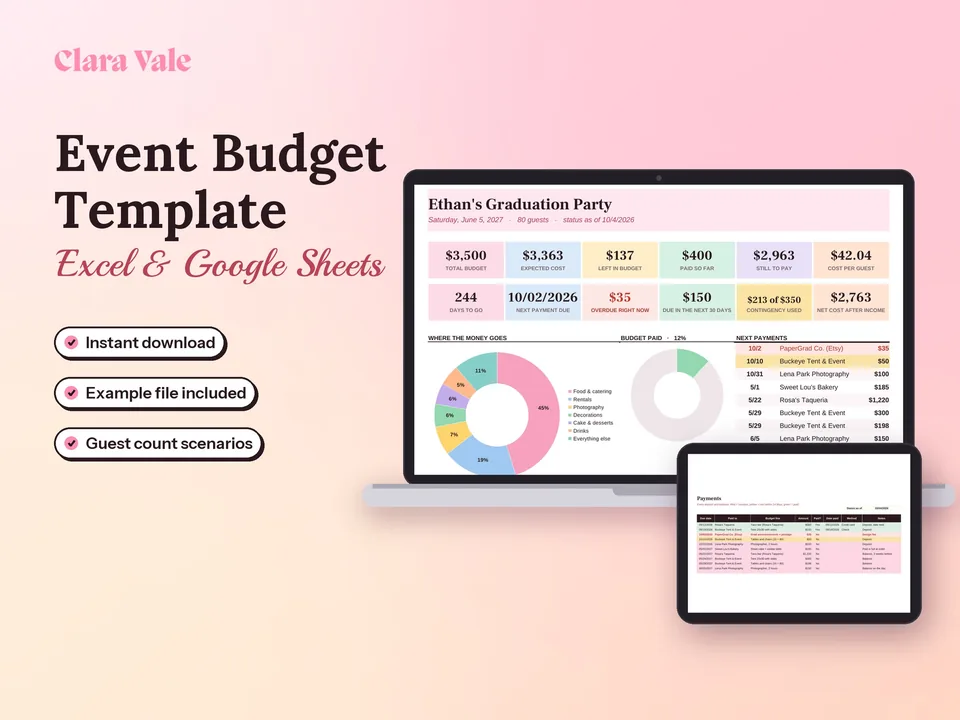
Then settle the money. Gather every receipt, log what you spent next to what you planned, and note what ran over. If friends or family split the cost, total the shared spend, divide it by the people sharing, subtract what each person already paid, and send one clear message with the balance. An event budget template keeps planned and actual side by side and logs what each person put in, so the math takes a minute. Bigger milestone parties with relatives chipping in follow the same pattern, which our graduation party budget guide covers in detail.
Finally, write two lines for next time: what you’d buy less of and what ran out. That note makes your next party planning checklist shorter.
Keep the whole plan in one place
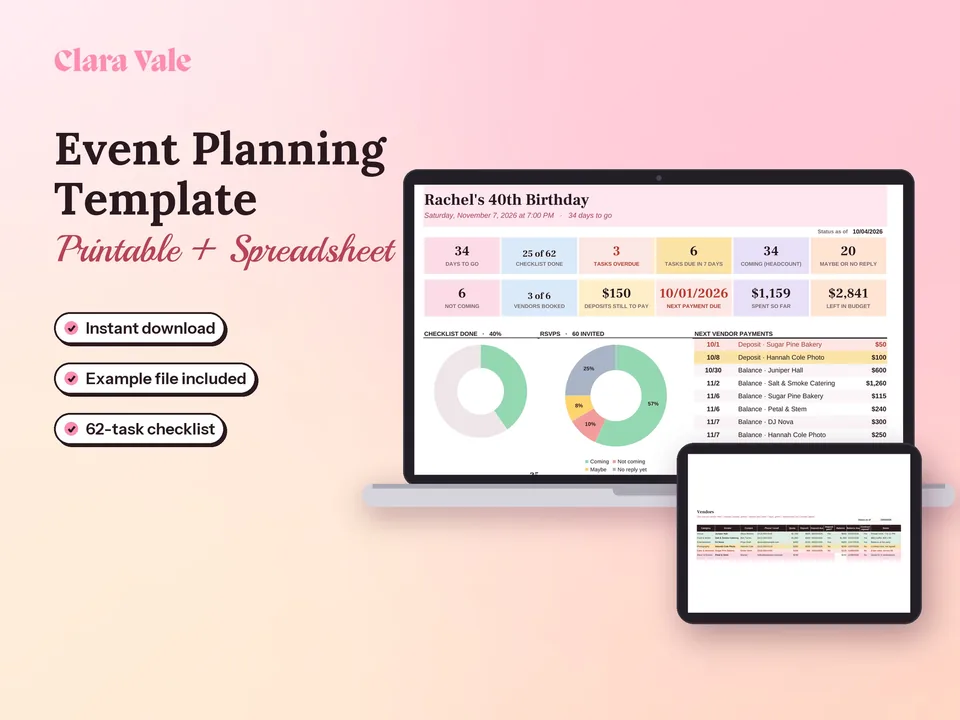
A party comes together when the budget, guest list and timeline live together instead of on three scraps of paper. The party planning checklist above is the same one a professional event planning checklist follows, just scaled down to a living room or a backyard. Start with the money and the headcount, send invitations with a firm RSVP date, size food and drinks from confirmed numbers, and finish with the thank-yous and the settling up. If you’d like a party planner template that holds this checklist, your guest list and RSVPs, and your vendor details in one spreadsheet, our event planning template is built for exactly this kind of party plan.
Questions people ask
What do you need when planning a party?
You need six decisions before anything else: a budget, a guest count, a date, a venue, a start and end time, and a food plan. Everything else follows from those. After that come invitations with an RSVP date, any vendors, drinks, decorations, music, and supplies like plates, cups, ice, napkins and trash bags. A timeline checklist keeps each task in the week it belongs to.
How to plan a party for 50 people?
Start eight to twelve weeks out, because venues and caterers for 50 book up. Set a per-guest budget, then pick the venue, since a crowd that size rarely fits a living room. Send invitations about six weeks ahead with an RSVP date two weeks before. Order food from the confirmed count, plan about one drink per guest per hour, and line up two or three helpers for setup and cleanup.
Is 40 people a lot for a house party?
It's a lot for most homes, but it can work. Forty guests who mingle and stand need far less room than forty seated at tables. Check three things: whether people can move between the kitchen, the drinks and the bathroom without a bottleneck, how many bathrooms you have, and where cars will park. Using a yard or patio, or staggering arrival times, makes 40 much easier.
What are the 7 stages of event planning in order?
Lists vary, but a common version runs: set goals and the budget, pick the date and venue, book vendors, plan the details (menu, decor, schedule), send invitations and manage RSVPs, run the event, and follow up afterward. A home party uses the same order on a smaller scale, which is why a party checklist ends with thank-yous and settling costs, not with the party itself.
What are the 5 stages of event planning?
The five-stage version usually groups the work as research and goals, design and budget, booking the venue and vendors, running the event, and evaluating it afterward. The names change from source to source, but the order doesn't: money and guest count first, bookings second, details third, the day itself fourth, and the wrap-up last.
How to organize your birthday party?
Pick the date and guest count first, then set a budget per guest. Book the venue or clear your space, send invitations three to six weeks ahead with an RSVP date, and plan food around the time of day. Buy decorations and supplies the week before, prep food the day before, and keep a short run-of-day list so you can enjoy your own party.
What is a reasonable budget for a birthday party?
There's no single right number. It depends on guest count, venue and whether you serve a meal or snacks. The easiest way to set one is per guest: decide what you can spend in total, divide by the number of guests, and check that figure against your menu and venue quotes. Food and drinks usually take the biggest share of a home party budget.