
Getting engaged hands you a long list of decisions and no clear starting point. Venue tours, dress appointments and photographer inquiries all seem urgent, and every vendor wants a date before they’ll quote. The trick to learning how to plan a wedding without a planner is to make the decisions in the right order. Each one sets the limits for the next: your priorities shape the budget, the budget sizes the guest list, the guest list picks the venue, and the venue fixes the date. Below are 13 steps in that order, with worked numbers you can swap for your own.
To plan a wedding, decide in this order: your priorities and vibe, the budget and who pays, the guest list, the date, the venue, key vendors, the wedding party, invitations, the ceremony, the reception, the day-of timeline, the final weeks, and after-wedding tasks. Each decision locks in the limits for the one after it.
The order to plan a wedding, at a glance
Here is the full sequence to plan a wedding and what each step settles. If you only keep one thing from this guide, keep this table.
| Step | Decision | What it locks in |
|---|---|---|
| 1 | Priorities and vibe | Where the money goes first |
| 2 | Budget and who contributes | Your total spending limit |
| 3 | Guest list | Venue size and catering cost |
| 4 | Date and season | Price level and vendor availability |
| 5 | Venue | The exact date, capacity and rules |
| 6 | Key vendors | Photographer, caterer, music, officiant |
| 7 | Wedding party | Who helps and who needs outfits |
| 8 | Save-the-dates and invitations | Your final headcount |
| 9 | Ceremony | License, officiant, vows |
| 10 | Reception | Food, seating, music, toasts |
| 11 | Day-of timeline | Who is where, when |
| 12 | Final weeks | Payments, confirmations, final count |
| 13 | After the wedding | Thank-yous and paperwork |
This guide covers the decisions. For a month-by-month list of tasks, use our wedding planning checklist.
Step 1: Agree on your priorities and the vibe
The first step to plan a wedding isn’t a venue tour. Before you open a venue website, sit down together and each pick your top three priorities. Food, photos, music, a big party, a short guest list, a particular place, no debt. Then compare lists. Where they overlap, that’s where the money goes first. Where they don’t, talk it through now, because it gets harder once deposits are paid.
Then describe the vibe in a few words. “Relaxed backyard dinner.” “Black-tie city ballroom.” “Twenty people and a long lunch.” That short phrase does a lot of filtering. It rules out venues, dress codes and vendors before you’ve spent an hour on them.
In our experience building wedding budget templates, the couples who struggle most aren’t the ones with small budgets. They’re the ones who never agreed on what mattered, so every quote turns into a negotiation between the two of them.
Step 2: Set the budget and who contributes
Your budget is the money you actually have, not an average from a magazine. Add up three sources:
- What you’ve saved together for the wedding
- What you can save from now until the final payments are due
- What each family has offered, as a confirmed amount
Ask families early and directly, and write the numbers down. “We’d love to help” isn’t a budget line. Also agree whether a contribution is a set sum or tied to something specific, like the rehearsal dinner or the photographer.
Worked example. A couple has $14,000 saved and can put away $500 a month for 12 months ($6,000). One set of parents offers $10,000. Their total is $30,000.
Next, split that total across categories. Our wedding budget calculator uses a common starting split of about a fifth for the venue, a quarter for catering and drinks, a tenth for photography, and smaller shares for everything else, with 5% held back for surprises. On $30,000, that’s $6,000 for the venue, $7,500 for food and drinks, $3,000 for photography and $1,500 in reserve. Then move money toward your Step 1 priorities.
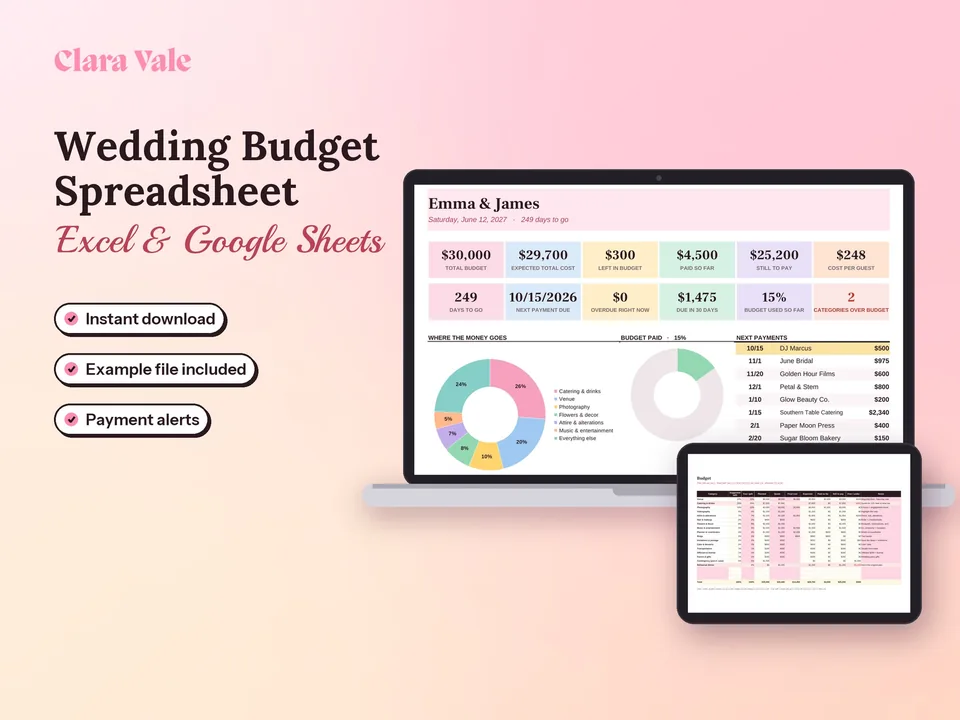
Once quotes start coming in, track every one against its budget line. Our wedding budget spreadsheet logs quotes, deposits and due dates, and shows your cost per guest as the list changes.
Step 3: Draft the guest list (it drives the cost)
If you need to plan a wedding on a budget, the guest list is your biggest lever. Every guest adds a meal, drinks, a chair, a place setting, a share of the cake and a piece of stationery. Your venue and caterer will quote you per person, so your guest count multiplies most of your costs.
Draft the list in three tiers: must invite, should invite, nice to invite. Give each family a fixed number of spots if they’re contributing. Then do the math.
Worked example. With $30,000 and 120 guests, the couple’s total budget per guest is $250. Their catering line is $7,500, which works out to $62.50 per guest for food and drinks. If the caterer they love quotes $85 per person, 120 guests costs $10,200, which is $2,700 over. They can cut the list to 88 guests ($7,480), move $2,700 from a lower priority, or find a different caterer. All three are fine. Not doing the math isn’t.
Track the list in one shared place with names, addresses, tier and RSVP status. You’ll need it for Steps 8, 10 and 13.
Step 4: Pick the date and season
Pick a season and two or three possible dates rather than one fixed day. When you plan a wedding with a flexible date, you have more to negotiate with. Venues and vendors often price peak Saturdays higher than Fridays, Sundays or off-season dates, so ask each one for their pricing by day and month.
Check the dates against the guests who matter most. Look for clashes with major holidays, school calendars, religious observances and big local events that push up hotel rates. Weather matters too: an outdoor ceremony in a rainy month needs a real backup plan, and that backup often costs extra.
Step 5: Book the venue
Now tour venues that fit your guest count, your vibe and your budget line. When you plan a wedding yourself, the venue usually comes before any other vendor because it fixes the date. Most other vendors won’t hold a date until you have one.
Ask every venue the same questions and compare the answers side by side:
- Seated capacity for dinner, not just standing capacity
- What’s included: tables, chairs, linens, staff, setup, cleanup
- Whether you must use their caterer or a vendor list
- Food and drink minimums, service charges and tax
- Noise curfews and end times
- The rain plan, if any part is outside
- The deposit, payment schedule and cancellation terms
A venue that looks cheaper can end up costing more once rentals and staffing are added. Compare the all-in total, not the headline rental fee.
Step 6: Book key vendors in order
Book the vendors who can only work one wedding per day first, because they fill up first. A reasonable order is:
- Caterer, if your venue doesn’t include one
- Photographer and, if you want one, a videographer
- Officiant
- Music: a band or a DJ
- Florist and decor
- Attire: ask the shop for its order lead time before you fall in love with a dress or suit
- Hair and makeup, cake, rentals and transportation
Read every contract before you sign it. Look for the deposit amount, what’s due when, overtime rates, what happens if they cancel, and what happens if you do. Log each deposit and due date as you go so nothing surprises you later.
Step 7: Choose the wedding party
Choose the people you want standing with you, not the number that looks balanced in photos. Before you ask, decide what you’ll expect from them: outfits, pre-wedding events, travel, help on the day. Being upfront about cost is kinder than surprising someone later.
Wedding party size also changes your budget. Each person might mean a bouquet or a boutonniere, a gift, hair and makeup if you’re covering it, and a seat at the rehearsal dinner.
Step 8: Send save-the-dates and invitations
Send save-the-dates once you’ve booked the venue and confirmed the guest list. Guests who need to travel will want as much notice as you can give.
Plan the invitations backward from one date: when your caterer needs the final headcount. Set your RSVP deadline before that, with enough time to chase the late replies. Then mail invitations far enough ahead of the RSVP deadline that guests can actually check their calendars. Working backward this way stops the classic problem of RSVPs still arriving after the caterer’s deadline has passed.
Put the wedding website address, dress code and RSVP method on the invitation. Then track every reply against your guest list.
Step 9: Plan the ceremony
Marriage license rules are set by each state and are often handled by the county, so they vary a lot. Check your county clerk’s website early. Look for the fee, the ID you’ll need, any waiting period after the license is issued, how long the license stays valid, and who has to return the signed certificate.
As one example, King County, Washington’s marriage licensing page says there’s a three-day waiting period after the license is issued, the license is then valid for 60 days, the ceremony must take place in Washington, and the officiant has 30 days after the ceremony to return the marriage certificate. Your county’s rules may be completely different, which is why the license belongs on your list months ahead.
Then plan the ceremony itself with your officiant: the order of events, readings, music, vows, who walks in when, and where the wedding party stands. Confirm your officiant is allowed to perform marriages where you’re getting married.
Step 10: Plan the reception
The reception is where most of the budget goes, so plan it in the order guests experience it: arrival and cocktail hour, entrances, dinner, toasts, first dance, cake, dancing, and the send-off.
Settle the menu and bar with the caterer, including dietary needs from your RSVPs. Build the seating chart once the final RSVPs are in. Give your band or DJ a must-play list, a do-not-play list and the exact songs for key moments. Keep toasts to a few people and ask them to keep it short.
Step 11: Plan the day-of timeline
Write a timeline for the whole day, from hair and makeup through the last song and cleanup. Include who needs to be where, when, and the contact number for each vendor. Then share it with every vendor and the wedding party a week or two out.
If you plan a wedding without a planner, also choose one calm, organized person to be your day-of point of contact, so vendors call them and not you. For a sample schedule hour by hour, see our wedding day timeline.
Step 12: The final weeks
The last few weeks are mostly confirmations and money. Give the caterer and venue your final headcount by their deadline. Confirm arrival times, addresses and final balances with every vendor. Pick up the marriage license within the window your county allows. Do final attire fittings, break in your shoes and pack an emergency kit.
Put final payments and tips in labeled envelopes, and give them to your point of contact, not to yourselves.
Step 13: After the wedding
Send thank-you notes for gifts, and thank the vendors who made the day work. A short review helps small vendors more than you might think. Make sure the signed marriage certificate was returned and order certified copies, since you’ll need them for paperwork.
If either of you is changing your name, USA.gov’s name change guide says to notify the Social Security Administration early, because other agencies learn of name changes through the SSA. It lists certified copies of documents like a marriage certificate as proof, and the driver’s license or state ID, passport, voter registration and tax records as later updates.
Keep every decision in one place
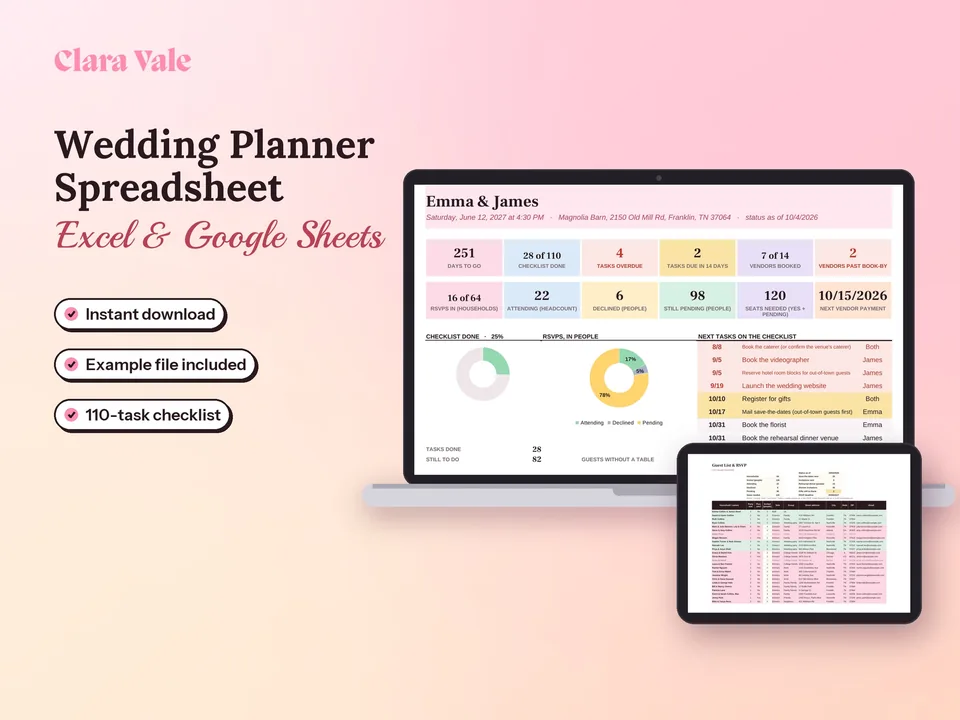
Planning a wedding without a planner comes down to three habits. Make decisions in order, so you aren’t booking things your budget can’t support. Do the guest-count math before you sign anything. And keep the budget, guest list, vendors and timeline in one place you both can see. Our wedding planner spreadsheet holds all of that in a single file, so you can take these 13 steps from first conversation to thank-you notes.
Questions people ask
What is the order to plan a wedding?
Decide in this order: your priorities, the budget and who's contributing, the guest list, the date and season, the venue, the key vendors, the wedding party, save-the-dates and invitations, the ceremony, the reception, the day-of timeline, the final weeks, and the after-wedding tasks. Each step sets limits for the next, so working out of order usually means redoing decisions.
What is the first step to planning a wedding?
Sit down together and agree on your top three priorities and the overall feel you want, before you look at a single venue. Then set a total budget and find out who's contributing. Those two conversations decide everything after them: how many guests you can host, which venues are realistic and which vendors get the most money.
How long does it realistically take to plan a wedding?
There's no fixed length. The real limit is how far ahead your venue and the vendors you want are already booked for your date. A long engagement gives you more choice and time to save. A short one works if you're flexible on the day of the week, the season or a less in-demand venue, and you make decisions quickly.
How much money do I need to plan a wedding?
Work it out from your guest count instead of an average. Multiply the number of guests by a per-guest cost from real catering and venue quotes, then add the fixed costs like the photographer, attire and officiant, plus a buffer of around 5%. If the total is more than you have, cut guests first, since every guest adds food, drinks, a seat and stationery.
What is the 50/20/30 rule for weddings?
It's an informal budgeting rule of thumb, not a standard, and the versions that circulate don't agree on what each bucket covers. Treat any fixed split as a first draft. A better approach is to start from a common category split, then move money toward your top three priorities and away from the things you care least about, keeping the total at 100%.
What is the cheapest way to do a wedding?
The cheapest legal option is a courthouse or civil ceremony with only the required witnesses, if your state or county asks for them. Beyond that, the biggest savings come from a shorter guest list, an off-peak day or season, a venue that allows outside food or a daytime reception, and fewer vendors overall. Guest count moves the total more than any decor choice.
What do the groom's parents usually pay for?
By tradition, the groom's family often hosts the rehearsal dinner, but there's no fixed rule today. Many families simply offer an amount, and couples decide where it goes. The cleanest way to handle it is to ask each family early what they'd like to contribute, write down the amounts, and agree whether it's a set sum or tied to a specific part of the wedding.