
Every wedding planning checklist starts in the same place: one date, and a lot of tasks that have to land before it. The trouble is that the tasks don’t all weigh the same. Book the venue late and the date moves. Order the dress late and you pay rush fees. Mail invitations without weighing one first and some come back for postage. Below is the full month-by-month checklist, from twelve or more months out to the thank-you notes, with a short note on why each task sits where it does, a one-table wedding to-do list you can print, and a compressed plan for engagements under six months.
A wedding planning checklist works backward from the wedding date. At 12+ months, set the budget and guest count, then book the venue and date. At 10–12 months, book the vendors who take one wedding per day. At 4–6 months, finalize details and send invitations about 6–8 weeks out. The last month is confirmations, payments and the marriage license.
The month-by-month wedding planning checklist
This wedding planning checklist follows the order most planners and venues work in, grouped by how far you are from the wedding. If your engagement is shorter, start at the row that matches your timeline and do anything above it first. (For the bigger-picture decisions, like style of wedding, who pays and how to split the work, our guide on how to plan a wedding covers the groundwork.)
12+ months out: budget, guest count, venue, date
- Decide the total budget and who is contributing. Have that conversation with any family members before you tour anything.
- Draft the guest list with two columns: must-invite and would-like-to-invite.
- Pick a rough season and the style of wedding (big party, small dinner, destination, courthouse plus reception).
- Tour venues and book one. The venue contract sets your date.
- Set up one place to track everything: a planner, a shared spreadsheet or a notebook.
- Start a wedding email address both of you can read, for vendor quotes.
- Buy wedding insurance if your venue requires it or the date is far out.
Budget and guest count come first because they’re tied together. The Knot’s 2026 Real Weddings Study of 10,474 US couples married in 2025 found an average spend of $34,000, 117 guests and $292 per guest. That per-guest figure is the reason every name on the list matters: at the average rate, ten extra guests add almost $3,000.
Plug your own numbers into our wedding budget calculator before you tour venues, so you know the ceiling you’re shopping under.
10–12 months out: the vendors who book first
- Book the photographer and videographer.
- Book the planner or day-of coordinator, if you’re using one.
- Book the caterer (unless the venue does it in-house).
- Book the band or DJ.
- Book the officiant.
- Choose the wedding party and ask them.
- Start a wedding website with the date, location and travel details.
8–9 months out: attire, guests’ travel, save-the-dates
- Shop for the wedding dress or suit. Ask each shop for its order lead time and how long alterations take, and work backward from that.
- Book the florist and rentals (tables, chairs, linens, tent).
- Reserve a hotel room block for out-of-town guests.
- Order and send save-the-dates. Most couples send them six to eight months ahead, earlier for a destination wedding.
- Register for gifts so the link is live when save-the-dates arrive.
6–7 months out: the details
- Book the hair and makeup artist and schedule a trial.
- Book transportation if guests or the wedding party need it.
- Order the cake or dessert, or book a tasting.
- Choose the wedding party attire.
- Plan the ceremony with your officiant.
- Book the honeymoon, and check that passports are valid well past your travel dates.
4–5 months out: invitations and the menu
- Order invitations. Get the exact wording right, including the RSVP date.
- Do the menu tasting and choose the menu.
- Buy wedding rings.
- Plan the rehearsal and rehearsal dinner.
- Order favors, signage and any welcome bags.
2–3 months out: send invitations, finalize the day
- Assemble one complete invitation and weigh it at the post office before buying stamps (more on postage below).
- Mail invitations six to eight weeks before the wedding, with RSVPs due three to four weeks before.
- Have dress or suit fittings.
- Write the day-of schedule and share a draft with your vendors.
- Choose ceremony readings and music, and the songs for first dance and entrances.
- Look up your county’s marriage license rules: waiting periods, how long a license stays valid, and what ID you need.
1 month out: license, headcount, seating
- Apply for the marriage license within your state’s valid window.
- Chase missing RSVPs, then give the final headcount to the caterer and venue.
- Make the seating chart.
- Confirm every vendor’s arrival time, address and contact person.
- Final dress fitting.
- Write vows, if you’re writing your own.
- Break in your shoes.
2 weeks out: payments and hand-offs
- Pay any final vendor balances due before the day.
- Put vendor tips in labeled envelopes, and give them to a trusted person.
- Send the final timeline to vendors and the wedding party.
- Get haircuts, color or any beauty treatments done now, not the day before.
- Pack for the honeymoon.
Week of the wedding
- Reconfirm every vendor by phone or email.
- Pack an emergency kit: safety pins, stain remover, pain reliever, phone charger, snacks, a sewing kit.
- Pick up the dress or suit.
- Give the venue or coordinator your decor, favors, place cards and guest book.
- Assign someone to collect gifts, cards and rentals at the end of the night.
Day before
- Rehearsal and rehearsal dinner.
- Hand over rings, license and tip envelopes to the people responsible for them.
- Lay out everything you’ll wear, including accessories.
- Eat a real dinner and go to bed at a normal time.
Day of the wedding
- Eat breakfast, and ask someone to keep water and snacks near you all day.
- Follow the timeline, and let the coordinator or a named friend handle problems.
- Sign the marriage license with your officiant and witnesses.
The hour-by-hour plan for the day itself is its own job. Our wedding day timeline walks through it from hair and makeup to the send-off.
After the wedding
- Make sure the signed license is returned to the county by the deadline (often the officiant’s job, but confirm).
- Return rentals and the suit on time.
- Have the dress cleaned and preserved, if you’re keeping it.
- Order certified copies of the marriage certificate.
- Start the name change, if either of you is changing names. Each office (Social Security, DMV, passport, bank, employer) has its own process, and most want a certified copy of the marriage certificate.
- Send thank-you notes while the day is fresh, ideally within the first few months.
- Leave reviews for the vendors you’d recommend.
Why the venue and date come first
Every wedding planning checklist puts the venue at the top, and for good reason. The venue decides more than it looks like. It fixes the date, the maximum guest count, the location your guests travel to, and often the caterer, the bar and the end time. Until it’s signed, every other quote is a guess, because a photographer can’t hold a date you don’t have yet.
The vendors on the 10–12 month list share one trait. Each one can work only one wedding per day. Saturdays in peak season are limited, so the photographers, bands and planners with the strongest reviews fill those dates first. Florists, bakers and stationers can often handle several orders a weekend, so they’re less urgent. That’s the logic behind the order above: book the people who can’t be in two places at once, then the ones who can.
If your heart is set on one specific photographer or band, it’s common to check their availability before you sign the venue. Then book the two in close succession.
Your wedding to-do list in one table
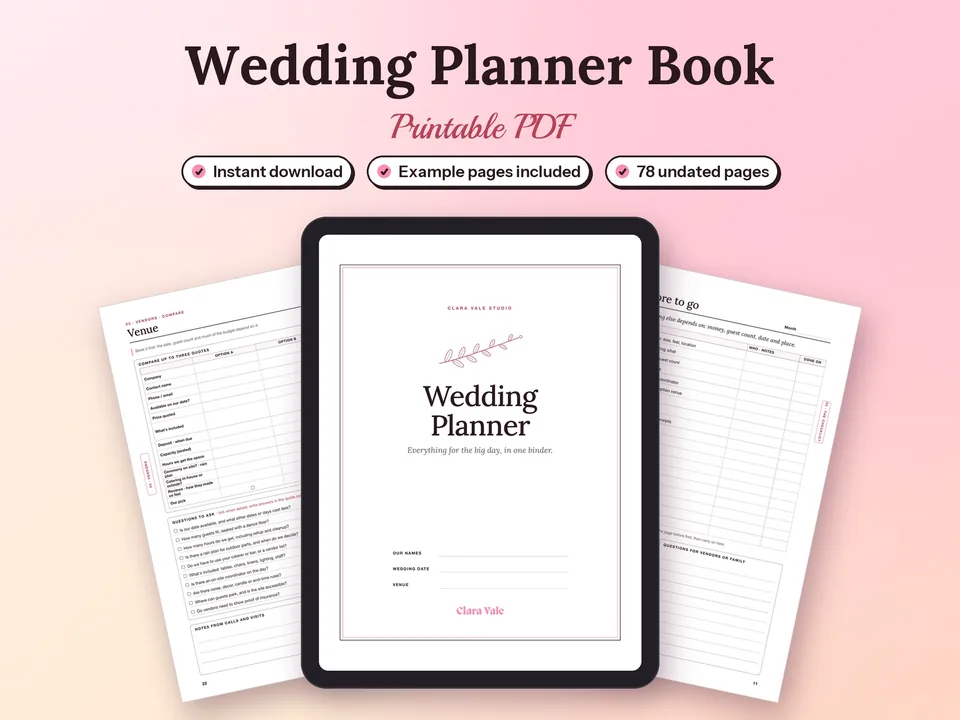
Here’s the same wedding to-do list in one table, a printable wedding planning checklist you can copy, print, or keep next to your planner. If you’d rather write it all by hand, our printable wedding planner book has this checklist laid out with space for notes, contacts and payments.
| When | Tasks | Done |
|---|---|---|
| 12+ months | Budget and contributors; guest list draft; style and season; tour and book venue (sets date); start a tracker | ☐ |
| 10–12 months | Photographer, videographer, planner, caterer, band or DJ, officiant; ask the wedding party; wedding website | ☐ |
| 8–9 months | Dress or suit; florist and rentals; hotel block; save-the-dates; registry | ☐ |
| 6–7 months | Hair and makeup trial; transportation; cake tasting; wedding party attire; ceremony plan; honeymoon and passports | ☐ |
| 4–5 months | Order invitations; menu tasting; rings; rehearsal dinner plan; favors and signage | ☐ |
| 2–3 months | Weigh and mail invitations (6–8 weeks out); fittings; draft day-of schedule; music; check license rules | ☐ |
| 1 month | Marriage license; final headcount; seating chart; confirm vendors; final fitting; vows | ☐ |
| 2 weeks | Final payments; tip envelopes; send timeline; beauty appointments; pack for honeymoon | ☐ |
| Week of | Reconfirm vendors; emergency kit; pick up attire; deliver decor; assign end-of-night helper | ☐ |
| Day before | Rehearsal and dinner; hand off rings, license, tips; lay out clothes | ☐ |
| Day of | Eat; follow the timeline; sign the license | ☐ |
| After | License returned; rentals back; certified copies; name change; thank-you notes; reviews | ☐ |
How to mail invitations without postage surprises
This is the step most wedding planning checklists skip, and it costs real money at 100+ envelopes. According to USPS’s letter-mailing guide, one $0.82 Forever stamp covers 1 ounce in a rectangular envelope, and each additional ounce is $0.29. Envelopes that are rigid, lumpy, or have clasps, string or buttons are “nonmachinable” and cost $0.49 more. Square envelopes cost more too.
A full invitation suite with an RSVP card, a details card and a vellum wrap often passes 1 ounce, so the extra charge applies to every envelope. That’s why the 2–3 month list says to take one finished invitation to the post office counter and have it weighed before you buy stamps. USPS also lets you ask for hand-canceling at the counter for embellished invitations, and suggests putting envelopes with wax seals or ribbons inside another envelope so they arrive intact.
Don’t forget the RSVP envelope inside. It needs its own stamp, at its own weight.
If you have less than 6 months
A short engagement is very doable. The wedding planning checklist doesn’t shrink, it stacks, so several months of tasks happen at once. Here’s the compressed version:
| When | Tasks |
|---|---|
| Week 1–2 | Set budget and guest count; book a venue with an open date (consider Fridays, Sundays or off-season); book the officiant |
| Weeks 2–4 | Book photographer, caterer and music in the same week; buy a dress or suit off the rack or with short lead times; skip save-the-dates and send an email or text announcement |
| Months 2–3 | Florist, cake, hair and makeup; order invitations with fast printing or use digital invitations; book the hotel block |
| 6–8 weeks out | Mail or send invitations; check marriage license rules; plan the rehearsal |
| Last month | Same as the standard list: license, headcount, seating, confirmations, payments |
Three things make a short timeline easier. Be flexible on the day of the week, since Friday and Sunday dates open up far more often than Saturdays. Ask venues about all-inclusive packages, where catering, rentals and sometimes flowers come bundled into one booking. And cut the guest list early, because every other task gets smaller with it.
Keep the checklist in one place
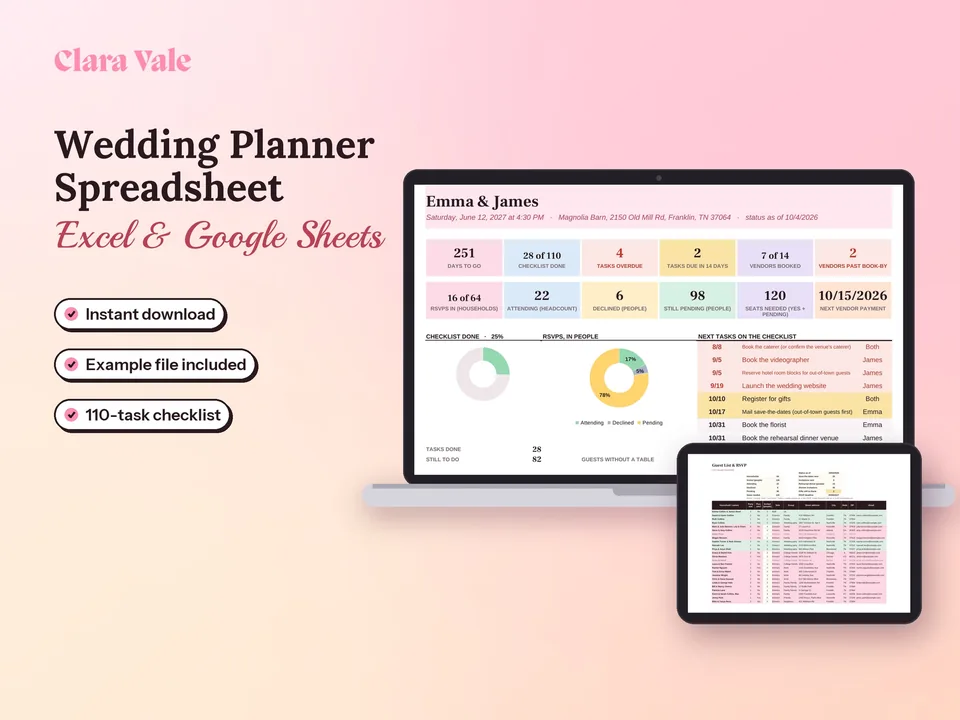
A wedding planning checklist only works if every task has a date next to it, and those dates move whenever your wedding date does. Pick one tracker for your wedding to-do list, give your partner access, and tick tasks off as you go. Our wedding planner spreadsheet has this checklist built in, with each due date calculated from your wedding date, so if the date changes, the whole timeline shifts with it.
Questions people ask
How long does it realistically take to plan a wedding?
Twelve to fifteen months is comfortable for a traditional wedding with a venue, caterer, photographer and printed invitations, because popular venues and vendors book that far out. Six months is tight but workable if you're flexible on the date or day of the week. A small courthouse wedding with a dinner afterward can come together in a few weeks, mostly limited by your state's marriage license rules.
What are the most forgotten wedding tasks?
The ones that sit between vendors: getting the marriage license in time, weighing a finished invitation before buying stamps, assigning someone to collect gifts and rentals at the end of the night, packing an emergency kit, writing vendor tips into envelopes ahead of time, and planning meals for the wedding party. After the wedding, people forget the name change paperwork and returning rented items on time.
What is the 50/20/30 rule for weddings?
It isn't a fixed industry rule, and different sources use it differently. Most borrow the 50/30/20 personal budget idea: needs first, wants second, savings third. The useful part for a wedding is the order. Fund the essentials that make the day happen (venue, food, officiant, license) before the nice-to-haves, and keep part of the total in reserve for overages and last-minute costs.
Is $5000 a good budget for a wedding?
It can be, if the guest list is small. The Knot's 2026 Real Weddings Study put the average at $292 per guest, so $5,000 at that rate covers about 17 guests. With a free or low-cost venue, a casual meal and a friend as photographer, $5,000 can stretch to 30 to 50 people. Set the guest count first, then divide the budget by it.
Is $1000 enough for a wedding?
Yes, for a courthouse or very small ceremony. $1,000 can cover the marriage license fee, a simple outfit, flowers from a grocery store or market, and a dinner for close family at a restaurant. It won't stretch to a rented venue, catering and a professional photographer. Write down your must-haves first and check what your county charges for the license before you plan anything else.
What is the groom's mom responsible for?
Traditionally, the groom's family hosts the rehearsal dinner, and his mother sends her side's guest list to the couple by the deadline they set. She often coordinates her outfit with the bride's mother, helps greet guests, and may join the receiving line or a parent dance. Many families split costs differently today, so it's worth agreeing on who pays for what early.
What are the four things a bride needs on her wedding day?
The four come from the old rhyme: something old, something new, something borrowed and something blue. Something old is often a family piece like jewelry or a handkerchief. Something new can be the dress or shoes. Something borrowed usually comes from a happily married friend or relative, and something blue is often hidden, like a garter or a stitch inside the hem.