
Extra income has to fit around something: a day job, school pickup, caring for a parent, or a retirement you’d like to keep relaxed. The side hustles for women that work best in that gap are the ones built on skills you already have, cost little to start, and can be priced with simple math before you take your first customer.
The best side hustles for women are low-cost service and maker businesses: bookkeeping, virtual assistance, proofreading, tutoring, pet sitting, handmade goods, reselling, home baking, consulting, digital templates, alterations, and companion care. Most need little more than a computer or your kitchen. Price each one from your monthly goal and your real hours.
This post is educational and is not financial or tax advice. Pay figures and fees are as of October 2026.
12 side hustles for women at a glance
A side hustle here means paid work you run on your own schedule alongside a job, caregiving, or retirement. Startup cost is rated by what you’d typically need to buy if you already own a phone and a computer.
| Side hustle | Startup cost | How to price it | Best for |
|---|---|---|---|
| Bookkeeping | Low (software, maybe a course) | Monthly flat fee | Former office and accounting staff |
| Virtual assistant | Near $0 | Hourly, then packages | Admins and natural organizers |
| Proofreading | Near $0 | Per word or per page | Teachers, writers, legal staff |
| Tutoring | Near $0 | Per session or package | Teachers and parents |
| Pet sitting | Near $0 | Per visit, walk, or night | Active animal lovers |
| Handmade goods | Moderate (materials) | Materials + time + overhead + profit | Crafters |
| Reselling | Moderate (inventory) | Sold comps minus fees | Thrift and estate-sale fans |
| Home baking | Low to moderate | Ingredients + time + packaging | The friend who brings dessert |
| Consulting | Near $0 | Per project | Deep career experience |
| Digital templates | Near $0 | Value to the buyer | Spreadsheet and planner people |
| Sewing and alterations | Low (machine, notions) | Fixed price list | Experienced sewists |
| Companion and errand help | Near $0 | Hourly with a minimum | Warm, reliable helpers |
For side hustles for women juggling other commitments, the column that matters most is the last one. If people already ask you to fix their spreadsheet, check their resume, or bake for a party, that’s your shortlist.
1. Bookkeeping for small businesses
What it is: One of the steadier side hustles for women with office experience: keeping income and expense records current for local shops, contractors, and solo business owners.
Startup cost: Low. You need a computer, comfort with numbers, and familiarity with common bookkeeping software. A short refresher course helps if you’re rusty.
How to price it: Many bookkeepers charge a monthly flat fee tied to how many transactions a client has. For a reference point, the US Bureau of Labor Statistics puts median pay for bookkeeping, accounting, and auditing clerks at $24.36 an hour ($50,670 a year) in May 2025.
That BLS figure is employee pay. An employer covers half of Social Security and Medicare and supplies the software. A freelance bookkeeper pays all of that herself, which is why freelance rates usually sit above the employee median.
Who it suits: Former office managers, accounting staff, and anyone who likes things tidy.
2. Virtual assistant
What it is: Handling email, scheduling, customer messages, travel booking, or simple social posts for busy professionals.
Startup cost: Near $0. A reliable computer, good internet, and a short written list of the services you offer.
How to price it: Start hourly while you learn how long tasks take, then move regular clients to monthly packages. To find a floor, plug your goal into our freelance rate calculator. It asks for billable hours separately from total hours, because email, invoicing, and finding clients are unpaid time.
Who it suits: Former executive assistants, admins, and people who already run the family calendar.
3. Proofreading and editing
What it is: Catching errors or improving clarity for business owners, students, authors, and bloggers.
Startup cost: Near $0. A sharp eye, a style guide you trust, and two or three sample edits to show.
How to price it: Per word or per page is easy for clients to understand. Time yourself on a sample to see how many words you handle in an hour, then work backward from your hourly goal.
Who it suits: Former teachers, writers, legal staff, and anyone who spots typos on restaurant menus.
4. Tutoring
What it is: Helping students with reading, math, test prep, or a subject you know well, in person or over video.
Startup cost: Near $0. Subject knowledge, patience, and a quiet corner for calls.
How to price it: Per session, with a small discount when a family books a package. Packages also smooth out your monthly income.
Who it suits: Retired teachers, moms who survived years of homework, and anyone with a strong subject background.
5. Pet sitting and dog walking
What it is: Caring for pets while owners work or travel.
Startup cost: Near $0. Reliable transportation and a way to find clients. Apps make that easier, but they take a service fee from each booking, so read the current fee page before you set rates.
How to price it: Per visit, per walk, or per night, with the app fee built in. The BLS reports median pay of $17.08 an hour for animal care and service workers in May 2025, and says 25% of animal caretakers are self-employed.
Who it suits: Active women who like being out and about.
6. Handmade goods
What it is: One of the classic side hustles for women who make things: selling quilts, jewelry, knitwear, candles, or home decor at craft fairs, on Etsy, or through local shops.
Startup cost: Moderate. Materials are the real expense, plus decent photos. Etsy also charges a listing fee and takes a cut of each sale.
How to price it: Add materials, your time at a real hourly wage, overhead, and profit. Our handmade pricing calculator does this and also shows a “lowest safe price” that covers costs and selling fees with zero profit. Anything below that line loses money on every sale.
Who it suits: Crafters who keep hearing “you should sell these.”
7. Reselling
What it is: Buying at thrift stores, estate sales, or yard sales and selling online for more.
Startup cost: Moderate. A small inventory budget, storage space, and time to photograph and list.
How to price it: Look up sold listings, not active ones, for the same item. Then subtract platform fees and postage. The reseller profit calculator shows your profit on eBay, Poshmark, Mercari, Depop, and Whatnot side by side from one sale price.
Who it suits: Bargain hunters who already know which vintage brands are worth picking up.
8. Home baking
What it is: Custom cakes, cookies, breads, and holiday treats for neighbors, parties, and events.
Startup cost: Low to moderate. You likely own the kitchen, but check your state’s cottage food rules first. They cover what you can sell from a home kitchen and vary a lot by state, so ask your state or local health department.
How to price it: Ingredients, box and board, your hours, and overhead, then a markup. The cake pricing calculator also gives a price per serving, which makes quotes easier to explain to customers.
Who it suits: The friend everyone asks to bring dessert.
9. Consulting from your past career
What it is: Selling know-how you built over years, like HR, nursing education, marketing, operations, or sales, to small businesses or individuals.
Startup cost: Near $0. What you need is a specific offer. “I help small dental offices set up new-hire training” sells faster than “consulting.”
How to price it: Per project usually beats hourly here, because clients see the result they’re buying instead of a clock.
Who it suits: Women with deep experience in one field who want flexible, part-time work.
10. Digital templates and printables
What it is: The closest thing to passive income among side hustles for women: planners, budget spreadsheets, checklists, and Google Sheets templates you make once and sell many times.
Startup cost: Near $0. A computer, a design or spreadsheet tool, and a clear problem your template solves.
How to price it: Price for the value to the buyer, not the hours you spent, and check similar listings. Remember that marketplace fees come out of every sale.
Who it suits: Organized women who already build their own spreadsheets and planners.
11. Sewing and alterations
What it is: Hems, taking in dresses, replacing zippers, and small repairs.
Startup cost: Low. A sewing machine you may already own, basic notions, and word of mouth.
How to price it: A fixed price list per job (hem, zipper, button) so customers know what to expect before they hand anything over.
Who it suits: Experienced sewists who enjoy steady, local work.
12. Companion and errand help
What it is: Helping older adults or busy families with errands, appointments, meal prep, or company.
Startup cost: Near $0. Reliability, a clean driving record if you drive, and patience. Some families ask for a background check.
How to price it: Hourly, with a minimum number of hours per visit so short trips still pay.
Who it suits: Warm, dependable women who like helping people directly.
Side hustles for moms: what fits around kids
The best side hustles for moms are the ones that don’t need you at a fixed time. Proofreading, bookkeeping, digital templates, and baking to order can all be done in school hours, during naps, or after bedtime. Tutoring and pet sitting work too, but they’re tied to other people’s schedules, which can collide with yours.
Be honest about hours, because side hustles for moms live or die on them. A week with a sick kid will happen. When you set a rate, use the hours you can count on in a normal week, not your best week, and build in weeks off. That’s why our rate calculator has a “weeks off per year” field: fewer working weeks means each paid hour has to carry more.
Side hustles for women over 50
Side hustles for women over 50 often have the biggest head start, because a long career is a product. Consulting, bookkeeping, tutoring, and proofreading turn decades of experience into an offer that clients trust quickly. Sewing, baking, and handmade goods reward skills many younger sellers are still learning.
When choosing between side hustles for women over 50, the main thing to weigh is energy and body, not age. Choose sitting-down work if that suits you, or pet sitting and errand help if you’d rather be moving. Then price it like a professional. Experience is the reason clients will pay more, so don’t start at a beginner’s rate.
Side hustles for retirees: check these first
Side hustles for retirees come with two money questions that working women don’t face.
First, Social Security. If you claim benefits before your full retirement age and keep working, the Social Security Administration may hold back part of your benefit once your earnings pass an annual limit. Check the current limit with SSA before you take on regular work.
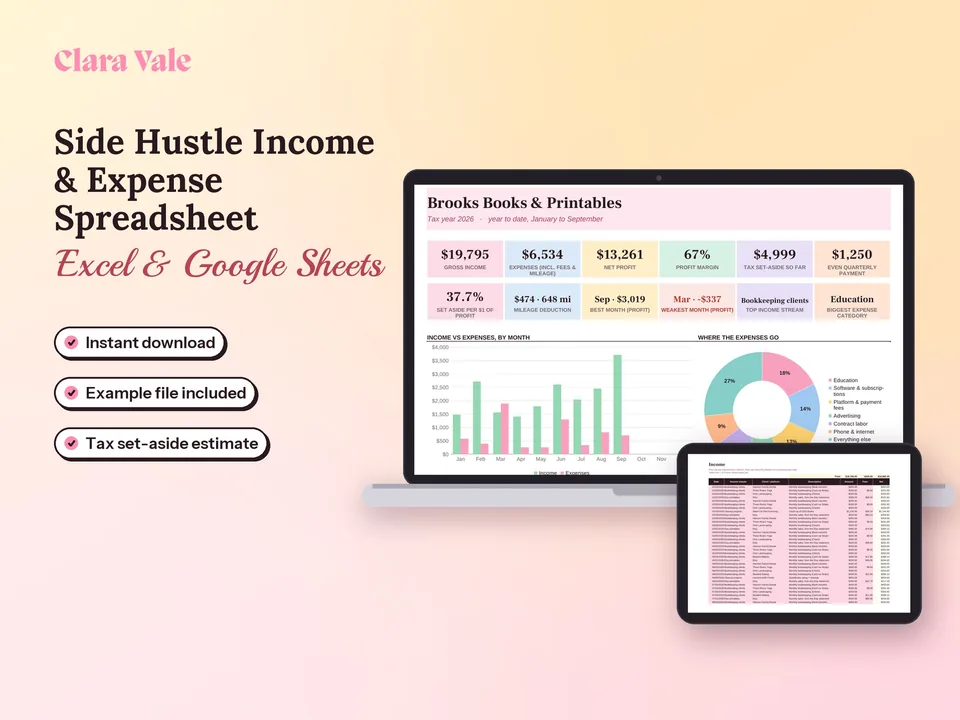
Second, self-employment tax. The IRS says self-employment tax is 15.3% (12.4% Social Security plus 2.9% Medicare), and it applies once your net earnings from self-employment reach $400 or more. Being retired doesn’t switch that off. That’s true for all side hustles for retirees, from tutoring to pet sitting. Set money aside from every payment, and keep a record of income and expenses from the first job.
How many hours does $500 or $1,000 a month take?
This is the question behind most side hustles for women, and it’s arithmetic, not luck. We ran three goals through our Freelance Rate Calculator with the same assumptions: $1,200 a year in business costs, a 25% tax set-aside, and six weeks off. The table shows the minimum hourly rate needed for each monthly take-home goal.
| Monthly take-home goal | 5 paid hrs/week | 10 paid hrs/week | 20 paid hrs/week |
|---|---|---|---|
| $500 | $40.00 | $20.00 | $10.00 |
| $1,000 | $74.78 | $37.39 | $18.70 |
| $2,000 | $144.35 | $72.17 | $36.09 |
The math works like this. Take-home goal divided by (1 minus the tax set-aside) gives the profit you need, and adding costs gives revenue. Divide revenue by billable hours (46 working weeks times weekly hours) and you get the rate. For $1,000 a month at 10 hours: $12,000 ÷ 0.75 = $16,000, plus $1,200 = $17,200, divided by 460 hours = $37.39.
Read the table across, not down. If your idea can’t charge the rate in your column, you need more hours, a higher-value service, or a smaller goal. That’s a far better thing to learn from a spreadsheet than from three months of underpaid work.
Start with one offer and a real price
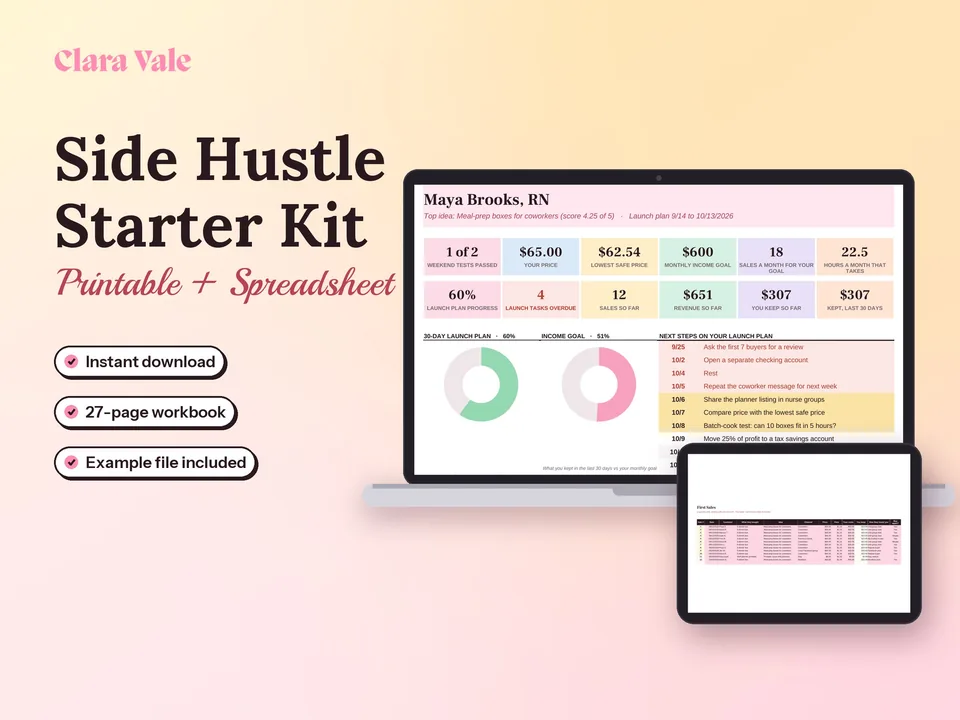
The best side hustles for women start small. Pick one idea from the list, offer it to a few people you know, and learn from your first handful of customers. Keep it small until the price and the hours both feel sustainable. Our Side Hustle Planner & Business Idea Workbook walks you through scoring your ideas, running a weekend test, setting a price, and planning your first 30 days.
Questions people ask
How can I make $500 a month on the side?
Pick one service you can sell this week, like proofreading, pet sitting, or virtual assistance, and set an hourly rate that covers taxes and costs. In our Freelance Rate Calculator, a $500 monthly take-home goal with $1,200 a year in costs, a 25% tax set-aside, six weeks off, and 10 paid hours a week works out to a minimum rate of $20 an hour.
How to make an extra $1000 a month from home?
Choose home-based work that bills by the hour or the project, such as bookkeeping, virtual assistance, online tutoring, or consulting. Using the same assumptions as our worked example, $1,000 a month take-home needs about $37 an hour at 10 paid hours a week, or about $19 an hour at 20 paid hours. Decide your hours first, then the rate follows.
How can I make an extra $2000 a month?
At $2,000 a month take-home, hours matter more than the idea. With $1,200 a year in costs, a 25% tax set-aside, and six weeks off, you'd need about $72 an hour at 10 paid hours a week, or about $36 an hour at 20. That points to skilled work like bookkeeping or consulting rather than low-rate gig work.
What is the best paying lazy job?
No side hustle pays well for no effort. The closest thing is a digital product, like a spreadsheet template or printable planner, because you do the work once and can sell it many times. The effort just moves to the front: building, testing, listing, and marketing it before the first sale arrives.
How can I make $1000 a month as a stay at home mom?
Look for work that fits around school hours or nap times and doesn't need you on the phone at fixed times: proofreading, bookkeeping, digital templates, or baking to order. Work out how many hours you truly have each week, then price so that those hours cover $1,000 after costs and a tax set-aside.
How to start over in life at 50 with no money?
Start with a service that needs only what you already own, usually a phone and a computer. Consulting in your old field, bookkeeping, proofreading, tutoring, and errand help cost close to nothing to begin. Offer it to people you know first, keep every receipt, and use the first few paid jobs to set a fair price.