
Depop vs Poshmark comes down to two things: what’s in your closet and how much of each sale you want to keep. Both are US resale apps for clothing, shoes and accessories, both let buyers make offers, and both take a cut. But the cut is very different. Depop charges US sellers no selling fee at all, while Poshmark takes 20% of most sales. The buyers are different too. Below, we put the fees side by side, run the math on a $12, $30 and $80 item, and walk through shipping, listing and payouts so you can pick the right app for your inventory.
Quick answer: For most US sellers, Depop is cheaper. It charges only payment processing, 3.3% + $0.45 on the item, shipping and tax. Poshmark charges $2.95 under $15 and 20% at $15 and up, but the buyer pays for a prepaid label. Pick Depop for vintage, Y2K and streetwear; pick Poshmark for mall brands and hands-off shipping.
Fees and policies are for US sellers and current as of October 4, 2026. Both apps can change them, so check the official pages linked below before you price.
Depop vs Poshmark: which should you sell on?
If you only remember one line, make it this one: Depop keeps fees low and rewards style, while Poshmark charges more and does more of the work for you. Here’s the comparison at a glance.
| Depop | Poshmark | |
|---|---|---|
| Selling fee (US) | 0% | $2.95 under $15; 20% at $15+ |
| Payment processing | 3.3% + $0.45 on item + shipping + tax | Included in the fee above |
| Optional promotion fee | 12% of item price on Boosted sales | None in the standard fee policy |
| Shipping | Depop USPS label or your own carrier | Prepaid USPS label, buyer pays |
| Listing fee | Free | Free |
| Best fit | Vintage, Y2K, streetwear, one-of-a-kind pieces | Mall brands, workwear, athleisure, everyday basics |
The rest of this post explains where each row comes from and when the cheaper app isn’t the better one.
Who each app is for: buyers, styles and what sells
The apps attract different shoppers, and that matters more than a few dollars in fees. A $30 jacket that sits for three months earns nothing on either platform.
Depop leans younger and trend-led. Its feed is built around shops with a look: vintage denim, Y2K tops, band tees, streetwear, upcycled pieces, and anything that photographs well on a person. Buyers browse by style as much as by brand, so presentation counts. Styled photos, a consistent shop aesthetic and a clear era or vibe in the title tend to move items faster than a plain flat lay.
Poshmark leans toward brand-name shoppers. People come looking for specific labels and sizes, often contemporary mall brands, workwear, athleisure and everyday basics. According to Poshmark’s legal center and fee policy, the marketplace takes new and pre-owned fashion plus select home goods, pet items and electronics. A buyer who wants “Lululemon leggings, size 6” is more likely to find you there than on Depop.
When we compare what typically sells on each app, the pattern is simple:
- Sell on Depop if your inventory has a story: thrifted vintage, niche brands, statement pieces, or items you can style into a look.
- Sell on Poshmark if your inventory is recognizable by brand name: mall labels, designer basics, kids’ clothes in bundles, and workwear.
- Cross-list if you have both. Many resellers list the same item on both apps and delete the second listing once it sells.
Depop vs Poshmark fees, side by side
This is where the two apps split the most. Here are the official US fee rules.
Depop fees. Per Depop’s seller fees page, US sellers pay a 0% selling fee. Each sale carries a payment processing fee of 3.3% + $0.45, charged on the full amount the buyer pays: item price, shipping and sales tax. If you use Boosted listings, Depop charges 12% of the item price (tax excluded), but only on a sale that’s attributed to the boost.
How does that attribution work? Depop’s developer documentation explains that a boosted item gets an extra placement in search results and “Suggested for you,” and the fee applies only when a buyer interacted with the boosted placement and bought within 28 days. A buyer who finds your item organically triggers no boost fee.
Poshmark fees. Poshmark’s fee policy is simpler. Listing is free. After a sale, Poshmark deducts a flat $2.95 for sales under $15, and 20% for sales of $15 and above, so you keep 80%. The fee comes off the final order price. Shipping isn’t part of your fee math because the buyer pays for the label. To check a Poshmark price before you list, try our Poshmark fee calculator.
As of October 2026, Depop charges US sellers no selling fee and a payment processing fee of 3.3% plus $0.45 on the item, shipping and tax, plus 12% on Boosted sales. Poshmark charges a flat $2.95 on sales under $15 and 20% of the final order price at $15 and above, with the buyer paying the shipping label.
Why is Depop’s fee so much lower? The two apps charge for different things. Depop’s 3.3% + $0.45 is close to a card processing rate, so it mostly covers the cost of moving money. Poshmark’s 20% is a marketplace commission that also pays for the prepaid shipping program, external ads that send traffic to listings, and customer support. You’re buying convenience and reach with those roughly 16 extra percentage points.
Depop vs Poshmark: what you keep at $12, $30 and $80
Percentages are hard to feel, so we ran three common price points through the same formulas our calculators use. Assumptions: the buyer pays $6.00 shipping on Depop (and the label costs the same $6.00, so shipping is a wash), sales tax is 7% on the item plus shipping, and Poshmark’s buyer pays its own label. Item cost and packaging aren’t included.
| Item price | Depop fee | You keep on Depop | Depop, Boosted sale | Poshmark fee | You keep on Poshmark |
|---|---|---|---|---|---|
| $12 | $1.09 | $10.91 | $9.47 | $2.95 | $9.05 |
| $30 | $1.72 | $28.28 | $24.68 | $6.00 | $24.00 |
| $80 | $3.49 | $76.51 | $66.91 | $16.00 | $64.00 |
Here’s the Depop math for the $30 item, step by step:
- The buyer pays $30 + $6 shipping = $36, plus 7% tax = $38.52.
- Processing is 3.3% of $38.52 = $1.27, plus $0.45 = $1.72.
- You keep $30 − $1.72 = $28.28. The $6 shipping covers the label.
- If the sale came through a Boosted listing, add 12% of $30 = $3.60. Total fees $5.32, and you keep $24.68.
On Poshmark, the same $30 sale costs 20% of $30 = $6.00, so you keep $24.00. At $12, the flat $2.95 applies because the sale is under $15.
Three things stand out. First, Depop’s processing fee grows with shipping and tax, so the “3.3%” you see quoted is really 3.3% of a bigger number. Second, Boosted sales close most of the gap at low prices: at $12, a Boosted Depop sale still leaves you $9.47 against Poshmark’s $9.05. Third, the gap widens fast as prices rise. On an $80 item, Poshmark takes $12.51 more than a non-boosted Depop sale.
Want to plug in your own numbers? Our reseller profit calculator puts Depop, Poshmark, eBay and Mercari side by side for the same item, including what you paid for it.
Depop vs Poshmark shipping: a prepaid label or two options
Poshmark shipping is the most hands-off. The buyer pays for shipping, and Poshmark emails you a prepaid USPS label. Under its shipping policy, one label covers a shipment up to 5 lbs, including the box. Heavier orders need an upgraded label, which the seller buys, up to a 15 lb maximum per order. You can also skip the printer and use a shipping QR code at any USPS location.
The 5 lb limit matters for boots, coats and big bundles. Weigh before you list, or that “free for you” shipping turns into an upgrade fee.
Depop shipping gives you a choice. Depop’s Selling API guide to managing shipping describes the same two methods sellers pick between when listing:
- Depop managed shipping (USPS in the US). You pick a parcel size, Depop calculates the shipping cost, and you print a label from Depop. The listing has a payer setting, so the buyer can cover the shipping.
- Your own shipping. You set a flat shipping price, choose your carrier, print your own label and add tracking to the order. Set shipping to $0 and you’re offering free shipping, which means the label comes out of your sale.
The trade-off is control versus effort. Depop lets you hunt for cheaper postage or offer free shipping to win a sale. Poshmark removes the decision entirely, but you can’t undercut its flat buyer-paid rate. Either way, remember that Depop’s processing fee also applies to whatever the buyer pays for shipping.
Listing and selling: what the day-to-day feels like
Both apps are phone-first. You snap photos, write a title and description, set a price, and accept or counter offers. The rhythm after that is different.
Poshmark is built around community activity. Its seller policy lists Reposh and copy-listing tools for one-click listing, Posh Shows for selling by livestream, pricing tools for offers, My Closet Insights and Bulk Actions for managing a large closet, and My Shoppers for following up with interested buyers. Sharing your listings and sending offers to likers is part of the routine, which can eat time but also creates sales.
Depop is closer to running a small style-led shop. Photos and shop aesthetic carry more weight, and buyers can message you with questions before they commit. The main paid lever is Boosted listings, either on single items or across the whole shop. Since you only pay when a boosted placement leads to a sale, boosting is low-risk, but that 12% does add up on higher-priced items.
The real difference is where your time goes. Poshmark tends to reward daily sharing; Depop tends to reward better photos. Choose the kind of effort you’d rather spend.
Depop vs Poshmark payouts: getting paid
Poshmark. Under its terms, your earnings are credited once the buyer confirms the item is OK, or automatically three days after delivery if the buyer doesn’t flag a problem. From there, Poshmark’s seller policy lists payout options including direct deposit, ACH, Instant Transfer, PayPal and Venmo. You can also spend your balance on other Poshmark listings.
Depop. Depop processes payments itself, which is what the 3.3% + $0.45 fee pays for. Sales land in your Depop balance, and you withdraw to a linked bank account. Depop’s help center has the current US release timing, so check it before you count on cash for a specific date.
On both apps, money from a sale isn’t instant. Build a buffer of a week or two into your cash flow if you’re reselling as a side hustle.
Where Mercari fits
Mercari comes up in almost every Depop vs Poshmark debate, so here’s the short version. Per Mercari’s help center (mercari.com/us/help_center/article/169), US sellers pay a 10% selling fee on the item price, buyers pay shipping, and there’s no payment processing fee on listings updated since January 6, 2025. That puts Mercari between the two: more than Depop’s processing-only model, far less than Poshmark’s 20%. It’s a general marketplace, so it suits non-clothing items both apps handle poorly.
Verdict: Depop or Poshmark for your situation
There’s no single winner in the Depop vs Poshmark question. Match the app to what you sell:
- You sell vintage, Y2K, streetwear or upcycled pieces: Depop. The buyers are there and the fees are low.
- You sell mall brands, workwear or athleisure by brand name: Poshmark. Its shoppers look for labels and sizes, and the higher fee buys you traffic.
- Most of your items are under $15: Depop. Poshmark’s flat $2.95 is about 25% of a $12 sale and 30% of a $10 one, and even a Boosted $12 Depop sale keeps more.
- You price items at $50 and up: Depop wins on fees by a wide margin. On an $80 item, a regular Depop sale keeps about $12.51 more than Poshmark.
- You hate dealing with postage: Poshmark. The buyer-paid prepaid label is as simple as reselling gets.
- You ship heavy items like boots or coats: Depop’s own-shipping option, or price in Poshmark’s label upgrade.
- You have a mixed closet: list on both and track what sells where.
To check a single Depop sale before listing, including a Boosted one, use our Depop fee calculator.
The bottom line
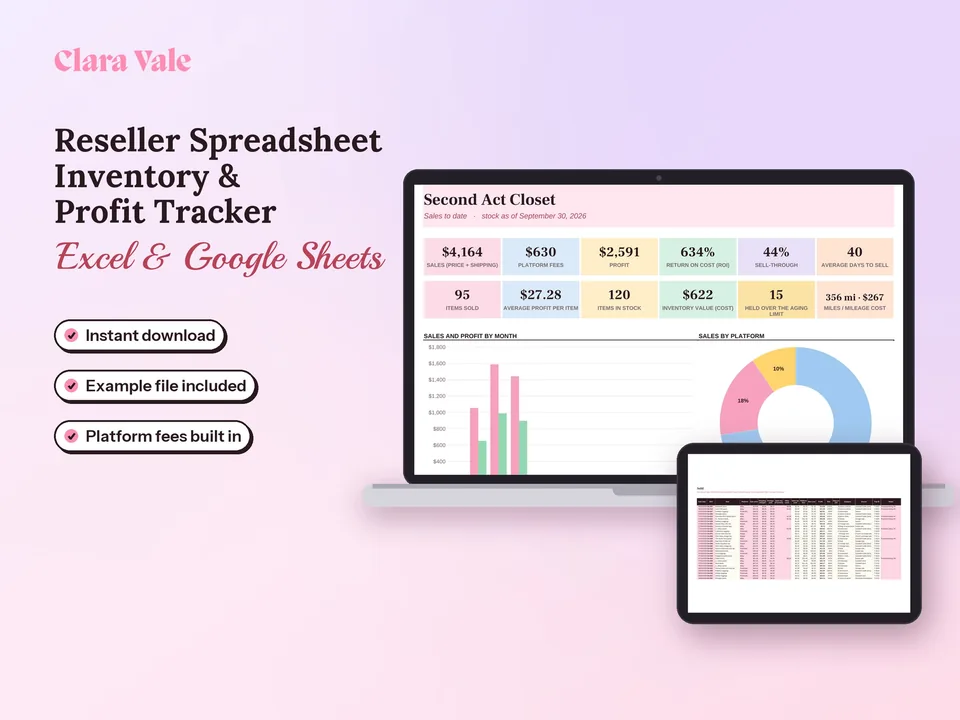
In the Depop vs Poshmark matchup, Depop is the cheaper app for US sellers, with no selling fee and only 3.3% + $0.45 processing on the full order. Poshmark costs more at 20% for sales of $15 and up, but it brings brand-focused buyers and fully buyer-paid shipping. The right choice is the one where your items actually sell. If you cross-list, our Reseller Spreadsheet logs each item’s cost, platform, fees and profit so you can see which app pays you more over time.
Questions people ask
Why is Depop better than Poshmark?
For most US sellers, Depop is cheaper. There's no selling fee, only payment processing of 3.3% + $0.45 on the item, shipping and tax. On a $30 item that's about $1.44 to $1.72, while Poshmark takes $6.00. Depop also suits vintage, Y2K and streetwear. Poshmark can still win for mall brands and sellers who want shipping fully handled.
What is the downside to Depop?
Depop's processing fee is charged on shipping and sales tax, not just the item, and a sale that comes through a Boosted listing adds 12% of the item price. If you offer free shipping, the label comes out of your earnings. And the buyer base leans toward trend-led and vintage pieces, so plain basics can sit.
How much does Depop take from $30?
On a $30 item with no shipping or tax, Depop's processing fee is 3.3% of $30 plus $0.45, or $1.44, so you keep $28.56. With $6 buyer-paid shipping and 7% sales tax, the fee rises to $1.72. If the sale came through a Boosted listing, add $3.60 (12% of $30).
How much does Depop take from a $100 sale?
On a $100 item alone, Depop takes $3.75 in payment processing (3.3% of $100 plus $0.45). With $6 shipping and 7% tax in the order, it's about $4.19, because processing covers the whole amount the buyer pays. A Boosted sale adds $12, for roughly $16 in total. Poshmark would take $20.
How much does Poshmark take from a $100 sale?
Poshmark takes $20 from a $100 sale, so you keep $80. Its fee is 20% for any sale of $15 or more, charged on the final order price. The buyer pays for the prepaid shipping label separately, so shipping doesn't come out of your $80.
What is the downside to Poshmark?
The 20% fee on every sale of $15 or more is the big one. On an $80 item you give up $16. The prepaid label also only covers up to 5 lbs, so heavier boxes need a label upgrade that the seller pays for. And your money isn't released until the buyer accepts the order.
Why are Poshmark fees so high?
Poshmark bundles more into its 20% than Depop does into its processing fee. The fee covers the prepaid buyer-paid shipping label program, external advertising on sites like Google and Facebook, livestream selling through Posh Shows and customer support. You pay for that convenience on every sale of $15 or more.
How much does Depop charge you to sell an item?
US sellers pay no Depop selling fee. The only standard charge is payment processing of 3.3% + $0.45 on the item price, shipping and tax. A 12% Boosted listing fee applies only when you've chosen to boost and the buyer interacted with that boosted placement before buying.