
You’ve finished a batch of candles or a tray of earrings, and now you need a number for the tag. Most makers start by copying a price they saw in another shop, which quietly leaves their time unpaid. Learning how to price handmade items with one repeatable formula fixes that, and you only have to set it up once per product.
To price handmade items, add your materials, your labor (hours × an hourly wage) and a per-item share of overhead to get your cost to make. Add a profit markup for your wholesale price, multiply that by 2 for retail, then check the price still clears selling fees and fits your market.
This post is educational and is not financial or tax advice. Fees are US Etsy fees as of October 2026.
How to price handmade items: the formula in one line
Here’s the whole craft pricing formula before we break it into steps. It’s the same for candles, soap, jewelry, woodwork or sewing, so it also answers how to price crafts of any kind:
Materials + Labor + Overhead = Cost to make
Cost to make × (1 + markup) = Wholesale price
Wholesale price × 2 = Retail price
Then you run one check: the retail price must stay above your lowest safe price, which is the price that covers your cost to make plus selling fees, with zero profit.
| Step | What you work out | Candle example |
|---|---|---|
| 1 | Materials per item | $5.45 |
| 2 | Labor per item | $3.33 |
| 3 | Overhead per item | $0.75 |
| 4 | Cost to make | $9.53 |
| 5 | Wholesale (100% markup) | $19.06 |
| 6 | Retail (wholesale × 2) | $38 |
| 7 | Lowest safe price on Etsy | $11.03 |
Each step below explains where the number comes from. If you’d rather not do the arithmetic by hand, our free Handmade Pricing Calculator is a handmade pricing calculator built on this same formula.
Step 1: Add up materials for one item
Count every supply that goes into a single finished piece, not just the main ones. For a candle that’s wax, wick, fragrance, jar, label and the box it ships in. For earrings it’s ear wires, beads, jump rings, the backing card and the bag.
If you buy in bulk, divide. A $19.20 bag of wax that makes 12 candles is $1.60 of wax per candle. Small things like glue, thread and tape are easy to miss, so either estimate them per item or move them into overhead in Step 3. Just don’t count them twice.
Step 2: Pay yourself for labor
Labor is the line makers skip most often when they price handmade items, and it’s the one that matters most. Pick an hourly wage you’d accept from an employer for the same work, then use it every time so your prices stay consistent.
Time a whole batch, not one piece, and divide. If 12 candles take 2 hours at $20 an hour, that’s $40 ÷ 12 = $3.33 of labor per candle. Include the time you spend cleaning up, photographing and packing if it happens for every batch.
Why include a wage when you’re the owner? Because without it the price can’t survive change. If you ever hire help, sell wholesale or take a month off, a price that never paid for time starts losing money the moment someone else has to do the work.
Step 3: Add a share of overhead
Overhead is everything you pay for that isn’t tied to one item: tools, molds, software or shop subscriptions, booth fees, packaging supplies and a slice of your electricity.
Add up a normal month of overhead, then divide by how many items you usually sell in a month. $30 of monthly overhead across 40 candles is $0.75 per candle. If your sales double, this number drops, which is one reason pricing gets easier as a shop grows.
Step 4: Total your cost to make
Add the first three steps together:
$5.45 materials + $3.33 labor + $0.75 overhead = $9.53 cost to make
This number is your floor before fees. Selling at it means you’ve paid for supplies and paid yourself a wage, but the business itself has earned nothing. Everything from here is about adding profit and protecting it.
Step 5: Add a markup to set your wholesale price
Your markup is the profit the business keeps on top of your wage. It pays for new tools, test batches and slow months. Wholesale is the price a store pays you.
Wholesale = Cost to make × (1 + markup)
The classic rule of thumb is to double your cost, which is a 100% markup: $9.53 × 2 = $19.06. That works well for low-labor items like candles, soap and simple jewelry. For pieces where labor is a big share of the cost, a smaller markup such as 20% to 50% often lands closer to what buyers will pay, because your wage is already covered. Our calculator starts at 20%, and you can change it. If you want to compare markup and margin on the same price, the Profit Margin Calculator shows both.
Step 6: Multiply for your retail price
Retail = Wholesale × 2
For the candle, $19.06 × 2 = $38.12, which we’d round to $38.
The second doubling exists because shops have their own rent, staff and card fees. A store that buys your candle at $19 needs to sell it near $38 to make that work. If you sell the same candle on your own site for $25, you undercut every shop that stocks you, and wholesale stops making sense for them.
If you’ll only ever sell direct, some makers use a lower multiplier. That’s fine, as long as the result stays above the lowest safe price in Step 7.
Step 7: Check the price against selling fees and the market
Selling platforms take a cut, so check what you actually keep. For US Etsy sellers, the main fees are:
| Etsy fee | Amount | Charged on |
|---|---|---|
| Listing fee | $0.20 | Each listing, which lasts 4 months |
| Transaction fee | 6.5% | Item price plus shipping and gift wrap (not sales tax) |
| Payment processing | 3% + $0.25 | Order total, including sales tax |
| Offsite Ads (only on ad-driven sales) | 15%, or 12% for larger shops, capped at $100 | The order |
On Etsy in the US, every sale costs a 6.5% transaction fee on the item price plus shipping and gift wrap, a payment processing fee of 3% plus $0.25 on the order total including sales tax, and a $0.20 listing fee. That means a handmade price needs about 9.5% plus $0.45 of headroom on every order.
Use that headroom to find your lowest safe price:
Lowest safe price = (Cost to make + fixed fees) ÷ (1 − percentage fees)
For the candle: ($9.53 + $0.45) ÷ (1 − 0.095) = $9.98 ÷ 0.905 = $11.03. Below that, Etsy fees start eating into your wage. Sales that arrive through Etsy Offsite Ads cost more: 15% of the order for shops that haven’t reached $10,000 in sales over 12 months, or 12% for shops that have, capped at $100 per order.
Our Etsy fees guide walks through every fee in detail.
Then check the market, because pricing handmade items is part math and part comparison. Look at 10 comparable listings, same size, materials and quality. If your price sits well above them, find out why before you cut. Better photos, a clear materials list or a smaller version at a lower price point usually work better than lowering your wage.
Worked example: how to price a handmade candle
Here are the full numbers for an 8 oz soy candle made in batches of 12.
| Materials per candle | Cost |
|---|---|
| Wax | $1.60 |
| Wick | $0.15 |
| Fragrance oil | $1.20 |
| Jar and lid | $1.75 |
| Label | $0.25 |
| Box and padding | $0.50 |
| Total materials | $5.45 |
- Labor: 2 hours per batch at $20 an hour = $40 ÷ 12 = $3.33
- Overhead: $30 a month ÷ 40 candles = $0.75
- Cost to make: $5.45 + $3.33 + $0.75 = $9.53
- Wholesale (100% markup): $9.53 × 2 = $19.06, round to $19
- Retail: $19.06 × 2 = $38.12, round to $38
What you keep on an Etsy sale. A buyer orders one candle at $38 and pays $6 shipping, so the order is $44.
- Transaction fee: $44 × 6.5% = $2.86
- Payment processing: ($44 × 3%) + $0.25 = $1.32 + $0.25 = $1.57
- Listing fee: $0.20
- Total Etsy fees: $4.63
$44 − $4.63 = $39.37. Take out the $6 shipping label and you have $33.37. Subtract the $9.53 cost to make, and $23.84 is profit, on top of the $3.33 wage already in the cost. If Etsy collects 7% sales tax on that order, processing applies to the $3.08 of tax too, adding about $0.09 in fees. If the sale came through Offsite Ads at 15%, the extra fee would be up to $6.60, leaving about $17.24.
Sold wholesale to a shop at $19.06, the candle has no Etsy fees, and the business keeps $9.53 of profit per candle.
Worked example: how to price handmade earrings
Earrings show what happens when labor is a larger share of the cost. These are made in batches of 6 pairs.
| Materials per pair | Cost |
|---|---|
| Ear wires | $1.80 |
| Beads and charms | $2.40 |
| Jump rings | $0.10 |
| Earring card | $0.15 |
| Gift box | $0.55 |
| Total materials | $5.00 |
- Labor: 2 hours per batch of 6 at $20 an hour = $40 ÷ 6 = $6.67
- Overhead: $34 a month ÷ 40 pairs = $0.85
- Cost to make: $5.00 + $6.67 + $0.85 = $12.52
Doubling would put wholesale at $25.04 and retail near $50, which is high for beaded earrings in most shops. So this maker uses a 40% markup instead:
- Wholesale (40% markup): $12.52 × 1.4 = $17.53
- Retail: $17.53 × 2 = $35.06, round to $35
- Lowest safe price on Etsy: ($12.52 + $0.45) ÷ 0.905 = $14.33
What you keep on an Etsy sale. $35 earrings plus $4.50 shipping is a $39.50 order.
- Transaction fee: $39.50 × 6.5% = $2.57
- Payment processing: ($39.50 × 3%) + $0.25 = $1.19 + $0.25 = $1.44
- Listing fee: $0.20
- Total Etsy fees: $4.21
$39.50 − $4.21 − $4.50 label = $30.79. Subtract the $12.52 cost to make, and $18.27 is profit on top of the $6.67 wage.
When the formula gives a price that feels too high
Sometimes the math produces a number nobody in your niche pays. When pricing handmade items that take many hours, that’s common. A crochet blanket that takes 25 hours at $15 an hour carries $375 of labor before any yarn, so a retail price above $1,000 isn’t a math error.
The mistake we see most often is fixing this by cutting the hourly wage. That hides the problem instead of solving it. Better options:
- Make it faster. A simpler pattern, a bigger hook or a batch process can cut hours without cutting quality.
- Offer a smaller version. A baby blanket, a mini candle or a single stud earring gives buyers a lower price point.
- Skip wholesale for that item. Sell time-heavy pieces direct using cost + markup, and keep wholesale for faster products.
- Change materials. A cheaper jar or base metal can bring the cost down if buyers don’t notice the difference.
What you shouldn’t do is price below your lowest safe price. At that point every sale costs you money.
Keep your handmade prices current
Knowing how to price handmade items once isn’t enough. The formula only works if the numbers behind it stay accurate. Recheck material costs every few months, update overhead when you add a subscription or a craft fair, and raise prices when your costs rise. Pricing handmade items the same way every time also makes it easier to explain your prices to buyers and to shops.
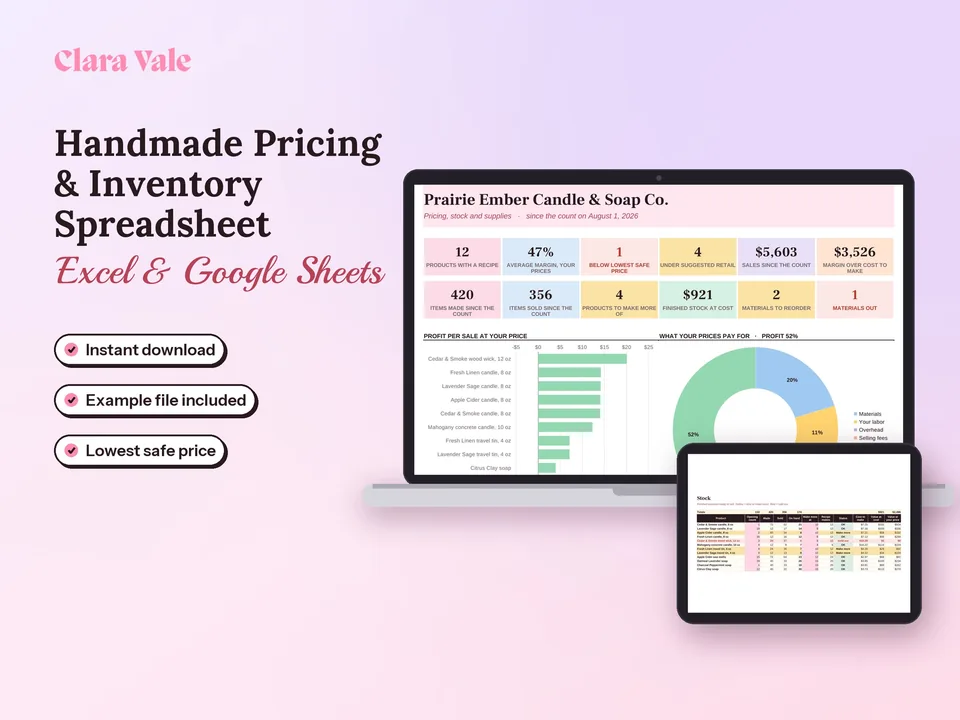
To keep every product’s costs, prices and stock in one place, our Handmade Pricing Calculator & Inventory Tracker runs this formula in Google Sheets for your whole catalog.
Questions people ask
What is the formula for pricing a product?
For handmade work, the formula is materials + labor + overhead = cost to make. Add a profit markup to get your wholesale price, then multiply wholesale by 2 for retail. Before you publish the price, check that it stays above your lowest safe price after selling fees and that it fits what buyers in your market pay.
How to calculate craft price?
Add up the materials in one item, multiply your hours by an hourly wage, and add a per-item share of overhead like tools and packaging. That total is your cost. Add a markup for wholesale, multiply by 2 for retail, and check the result against your platform's fees and comparable listings.
How much should I charge for something I made?
Charge at least enough to cover materials, a fair hourly wage for your time, overhead and selling fees, then add profit on top. For example, a soy candle that costs $9.53 to make works out to about $38 retail using the classic doubling rule. Never price below the point where fees eat your wage.
What is a good profit margin for handmade items?
There's no single standard, because it depends on whether your wage is already in the cost. In our candle example, $23.84 of profit on a $38 sale is about a 63% margin after Etsy fees, on top of the maker's wage. The earrings example lands near 52%. Run your own numbers and keep the margin above zero after every fee.
How do you price items for a craft fair?
Use the same formula, but swap online fees for fair costs. Add your booth fee and travel to overhead, divide by the number of items you expect to sell, and include any card reader fees. Round to easy cash prices like $20 or $35, and keep the same price you charge online so buyers trust it.
What is the most profitable handmade item to sell?
No single item wins for everyone. The most profitable ones combine low material costs, a short make time and a price buyers already accept, so profit per hour is high. Run each product through the formula, divide its profit by the hours it takes, and put more of your time into the items at the top of that list.