
A bank, a landlord or a business partner will ask for it sooner or later: your coffee shop business plan. It’s the document that shows what you’ll sell, who will buy it, where, and whether the numbers add up. Most of it is plain writing. One section, the financial projections, decides whether anyone says yes, so we spend the most time there, with a full worked example.
A coffee shop business plan has nine sections, in this order: executive summary, concept, market and location, menu and pricing, operations and staffing, marketing, management, financial projections and funding request. Each section answers one question a lender asks. The financial projections turn your covers per day and average ticket into break-even and profit.
This post is educational and is not financial, legal or tax advice. All numbers in the examples are assumptions for illustration, not industry benchmarks.
What goes in a coffee shop business plan
The structure below follows the traditional business plan sections that the U.S. Small Business Administration recommends, adapted for a café. A cafe business plan and a coffee shop business plan are the same document. Only the menu mix changes.
| # | Section | The question it answers |
|---|---|---|
| 1 | Executive summary | What is this, and why will it work? |
| 2 | Concept | What kind of coffee shop, for whom? |
| 3 | Market and location | Who is nearby, and who else serves them? |
| 4 | Menu and pricing | What do you sell, at what price and cost? |
| 5 | Operations and staffing | How does a day run, and who works it? |
| 6 | Marketing | How will people find you and come back? |
| 7 | Management | Who runs it, and what have they done before? |
| 8 | Financial projections | How many customers, what profit, when? |
| 9 | Funding request | How much money, for what, on what terms? |
Write section 8 first. Every other section either feeds it (menu, staffing, location) or summarizes it (the executive summary). Writing in reading order is how plans end up promising 400 customers a day in a 20-seat room.
1. Executive summary
The SBA says the executive summary should tell the reader “what your company is and why it will be successful.” Keep it to one page. Cover the concept, location, the team, how much you need and the headline numbers.
Example: “Morning Rows is a 30-seat specialty coffee shop opening on Main Street next to the commuter rail station. We expect 200 customers a day at a $9.00 average ticket. We break even at 153 customers a day. We’re asking for a $175,000 loan, alongside $56,000 of owner equity.”
2. Concept
This is where your coffee shop business plan says what you are and what you’re not. Espresso bar, café with a full kitchen, drive-thru, or bakery-café? Name the hours, the feel of the room and the customer you’re building for.
Example: “A fast-service espresso bar for commuters from 6 a.m. to 9 a.m., with a slower café trade after 10 a.m. Pastries are baked off-site by a local bakery. No hot kitchen.”
3. Market and location
Show who walks past, who lives and works within a few blocks, and who already sells them coffee. List each competitor with their prices and hours. Explain why your spot wins: foot traffic, parking, a morning route, or a gap no one fills.
Example: “The station sits between two office buildings. The nearest competitor is a chain four blocks away. There’s no independent café on the station side of the street, and nothing opens before 7 a.m.”
Count real traffic yourself for this part of the cafe business plan. Stand outside at 7 a.m. on a weekday and count. Your own count beats any general statistic, because it’s about your door.
4. Menu and pricing
List your core menu with a price and an ingredient cost for each item. Show the cost % for drinks and food separately, because they’re very different. A latte is mostly milk and espresso. A sandwich carries bread, fillings and more waste.
The standard pricing method is to divide the ingredient cost by your target cost %. A latte that costs $1.20 in espresso, milk, cup and lid, priced at a 25% drink cost, sells for $1.20 ÷ 0.25 = $4.80. If you mix up markup and margin here, every later number is off, so it’s worth reading our guide to markup vs margin before you set prices.
Example: “Drinks average a 25% cost and make up 75% of sales. Food averages a 35% cost and makes up 25% of sales. Our blended cost of goods is 27.5%.”
5. Operations and staffing
Explain how a day runs: opening, the morning rush, deliveries, cleaning and closing. Then write a staffing schedule by hour, not just a headcount. Labor is one of your biggest costs, and it’s set by the schedule you write here.
Example: “Open 6 a.m. to 5 p.m., seven days. We schedule an average of 2.5 people per hour across a 12-hour day including setup and close, or 30 labor hours a day, at $18 an hour.”
Leave the owner’s own hours out of paid labor only if you really won’t be paid. Lenders notice when a plan only works because the owner works 70 unpaid hours a week.
6. Marketing
Describe how people will hear about you before opening, in the first month, and after. Keep it concrete: signage, an opening week offer, a loyalty card, local office partnerships, maps listings, social posts. Tie each one to a goal, such as getting commuters to come back daily.
Example: “Free drip coffee for station commuters in opening week, a 10th-drink-free loyalty card, and a standing pastry order for the two office buildings’ Friday meetings.”
7. Management
Name who runs the business and what they’ve done. Café experience, a head barista with years behind the bar, or a business partner who handles the books all count. If there are gaps, say how you’ll fill them, such as an outside bookkeeper.
Example: “Owner-operator with six years as a café shift manager. Part-time bookkeeper for payroll and monthly accounts.”
8. Financial projections
The SBA asks for projections covering the next five years, and for the first year it says to “be even more specific and use quarterly — or even monthly — projections.” In a coffee shop business plan, every one of those numbers is built from seven inputs. Get these right and the rest of the forecast follows.
The seven numbers that drive a café forecast
- Covers per day. A cover is one paying customer order. A table of three paying separately is three covers. A commuter buying one latte is one.
- Average ticket. Total sales divided by covers. If a typical day brings $1,800 from 200 covers, the average ticket is $9.00.
- Capacity ceiling. The most covers you can physically serve: seats × turns for dine-in, plus what your bar can make for takeaway in the busiest hours.
- Food and drink cost %. Ingredient cost as a share of sales, kept separate for food and drinks.
- Labor. Scheduled hours × hourly wage, plus an allowance for payroll taxes and workers’ comp.
- Rent. Base rent plus any common-area or property charges in your lease.
- Break-even in customers per month. Monthly fixed costs divided by the profit each customer leaves after variable costs.
Worked example: a 30-seat coffee shop
Here’s the full chain for our example shop. Every input is an assumption you’d replace with your own quotes and counts.
Revenue. 200 covers a day × $9.00 average ticket × 30 days = $54,000 a month. With a 75/25 split, that’s $40,500 in drinks and $13,500 in food.
Capacity check. 30 seats × 3 turns a day = 90 seated covers. The other 110 covers are takeaway. In this example, the morning rush has to handle most of them, so time your own bar: if one station makes about one drink a minute, a three-hour rush tops out near 180 drinks. A forecast of 200 covers sits inside the ceiling. A forecast of 400 wouldn’t.
Variable costs (rise and fall with sales):
| Cost | Calculation | Monthly |
|---|---|---|
| Drink cost | $40,500 × 25% | $10,125 |
| Food cost | $13,500 × 35% | $4,725 |
| Card processing (assumed rate) | $54,000 × 3% | $1,620 |
| Total variable | 30.5% of sales | $16,470 |
Fixed costs (stay the same each month):
| Cost | Calculation | Monthly |
|---|---|---|
| Labor | 30 hrs × 30 days × $18 = $16,200, plus 10% for payroll taxes and comp | $17,820 |
| Rent and common-area charges | Lease quote | $5,500 |
| Utilities, insurance, POS, repairs, marketing | Quotes | $3,000 |
| Loan payment | Lender’s quote on $175,000 | $2,300 |
| Total fixed | $28,620 |
Profit at 200 covers a day. $54,000 − $16,470 − $28,620 = $8,910 a month, before owner pay and income tax.
Break-even. Each customer leaves $9.00 × (1 − 0.305) = $6.255 after variable costs. That’s the contribution per cover. Divide fixed costs by it: $28,620 ÷ $6.255 = 4,575.5, so you need 4,576 customers a month, or about 153 a day over 30 days.
That single figure is the strongest line in your coffee shop business plan. It turns “we hope to do well” into “we need 153 customers a day, and we expect 200.” You can check your margin at any price with our profit margin calculator.
Stress-test it
Break-even is only useful if you test what moves it. Here’s why the average ticket matters so much. Fixed costs don’t change when customers spend less, but the contribution per cover does. Drop the average ticket from $9.00 to $8.00 and each customer leaves $8.00 × 0.695 = $5.56. Break-even rises to $28,620 ÷ $5.56 = 5,147.5, so 5,148 customers a month, or about 172 a day. A $1 change in ticket moved break-even by 19 customers a day.
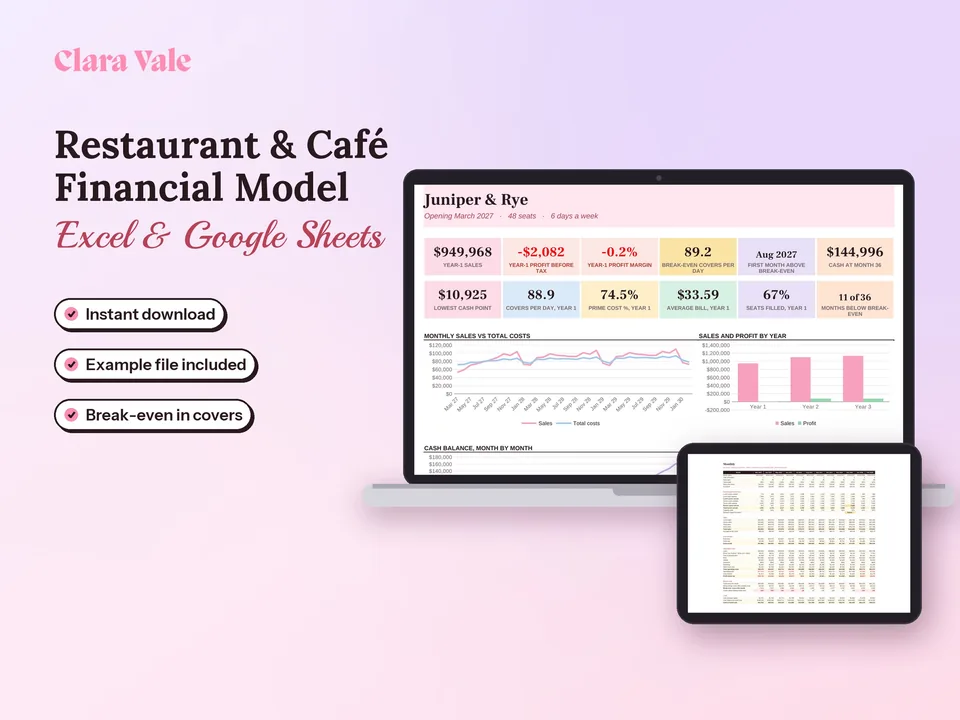
Run the same test on rent, wages and covers. If a 15% slower month puts you under break-even, the plan needs a bigger cash reserve. When we built our Coffee Shop Business Plan & Financial Model, we made covers unable to outgrow seats × turns, because that’s the error that hides most easily in a hand-built forecast. It also shows prime cost (ingredients plus labor) and break-even in covers a month for 36 months.
The SBA also tells you to match your projections to your funding request. That’s the next section.
9. Funding request
The SBA says this section should explain “how much funding you’ll need over the next five years and what you’ll use it for,” whether you want debt or equity, and on what terms. Show the one-time costs line by line, then the cash reserve.
Example startup budget:
| Item | Amount |
|---|---|
| Espresso machine, grinders, refrigeration, furniture | $60,000 |
| Build-out (plumbing, electrical, counters) | $70,000 |
| Deposits, permits and licenses | $10,000 |
| Opening inventory | $5,000 |
| Cash reserve: 3 months of fixed costs (3 × $28,620 = $85,860) | $86,000 |
| Total | $231,000 |
“We’re contributing $56,000 of owner equity and request a $175,000 term loan. The reserve covers three months of fixed costs while daily covers build toward 153.” Notice the loan payment from section 8 appears here too. A lender will check that the two sections tell the same story.
Common mistakes that sink a cafe business plan
- Covers above capacity. Always check the forecast against seats × turns plus your bar’s speed.
- One cost % for everything. Food and drinks behave differently, so blend them by sales mix.
- Free owner labor. If the plan only works because you work for nothing, say so, or pay yourself in the model.
- No card fees. Every card sale costs a percentage. Put it in variable costs.
- No cash reserve. Don’t assume you’ll open at full volume. Fund the slow first months up front.
Start with the numbers
Write your coffee shop business plan around one question: how many customers a day does this café need, and can the room serve them? Answer that in section 8 first, then let the menu, staffing and funding sections explain how you’ll get there. Before you set your opening prices, run each core item through our menu pricing calculator so the cost % in your plan matches the menu you’ll actually print.
Questions people ask
How do I write a business plan for my coffee shop?
Write it in nine sections: executive summary, concept, market and location, menu and pricing, operations and staffing, marketing, management, financial projections and funding request. Write the financial projections before the executive summary. Every other section feeds those numbers, and the summary is a short version of the whole plan.
How much money do I need to start up a coffee shop?
It depends on your space, build-out and equipment, so there is no honest single number. Add your one-time costs (equipment, build-out, deposits, permits, opening stock) to a cash reserve of at least three months of fixed costs. In our worked example that comes to $231,000, but your quotes will set your figure.
Are cafes a profitable business?
A café is profitable when its daily covers sit comfortably above break-even and below what the room and bar can physically serve. Work out break-even covers per day from your fixed costs and contribution per customer. If that number is close to your capacity ceiling, the plan has too little room for a slow month.
What are the common mistakes in a cafe plan?
The most common ones are forecasting more customers than the seats and bar can serve, using one cost % for both food and drinks, leaving the owner's time out of labor, forgetting card fees, and asking for a loan with no cash reserve for the first slow months. Each one makes break-even look closer than it is.
How do I start a small café business?
Start with the numbers before the lease. Pick a concept, price a sample menu, estimate covers and average ticket, then work out break-even covers per day. If the location can deliver that comfortably, write the full plan, line up funding, and then handle permits, build-out, equipment and hiring.
How do I write a simple business plan sample?
Use a lean format. The SBA describes lean plans as high-level and often one page. For a café, write one or two lines each on your concept, customer, location, menu and price range, team, startup cost, break-even covers per day and funding needed. Expand it into a full plan when a lender asks.
What are the 4 P's of marketing for a coffee shop?
Product, price, place and promotion. For a coffee shop: product is your menu and coffee sourcing, price is your average ticket and how it compares nearby, place is your location, hours and takeaway options, and promotion is how people hear about you, from signage and opening events to loyalty cards and social posts.