
Shadow work prompts are most useful in ordinary moments: the evening after a comment stung, the week a friend’s good news felt harder to hear than it should, the third time this month you said yes while meaning no. A good prompt turns that moment into a question you can actually answer on paper. Below are 100 of them, grouped by theme, plus a simple way to use them that keeps the practice gentle.
Shadow work prompts are journaling questions that help you notice the parts of yourself you usually hide or overlook, such as triggers, repeating patterns, envy and the voice of your inner critic. You answer one at a time, honestly and kindly, then reread your entries to see what keeps coming up. Start with the beginner prompts and move deeper slowly.
If you’d like the background first, our guide to what shadow work is explains Carl Jung’s idea of the shadow and a six-step beginner routine. This page is the prompt library.
Shadow work prompts for beginners
These ten stay close to everyday life. They’re the best place to start, and a good place to return to on lighter days.
- What small thing annoyed me today, and what did it remind me of?
- When did I last feel defensive? What was I protecting?
- What do I do when I feel left out?
- Which conversation do I keep replaying in my head?
- What do I tend to hide when I meet new people?
- When did I last pretend to be fine? What was really going on?
- What do I complain about most often?
- Which of my habits would I be embarrassed for others to see?
- What feeling do I try hardest to avoid?
- What did I need today that I didn’t ask for?
Prompts about triggers and strong emotions
A trigger is a reaction that feels bigger than the moment. These prompts slow the reaction down so you can look at it. Naming the feeling precisely makes a real difference here; our free emotion wheel helps you move from “upset” to a sharper word like “dismissed” or “embarrassed.”
- Describe the last time I overreacted. What happened just before?
- What tone of voice makes me tense up right away?
- Which situations make me feel small?
- What do I feel in my body when I’m about to lose my temper?
- When I feel criticized, what story do I tell myself about what the other person thinks?
- What emotion shows up as anger for me?
- Which kind of request makes me feel guilty for saying no?
- When do I feel the urge to leave a room or go quiet?
- What feeling usually follows the moment after a trigger fades?
- If this week’s strongest reaction had a message for me, what would it be?
Prompts about projection: what bothers you in others
Jung noticed that traits we reject in ourselves often show up as strong judgments of other people. Simply Psychology’s overview of Carl Jung’s theory puts it this way: shadow elements often show up when we “project disliked traits onto others, serving as mirrors to our disowned aspects.” These prompts use your judgments as clues.
- Which type of person do I find hardest to be around? Describe them in five words.
- Which of those five words has ever described me, even briefly?
- What behavior in others do I call “selfish”? When have I wanted to do the same?
- Who do I judge for being “too much”? Too much of what?
- What do I criticize in my partner, friends or family most often?
- Which celebrity or public figure irritates me, and why?
- What would I lose if I let myself act a little more like the person who annoys me?
- Who do I admire without reservation? Which of their qualities might I share?
- What rule do I silently expect other people to follow?
- When someone breaks that rule, what do I feel first?
Prompts about your inner critic
The inner critic is the voice that comments on everything you do. These prompts help you hear it clearly, then answer it.
- What phrase does my inner critic repeat most?
- When is the critic loudest: at work, with family, in the mirror, at night?
- What does the critic want me to do or avoid?
- Whose voice from my past does it sound like?
- What would the critic say about this journal entry?
- When has the critic been right, and when has it been unfair?
- What standard am I holding myself to that I would never hold a friend to?
- If the critic is trying to keep me safe, what is it afraid of?
- What would a kind coach say instead?
- What one sentence can I say back to the critic next time?
Prompts about childhood and family patterns
Go slowly with this group. Pick the prompts that feel manageable today and leave the others for later.
- What was I praised for as a child?
- What got me in trouble, or made the adults around me go quiet?
- Which emotions did my family express freely, and which stayed hidden?
- What did I learn about money, rest or success from watching the adults in my home?
- What role did I take on in my family, and what did it cost me?
- Which family saying or rule still runs in my head?
- What did I promise myself I would do differently as an adult?
- Where do I see one of my parents’ habits in my own life?
- What did I want more of from the people who raised me?
- What would I like my younger self to know now?
Prompts about relationships and boundaries
- In which relationship do I hold back the most of who I am?
- What do I do to keep people from leaving?
- When do I give more than I want to, and why?
- Which boundary do I struggle to keep?
- How do I act when I feel jealous in a relationship?
- What do I expect people to know without me telling them?
- Which friendship drains me, and what keeps me in it?
- What kind of attention do I crave most?
- How do I respond when someone I love is disappointed in me?
- What would I ask for in my closest relationship if I knew the answer would be yes?
Prompts about envy and resentment
Envy is uncomfortable, and it’s also one of the most honest clues in shadow work. It points at something you want.
- Whose life or success did I feel a pang about recently?
- What exactly do they have that I want?
- What have I told myself I’m not allowed to want?
- Who do I resent, and what do I wish they had done differently?
- Which resentment have I carried the longest?
- What does holding on to that resentment give me?
- When did I last hide good news so someone else wouldn’t feel bad?
- What would I go after if I stopped comparing myself to one specific person?
- Which compliment of someone else was hard for me to say out loud?
- What small step could I take toward the thing my envy points at?
Shadow work prompts for anxiety and fear
These prompts are for noticing patterns around worry. They’re self-reflection, and they sit well next to other support. If anxiety is frequent, intense or getting in the way of daily life, a licensed therapist or your doctor is the right next step.
- What am I most afraid people will find out about me?
- What do I worry about that I rarely say out loud?
- Which situation do I avoid, and what do I tell myself about it?
- What do I picture when I imagine failing?
- What does “being in control” mean to me?
- Which worry has followed me for years? When did it start?
- What do I do to calm myself that also keeps me stuck?
- What would I do this week if I felt ten percent braver?
- Which fear has protected me in the past?
- What helps me feel safe in my body, and how can I add more of it?
Shadow work prompts for self-love and self-compassion
Every session goes better when it ends here. Use one of these as a closing prompt after a harder one.
- What part of me do I find hardest to love?
- How would I speak to a friend who felt this way?
- Which mistake am I still punishing myself for?
- What would forgiving myself for it look like in practice?
- What do I like about the way I handle hard days?
- Which need have I been calling “too much”?
- What do I deserve that I rarely give myself?
- When did I last feel at home in myself?
- What kind words would I like to hear today? Write them to myself.
- What is one thing I did well this week, however small?
Prompts about your golden shadow and integration
The shadow also holds strengths you set aside. Jung’s idea of integration means accepting a trait as part of you and choosing what to do with it.
- Which quality was I told was “too much” that I secretly like?
- What talent do I downplay?
- What would I create if no one ever saw it?
- Which of my “bad” traits has helped me in a hard moment?
- How could my anger, stubbornness or sensitivity serve me in a healthy way?
- What do I keep starting and stopping? What would it take to stay with it?
- Which part of myself do I want to bring back into my life?
- What pattern from these pages am I ready to change, and what is one small first step?
- What have I learned about myself this month?
- Who am I when I’m not trying to be anyone in particular?
How to use shadow work prompts safely
Shadow work prompts ask you to look at uncomfortable material, so a little structure keeps the practice steady. This routine suits most people:
- One prompt per session. Ten to fifteen minutes is enough. Depth matters more than speed.
- Start with facts. Describe the moment plainly before you interpret it. “She checked her phone while I was talking” is easier to work with than “she doesn’t care.”
- Name the feeling. Pick the most precise word you can, then write what it reminded you of.
- Skip freely. If a prompt feels like too much today, move on. That choice is part of being gentle with yourself.
- Close with kindness. End with one compassionate sentence or a prompt from the self-love section.
- Know where your limit is. Everyday triggers and habits are good ground for self-guided work. Trauma, abuse and grief that still feels raw deserve a licensed therapist or counselor. In the US, the 988 Suicide & Crisis Lifeline is free, confidential and available 24/7 by call or text to 988.
Shadow work is self-reflection. It works alongside professional care, and a therapist is the right person to turn to when old pain keeps resurfacing or low mood lasts for weeks.
How often to do shadow work
Two or three short sessions a week work well for most people. That’s often enough to keep the thread from one entry to the next and spaced enough to let each one settle. Once a week, reread what you’ve written. Patterns rarely show up on a single page, and they’re often clear across six or eight entries.
A simple four-week rhythm looks like this:
| Week | Focus | Prompts |
|---|---|---|
| 1 | Everyday patterns | 1–10, plus one from 81–90 to close |
| 2 | Triggers and projection | 11–30 |
| 3 | Inner critic, relationships, envy | 31–40, 51–70 |
| 4 | Self-compassion and integration | 81–100 |
Childhood and family (41–50) and anxiety (71–80) can slot in whenever they feel right. Some people come back to them months later, and that’s fine.
Where to write your answers
Paper works beautifully for shadow work, because slowing down to write by hand gives a reaction time to cool. Keep the notebook somewhere private. If you’d rather type, a private journal app such as 3 Pages Daily keeps entries on your iPhone, iPad or Mac and on the web. For lighter days between deeper sessions, our list of journal prompts has gratitude and daily check-in questions too.
Keep going with a guided shadow work journal
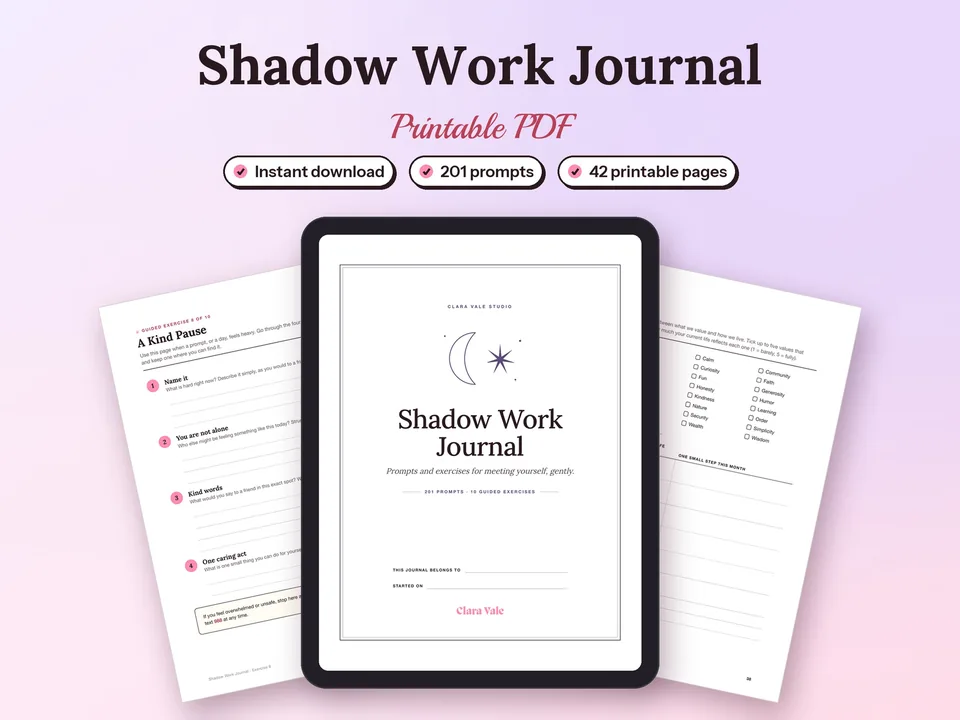
Pick one prompt from the beginner list tonight, give it ten minutes and close with a kind sentence. When you’d like a longer, structured path, our Shadow Work Journal Prompts & Exercises is a printable 42-page PDF with 201 numbered prompts in eight sections, from noticing your patterns to integration, and 10 guided exercises such as a Trigger Tracker, a Mirror Page and an Envy Decoder. It prints on US Letter paper and works in GoodNotes and Notability.
Questions people ask
What are some good shadow work prompts?
Good shadow work prompts point at a specific moment rather than at your whole personality. Questions like "Who irritated me most this week, and what exactly did they do?" or "Which compliment do I wave away fastest?" work well because they start with something concrete. From there, the prompt asks what the reaction reminds you of and what it may be protecting.
What are shadow work prompts for beginners?
Beginner shadow work prompts stay with everyday material: small irritations, habits you keep repeating, times you said yes while meaning no. They ask you to describe what happened, name the feeling and notice a pattern. Save prompts about childhood and family for later, once a short, regular journaling routine feels steady and familiar.
How do I start shadow work journaling?
Set aside ten to fifteen minutes, choose one prompt and write without editing. Start with the facts of a recent moment, then name the emotion as precisely as you can, then ask what it reminded you of. Close with one kind sentence to yourself. Reread your entries once a week to spot themes that repeat.
How often should you do shadow work?
Two or three short sessions a week suit most people. Ten to fifteen minutes is enough for one prompt, and a weekly reread of your entries does the rest. Daily practice works too, as long as each session feels manageable. Rest days are part of the practice, especially after a prompt that stirred up a lot.
Can shadow work prompts help with anxiety?
Shadow work prompts can help you notice what tends to come before anxious moments, such as certain situations, thoughts or old rules about being good enough. That awareness is self-reflection, and it works best alongside other support. Anxiety that is frequent, intense or disrupts daily life is worth bringing to a licensed therapist or your doctor.
Is it safe to do shadow work alone?
Gentle shadow work about everyday triggers, habits and relationships is a self-reflection practice most people can do on their own. Go slowly, skip any prompt that feels like too much today and stop if memories start to feel overwhelming. Trauma, abuse and raw grief belong with a licensed therapist. In the US, call or text 988 in a crisis.
What is a shadow work journal?
A shadow work journal is a notebook, app or printable workbook set aside for shadow work prompts and your answers. Keeping the entries in one place makes patterns easier to see over weeks and months. Some journals add guided exercises, such as trigger trackers or pages for projection, alongside the questions.