
The hardest part of a gratitude journal is the second week. The first few entries come easily: family, health, a roof overhead. Then the answers start to repeat, and the page feels like a chore. Fresh gratitude journal prompts fix that. Each one points your attention at a different corner of your day, so you notice things you’d have walked past. Below are 100 original prompts in eight themes, a 30-day gratitude challenge with one prompt per day, and a simple routine to start a gratitude journal that lasts.
Gratitude journal prompts are short questions that help you notice and write about specific good things in your life, from people and small moments to your body, home and work. Pick one prompt, write two or three detailed sentences, and say why it mattered. Specific beats general, and one detailed answer beats a long list.
100 gratitude journal prompts by theme
Choose a theme that fits your day, or move through them in order. Each prompt works in a paper notebook, a notes app or on a printed page.
Quick daily gratitude prompts (2 minutes)
For busy mornings or the last five minutes before sleep.
- What’s one good thing that happened in the last 24 hours?
- What made me smile today, even for a second?
- What went more smoothly than I expected?
- What’s one thing I’m glad I did today?
- Who did I enjoy talking to today?
- What did I eat or drink today that I really enjoyed?
- What’s something I have now that I once wished for?
- What problem didn’t happen today?
- What’s one thing I can look forward to tomorrow?
- What did I learn today, however small?
- What was the best ten minutes of my day?
- What’s one thing that’s working in my life right now?
- Which part of my morning would I keep exactly the same?
- What’s a choice I made today that my future self will thank me for?
- What am I glad is over?
Gratitude prompts about people
Writing about people tends to stick longer than writing about things. Name the person and what they actually did.
- Who checked in on me recently, and what did they say?
- Who makes ordinary days more fun?
- What’s a piece of advice someone gave me that I still use?
- Who believed in me before I believed in myself?
- Which friend knows me best, and how can I tell?
- What’s a family habit or tradition I’m glad I grew up with?
- Who did something kind for me that they never mentioned again?
- Which coworker or classmate made a hard week easier?
- Who taught me how to do something practical, like cook, drive or fix things?
- Which stranger was kind to me lately?
- Who do I miss, and what did they give me that I still carry?
- What do I appreciate about the person I live with, or the person I talk to most?
- Who should I thank this week, and for what?
Small moments and everyday joys
These gratitude journal prompts catch the details that disappear by evening unless you write them down.
- What’s the best sound I heard today?
- What did the light look like at some point today?
- What small convenience saved me time this week?
- What song lifted my mood recently?
- What’s a smell that made me stop for a moment?
- What made me laugh out loud this week?
- What small purchase has been worth every penny?
- What’s a comfortable piece of clothing I’m glad to own?
- What did I see outside that I’d normally walk past?
- What’s a tiny ritual I enjoy, like the first sip of coffee?
- What surprised me today in a good way?
- What’s a text or message I was happy to receive?
Gratitude prompts for hard days
On a hard day, gratitude doesn’t have to cancel the stress. Write the hard part down if you need to, then look for the small good thing beside it.
- What helped me get through today, even a little?
- Who could I call or text if I needed to?
- What’s one thing I handled today that I couldn’t have handled a year ago?
- What small comfort is within reach right now?
- What did today teach me about what I need?
- What part of this hard season is temporary?
- What’s a past hard time I got through, and what helped then?
- What’s one thing that went right in a day that mostly went wrong?
- Who showed up for me when things were difficult?
- What strength did I use today without noticing?
- What can I let go of tonight so tomorrow is lighter?
- What would I say to a friend having this exact day?
If a heavy day is hard to name, the feelings wheel tool can help you find a more precise word before you write.
Body and health
These gratitude journal prompts focus on what your body does for you, not how it looks.
- What did my body let me do today that I took for granted?
- Which of my senses did I enjoy using most today?
- What’s a meal that made me feel good, not just full?
- How did sleep, rest or a nap help me this week?
- What movement felt good recently: a walk, a stretch, a dance in the kitchen?
- What part of my body is stronger or healthier than it used to be?
- Who has helped me take care of my health?
- What healthy habit am I glad I kept this week?
- What did my body recover from that I’m thankful for?
- What’s a physical skill I’m proud of?
- When did I feel calm in my body today?
- What do my hands do for me every day?
Home and place
Where you live shapes most of your hours. Look at it with fresh eyes.
- What’s my favorite spot in my home, and why?
- What’s something in my kitchen I use almost every day?
- What’s a view from a window I like?
- What do I appreciate about my neighborhood?
- What local place, like a park, library or café, makes life better?
- What’s an object at home with a story behind it?
- What chore am I glad someone else does, or that I’ve made easier?
- What’s the coziest moment in my home each day?
- Which place from my childhood am I grateful for?
- What’s something about where I live that visitors notice and I forget?
- What season do I enjoy most where I live?
- What does home feel like on a good evening?
Work and growth
For your job, your studies or the work you do at home.
- What’s one task I finished this week that I’m proud of?
- Which colleague, client or teacher made my work better?
- What skill have I built over the last year?
- What’s something about my work that I’d miss if it changed?
- What mistake taught me something useful?
- What feedback helped me improve?
- What part of my workday do I actually enjoy?
- What opportunity am I glad I said yes to?
- What tool, app or routine makes my work easier?
- What’s a goal I reached that once felt far away?
- Who did I help this week, and how?
- What does my paycheck or my work make possible for me and the people I love?
Gratitude prompts for kids and families
Read these aloud at dinner or bedtime. Younger kids can draw an answer instead of writing it.
- What was the best part of your day?
- Who was kind to you today?
- What’s something fun you did with your family this week?
- What’s your favorite toy, book or game, and why?
- What’s something new you learned to do?
- Which animal are you thankful exists?
- What food do you love most?
- Who helps you when you feel sad?
- What’s something nice you did for someone else?
- What’s your favorite thing about our home?
- What made you laugh today?
- If you could say thank you to anyone right now, who would it be?
For a family version of a gratitude journal, keep one shared notebook on the kitchen table. Each person adds one line at dinner, and a month later it’s a record everyone enjoys rereading.
A 30-day gratitude challenge
A 30-day gratitude challenge gives you one prompt per day, so there’s nothing to choose. Each week has a theme, which keeps answers from repeating. Start on any day of the month; the days are numbered, not dated.
| Day | Prompt | Day | Prompt |
|---|---|---|---|
| 1 | Who made today easier? | 16 | What part of my body worked hard for me today? |
| 2 | What’s a lesson I learned from a grandparent or older relative? | 17 | What do I enjoy about my bedroom or bed? |
| 3 | Which friend could I call at 2 a.m.? | 18 | What’s a meal I’d happily eat again tomorrow? |
| 4 | Who taught me something at work or school? | 19 | What’s one thing I love about my street or town? |
| 5 | What did a stranger do that I appreciated? | 20 | What’s a household item that makes life easier? |
| 6 | Who do I rarely thank but should? | 21 | Where do I feel most at peace? |
| 7 | Write a short thank-you note to one person (send it or keep it). | 22 | What’s a skill I’m glad I learned? |
| 8 | What was the best moment of today? | 23 | What setback turned out to help me? |
| 9 | What did I notice outside today? | 24 | What am I better at than I was last year? |
| 10 | What small luxury do I enjoy? | 25 | What’s a hard thing I’m getting through right now? |
| 11 | What made me laugh this week? | 26 | Who has supported me during a difficult time? |
| 12 | What’s a song, show or book I’m glad exists? | 27 | What’s a choice I’m proud of? |
| 13 | What did I enjoy tasting or smelling today? | 28 | What does a good day look like for me now? |
| 14 | What’s something I’d miss if it disappeared tomorrow? | 29 | Reread the month. Which entry surprised me? |
| 15 | How did my body help me today? | 30 | What changed in how I notice things? |
Week one is about people, week two about small moments, week three about body and home, and week four about growth and hard days. The last two days are for looking back. Missed a day? Pick up where you left off; the streak matters less than the habit.
How to start a gratitude journal
Starting a gratitude journal takes less than you think: a notebook or app, a time slot and one exercise to begin with.
1. Pick your format. Paper slows you down, which helps some people think. A notes app is always in your pocket. Either works; choose the one you’ll actually open. If you’d like affirmations and a vision board alongside it, Manifestly puts a gratitude journal, affirmations and a vision board in one free app for iPhone, iPad and Mac.
2. Attach it to something you already do. Right before bed, with morning coffee or on the train home. A habit tied to an existing routine is easier to keep than one with its own alarm.
3. Start with Three Good Things. This is the most studied gratitude journal exercise. The Greater Good in Action guide to Three Good Things asks you to spend about 10 minutes a day, for at least one week, writing three things that went well and why each one happened. For each item, give it a title, describe what happened, note how it felt then and now, and write what caused it. Writing before bed can help it become a routine.
4. Then rotate prompts. After the first week, swap in one prompt from the list above for one of your three things. That’s how gratitude journaling stays fresh beyond the first month.
5. Choose your rhythm. Daily short entries work for many people. Others do better with a longer entry once or twice a week (more on that below).
The “why” in Three Good Things is the part people skip, and it’s the part that matters. Writing why something went well pushes you to see the people, choices and luck behind it, which turns a list into reflection.
Tips that make gratitude journaling stick
The Greater Good Science Center’s tips for keeping a gratitude journal, drawn from UC Davis psychologist Robert Emmons, line up with what makes prompts work:
- Depth over breadth. One thing described in detail does more than a quick list of many things.
- Get personal. Writing about people you’re grateful to tends to have more impact than writing about things.
- Try subtraction. Imagine your life without something good, like a friend or a working car, instead of only listing what you have.
- Savor surprises. Unexpected good events tend to stir stronger gratitude.
- Don’t overdo it. The same article reports a study by Sonja Lyubomirsky in which people who wrote once a week for six weeks reported a happiness boost, while people who wrote three times a week did not. Emmons’ explanation: we adapt to positive events quickly when we focus on them constantly.
That last point explains why the second week feels flat. Repeating “my family, my health, my home” is adaptation in action. Rotating prompts by theme is one way around it, and writing less often is another.
What research says about gratitude journals
Gratitude journals have a solid research base for a simple habit, though the results are more modest than many headlines suggest.
In a 2003 paper, psychologists Robert Emmons and Michael McCullough randomly assigned participants to keep records of things they were grateful for, daily hassles, or neutral events, either weekly or daily (Journal of Personality and Social Psychology, via PubMed). The gratitude groups showed higher well-being on several, though not all, outcome measures, and the effect on positive mood was the most consistent finding.
The Three Good Things exercise comes from a 2005 internet study by Martin Seligman and colleagues. According to the Greater Good in Action summary linked above, happiness rose after the exercise and was still measured at one week, one month, three months and six months afterward. Later studies with adults in Israel, adolescents in India and teens in Nairobi found related benefits. The same summary notes a limit: the original study mostly included white, college-educated Americans with average or higher incomes, so results may differ for other groups.
A gratitude journal is a self-reflection habit, not a treatment. If low mood, anxiety or grief are getting in the way of daily life, a licensed mental health professional can help in ways a notebook can’t.
Gratitude journal vs. a general journal
A gratitude journal asks one kind of question: what’s good, and why. A general journal can hold anything, from feelings and decisions to plans and worries. Many people keep both, or switch depending on the day. If you’d like prompts for self-discovery, feelings, shadow work and year-end reflection too, our 120 journal prompts in 10 themes cover the rest.
Keep a prompt waiting for tomorrow
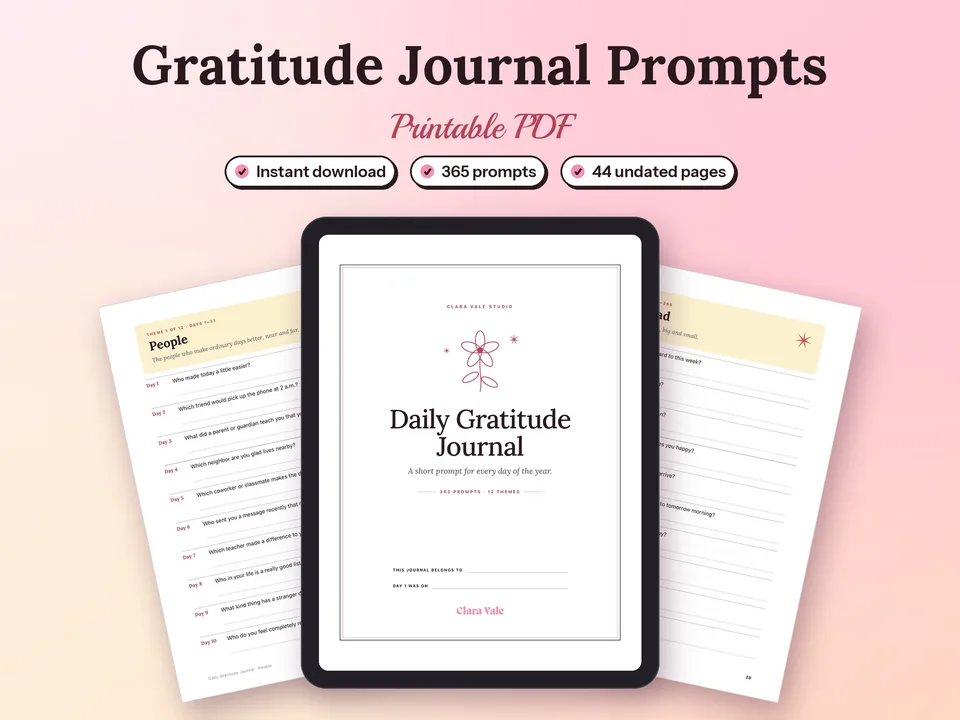
The best gratitude journal prompts are specific, personal and a little unexpected, so rotate themes, write why each thing mattered, and give yourself permission to write less often. When you’d like a prompt ready for every day of the year, our Daily Gratitude Journal has 365 undated prompts in 12 themes, a printable five-minute daily page with three good things, the day’s prompt and one intention, plus a 30-day gratitude tracker.
Questions people ask
What are some good ideas for writing a gratitude journal?
Write about one specific moment instead of a long list, name a person and what they did, and note anything that surprised you. Try imagining your week without something you take for granted, like hot water or a friend's texts. On hard days, a small comfort counts. Two or three detailed sentences beat ten one-word answers.
What are some good prompts for a 30 Days of gratitude journal?
Give each week a theme so the month doesn't repeat itself: people in week one, small moments in week two, body and home in week three, growth and hard days in week four, then two days to look back. Our 30-day table above has one prompt per day, from "Who made today easier?" to "What changed in how I notice things?"
What is the 3/2-1 method of journaling?
There's no single official version. It borrows the 3-2-1 reflection format teachers use, where you write three things, then two, then one. For a gratitude journal, try three good things from today, two feelings you noticed and one intention for tomorrow. It takes about five minutes and keeps entries short enough to repeat.
What are the four A's of gratitude?
There's no single agreed list. Different writers and programs use different sets of four A-words. A simple journaling version: Awareness (notice something good), Acknowledgment (name it on the page), Appreciation (write why it mattered) and Action (thank someone or pass it on). Treat it as a memory aid, not a fixed rule.
How do I start a gratitude journal?
Pick a notebook or a notes app and a time you already have, like right before bed. Write about three good things from the day and why each happened, which is the Three Good Things exercise from positive psychology. Keep it to about 10 minutes, and try it for one week before deciding how often to continue.
How often should you write in a gratitude journal?
Once or twice a week is enough for many people. The Greater Good Science Center reports a Sonja Lyubomirsky study where people who wrote once a week for six weeks felt happier afterward, while those who wrote three times a week did not. Daily short exercises like Three Good Things also work, so choose the rhythm you'll keep.
Does gratitude journaling really work?
Research suggests it can lift mood for many people. In Emmons and McCullough's 2003 studies, people who listed things they were grateful for showed higher well-being on several, though not all, measures than comparison groups. It's a self-reflection habit, not a treatment, so talk to a licensed professional if low mood sticks around.
What do you write in a gratitude journal on a bad day?
Go small and honest. Write one thing that made the day a bit easier, like a warm shower, a short call or getting through a meeting. You can name the hard part first, then add the small good part beside it. Gratitude can sit next to stress without pretending the stress isn't there.