
The oil-change sticker on the windshield says 3,000 miles. The owner’s manual says something much longer. The dashboard shows a percentage that drops at its own pace. So how often should you change your oil? The answer is whichever of those three is written for your engine, and it’s rarely the sticker. Below we turn the advice into numbers you can use: typical ranges for newer cars, the driving that shortens them, the time limit that applies when you barely drive, and a simple car maintenance schedule for everything else.
Change your oil when your owner’s manual or oil-life monitor says to. For most cars from the last 15 years that means every 5,000 to 7,500 miles, up to 15,000 on some full-synthetic engines, and at least once or twice a year even at low mileage. Short trips, towing, dust and stop-and-go traffic call for sooner changes.
How often should you change your oil? Follow the manual first
The interval for your car is set by the automaker, for your engine and the oil spec it requires. It’s printed in the maintenance section of the owner’s manual, and on most newer cars it’s also tracked by an oil-life monitor on the dashboard. Both beat any general rule, including this article.
For a sense of scale, AAA’s article on common car maintenance myths puts it plainly: cars 15 years old or newer are usually recommended for oil changes every 5,000 to 7,500 miles, and full-synthetic oil may go as far as 15,000 miles between services. The same AAA survey found that 45% of people still believe their oil should be changed every 3,000 miles.
Consumer Reports’ guide to oil changes for your car adds the time side: many automakers set intervals of 7,500 or even 10,000 miles and six or 12 months, whichever comes first.
AAA and Consumer Reports both describe the old “every 3,000 miles” oil change as outdated for most newer cars. AAA says cars 15 years old or newer usually call for 5,000 to 7,500 miles, and Consumer Reports says many automakers now list 7,500 to 10,000 miles with a six- or 12-month limit. The owner’s manual sets the exact figure.
Why the 3,000-mile rule stuck around
Toyota’s own guide to signs you need an oil change explains where the old number came from: the traditional advice was every 3,000 miles or every three months. Toyota credits advances in engine technology and in the quality of synthetic oils, and now notes that many newer vehicles can go 5,000 to 7,500 miles, or even up to 15,000, between changes.
The sticker habit lives on because it’s simple and it’s printed by the shop doing the work. Following it on a newer car mostly means paying for more oil changes than the engine needs. Consumer Reports’ example shows the scale: at $100 per change, moving from 3,000-mile to 7,500-mile intervals saves about $600 over two years and 30,000 miles.
Oil change intervals by oil type
Oil type changes how often you should change your oil, but less than most shop signs suggest. The manual names an oil specification and viscosity, such as 0W-20, and sets the interval for that spec. Here’s how the three common types fit in.
| Oil type | What it is | Typical interval |
|---|---|---|
| Conventional | Refined crude oil, the traditional base | Use the manual’s interval; older engines that spec it often have shorter ones |
| Synthetic blend (semi-synthetic) | A mix of synthetic and conventional oil | Use the manual’s interval if it allows a blend |
| Full synthetic | Fully synthetic base oil, slower to break down | Use the manual’s interval; AAA says it may go as far as 15,000 miles |
Two rules keep this simple. First, use the oil your manual calls for. Consumer Reports’ chief mechanic advises using synthetic only if the manufacturer calls for it, since synthetic oil can cost two to four times as much as conventional. Second, downgrading the oil shortens the interval. A Hyundai owner’s manual lists using oil that isn’t the recommended spec, including mineral or semi-synthetic oil, as a severe-usage condition, which moves you to the shorter schedule.
The right grade also pays off at the pump. The U.S. Department of Energy’s fuel economy maintenance tips say using the manufacturer’s recommended grade of motor oil can improve gas mileage by 1% to 2%.
When severe service means more frequent oil changes
Most manuals print two schedules: normal and severe (sometimes called special operating conditions). The names are misleading. Severe service describes a lot of ordinary driving, and many households fit at least one condition.
The Hyundai manual’s list is one of the most specific. It applies the severe schedule if you regularly:
- Drive short trips of less than 8 km (about 5 miles), or less than 16 km (about 10 miles) in freezing weather
- Idle for long periods or drive at low speed for long distances
- Drive on dusty, muddy, gravel or salted roads, or in very cold weather
- Sit in heavy traffic or frequent stop-and-go driving
- Drive up and down mountain roads repeatedly
- Tow a trailer, go camping or carry loads on the roof
- Use the car commercially, such as for taxi or patrol work
- Drive at high speed or with hard acceleration and braking often
Toyota’s list covers the same ground: frequent short trips, towing, very hot or cold climates, dusty roads and regular stop-and-go traffic.
Why do short trips count? A cold engine produces moisture and unburned fuel, and on a short drive the oil never gets hot enough to burn them off. They stay in the oil and wear it out sooner, which is why a car used only for school runs can need oil more often than one that does long highway miles.
Time limits: why oil ages even when the car sits
Mileage is only half of how often you should change your oil. Toyota notes that oil breaks down over time whether the car is driven or parked in a garage. That’s why every interval has a time cap.
- Consumer Reports: if you drive fewer miles than your automaker’s interval, still change the oil about twice a year.
- Honda: the 2025 Civic Hatchback Hybrid owner’s manual says that if no Maintenance Minder message appears more than 12 months after the last reset, change the engine oil every year.
So a car that covers 4,000 miles a year still gets at least one oil change a year, and more often two, depending on the manual.
How to read your oil-life monitor
An oil-life monitor estimates how much useful life is left in the oil. It counts down from 100% after each change, faster when the engine is worked hard or driven in short cold trips, and slower on steady highway miles.
Honda’s Maintenance Minder, from the same 2025 manual, shows how the stages work:
| Display | What it means | What to do |
|---|---|---|
| 15% (Maintenance Due Soon) | 15 to 6% oil life left | Book the oil change |
| 5% (Maintenance Due Now) | 5 to 1% oil life left | Get it done as soon as possible |
| Negative miles, blinking | Oil life has run out | Service immediately |
Honda’s display also shows codes for what to do at the same visit. Code A is an oil change; code B adds the oil filter and a brake inspection; sub-codes cover jobs such as tire rotation (1), air filters (2) and brake fluid (7). Other brands use different wording, so check the manual for your monitor’s stages.
Two habits keep the monitor honest. Have it reset after every oil change, or it keeps counting down from the old oil. And keep checking the oil level by dipstick: Consumer Reports’ mechanics recommend checking at least once a month, or every other fill-up, because some engines burn oil between changes and the monitor tracks oil life, not how much oil is left.
A simple car maintenance schedule
Oil is the most frequent job, so it makes a natural anchor for the rest of the car maintenance schedule. The table below lists typical intervals from the sources in this article. Treat them as a starting point and check each line against your manual, since automakers set the final numbers.
| Item | Typical interval | Source |
|---|---|---|
| Engine oil and filter | Per the manual or oil-life monitor; often 5,000 to 7,500 miles on cars 15 years or newer; at least once or twice a year | AAA, Consumer Reports, Honda |
| Oil level check | Once a month or every other fill-up | Consumer Reports |
| Tire pressure | At least once a month and before long trips | Michelin |
| Tire rotation | Often every 6,000 to 8,000 miles | Michelin |
| Brakes | Inspected at the oil-and-filter service on Honda’s schedule | Honda |
| Brake fluid | Every two or three years on most cars | AAA, Honda |
| Engine air filter | Check your manual; Honda says every 15,000 miles in dusty conditions | Honda |
| Cabin (dust and pollen) filter | Check your manual; Honda says every 15,000 miles in sooty city air | Honda |
| Battery | Have it tested as it approaches three years | AAA |
| Coolant, transmission fluid, spark plugs | Check your manual | Owner’s manual |
Michelin’s tire maintenance guide gives the rotation and pressure figures, and notes that your vehicle manufacturer sets the rotation schedule. One pattern stands out: tire rotation lands close to many oil intervals, so a lot of drivers do both at the same visit.
Keep a car maintenance log
Every number above depends on knowing when you last did each job. A car maintenance log answers that in seconds: date, odometer reading, what was done, the oil type and who did it. It also helps when you sell the car, since a full service record shows a buyer the car was looked after.
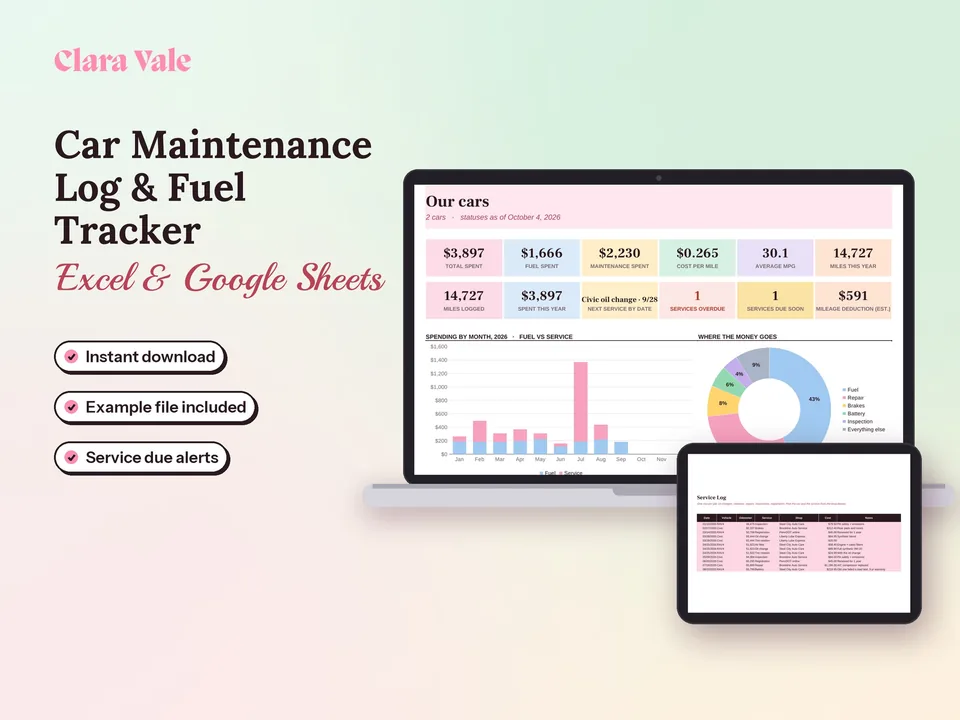
A notebook in the glove box works. A car maintenance spreadsheet goes further, because it can do the counting for you. Our Car Maintenance Log & Fuel Tracker is built for this: a spreadsheet for Excel and Google Sheets that covers up to three cars. You set how often each car needs each service, in miles, months or both, straight from your manual. Log each service and fill-up, and it shows the miles and days left until the next oil change, tire rotation, inspection or registration. Due-soon items turn yellow and overdue items turn red.
The fill-up log does a second job: it works out MPG and cost per mile from your own receipts. If you drive for work, its mileage log keeps business trips separate, which lines up with the records described in our guide to self-employed tax deductions.
The short answer, and what to do next
How often should you change your oil? Go by the manual or the oil-life monitor, not the windshield sticker. For most newer cars that’s 5,000 to 7,500 miles or more, with a time cap of six to 12 months. Switch to the severe schedule if most of your driving is short trips, towing, dust or heavy traffic. Then log every service so the next one never sneaks past you.
Oil is one part of what a car costs to run. To see the other big one, put your real MPG and local gas price into our fuel cost calculator and get the cost of any drive.
Questions people ask
What is the 30-60-90 rule for cars?
The 30-60-90 rule is an old rule of thumb that groups bigger services at 30,000, 60,000 and 90,000 miles: filters, tire rotation and brake checks at 30,000; brake fluid, coolant and transmission fluid at 60,000; timing belt and water pump at 90,000. Modern cars often run longer intervals, so treat it as a rough template and follow the schedule in your owner's manual.
What is the average cost of an oil change?
The price depends on how much oil your engine takes, which type it needs and how easy the filter is to reach, so a local quote for your exact car is the reliable number. Oil type moves the price most: full synthetic oil can cost two to four times as much as conventional oil, per Consumer Reports. Fewer changes a year also lowers your yearly total.
What is the recommended oil change interval for semi-synthetic oil?
Your owner's manual sets the interval for the oil spec your engine needs, not for the oil type on the bottle. If your manual calls for full synthetic and you use semi-synthetic, at least one Hyundai owner's manual says to switch to the severe-usage schedule, which means shorter intervals. If your manual allows a synthetic blend, use its normal interval.
How long does a Jiffy Lube oil change take?
Jiffy Lube advertises a 15-minute oil change service. Its own footnote says the time is based on national averages from independent store audits of the oil change service only, and it leaves out wait time and any extra services. Plan for longer if the shop is busy or you add a tire rotation or filter.
How often should you change your oil if you don't drive much?
Go by time instead of miles. Oil ages even when the car sits, and short trips never get the engine fully warm. Consumer Reports says low-mileage drivers should still change oil about twice a year, and Honda's 2025 Civic Hatchback Hybrid manual says to change it every year if no reminder has appeared within 12 months.
Is the 3,000-mile oil change still necessary?
For most newer cars, no. AAA says cars 15 years old or newer usually call for oil changes every 5,000 to 7,500 miles, and full synthetic oil can stretch to 15,000. The 3,000-mile habit came from older engines and oils. Older cars, and cars driven under severe conditions, may still need shorter intervals, so check the manual.
How do I read my oil life monitor?
The percentage counts down from 100 after each oil change, based on how the engine is driven. On Honda's Maintenance Minder, 15% means service is due soon, 5% means due now, and a blinking negative distance means past due. Book the change when you reach the soon stage, and have the monitor reset after the service.