
A blank page can feel loud. You sit down to write, pen ready, and nothing comes, or everything comes at once and none of it fits in a sentence. Good journal prompts fix both problems. They hand you one small question, so you have a place to start and a reason to keep going. Below are 120 original prompts in 10 themes: quick daily check-ins, gratitude, self-discovery, feelings, gentle shadow work, relationships, work and money, anxious days, year-end reflection, and prompts for teens and students.
Journal prompts are short questions or sentence starters that give a journaling session a focus. Pick one prompt, write for five to ten minutes without editing, and stop when the timer ends. The best prompt is the one that matches today: a check-in on busy days, gratitude when things feel heavy, deeper self-discovery questions when you have time.
Daily check-in journal prompts (2 minutes)
These daily journal prompts are for days when five minutes feels like a lot. Answer one in a few lines, morning or night.
- What took up most of my attention today?
- What’s one word for how I feel right now?
- What gave me energy today, and what drained it?
- What’s one thing I want to remember about today?
- What am I looking forward to tomorrow?
- What did I handle better than I expected?
- Where did my body feel tense today?
- What’s the one task that would make tomorrow easier if I did it first?
- Who did I talk to today, and how did it feel?
- What’s something small that went right?
- What am I carrying into tonight that I can set down?
- If today had a title, what would it be?
Gratitude journal prompts
Gratitude prompts work best when they’re specific. “My family” is a fine answer, but “the way my sister texted me a photo of our old dog” is the one you’ll remember. Hard days count too; gratitude can sit next to stress without cancelling it.
- What’s one small comfort I used today without thinking about it?
- Who made my week a little easier, and how?
- What’s something in my home I’m glad to have?
- What did my body let me do today?
- What’s a sound, smell or taste I enjoyed recently?
- What’s a hard thing from the past that I’m now grateful for?
- Who taught me something I still use?
- What’s a part of my routine I’d miss if it disappeared?
- What did someone do for me that they probably forgot about?
- What’s something in nature I noticed this week?
- What skill am I glad I learned?
- What’s one thing about today I’d like to have again tomorrow?
If you’d like a prompt waiting for you every day, our Daily Gratitude Journal has 365 gratitude journal prompts in 12 themes, a printable five-minute daily page and a 30-day tracker. You’ll find it with the other journals at the end of this post.
Journal prompts for self-discovery
Self-discovery prompts are the questions to ask yourself when you’re at a turning point: a new job, a move, a breakup, a birthday. They take longer, so save them for a quiet evening or a weekend morning.
- When do I feel most like myself?
- What do I value that I rarely say out loud?
- What are three things people come to me for?
- What would I do with a free year and enough money?
- What did I believe at 15 that I no longer believe?
- What am I afraid people would think if they knew what I really wanted?
- What kind of tired am I most often: bored, overworked or lonely?
- What does a good day look like for me, start to finish?
- Which compliment do I brush off, and why?
- What do I keep saying I’ll do “someday”?
- What would I stop doing if nobody was watching?
- Who do I envy, and what does that tell me about what I want?
- What rules did I grow up with that I still follow?
- What’s a decision I’m proud of, even though it was hard?
- What do I want to be known for in ten years?
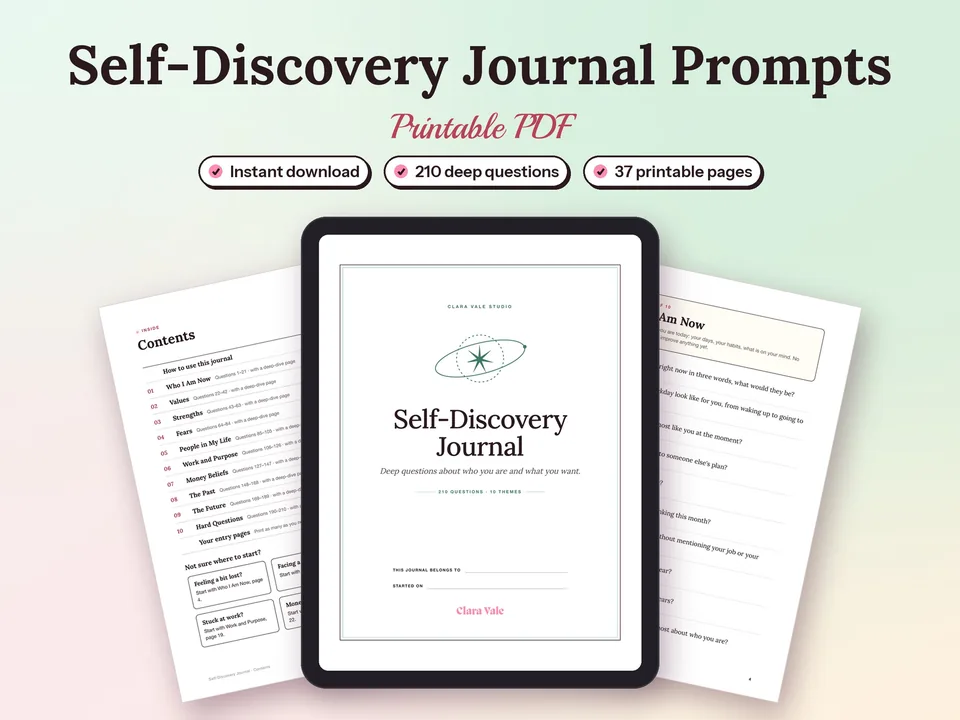
For a longer set, our Self-Discovery Journal has 210 deep questions in 10 themes, from values and strengths to fears, money beliefs and a set of hard questions, with a deep-dive page at the end of each theme.
Journal prompts for emotions, with a feelings wheel
“I feel bad” is a starting point, not an answer. A feelings wheel helps you narrow it down. The wheel by Geoffrey Roberts starts with seven core feelings in the center (happy, surprised, bad, fearful, angry, disgusted and sad) and opens into more specific words toward the edge. Bad becomes stressed, and stressed becomes overwhelmed or out of control. Our free emotion wheel tool lets you tap a core feeling, zoom in to the exact word, read what it means and get a journal prompt for it.
Pick a word from the wheel first, then use one of these journal prompts:
- Which core feeling is closest right now, and which outer-ring word fits best?
- When did this feeling start today?
- Where do I notice it in my body?
- What is this feeling trying to protect?
- What would I say to a friend who felt this way?
- Is there a second feeling underneath the first one?
- What made this feeling stronger today, and what made it softer?
- What do I need right now: rest, company, movement or quiet?
- When did I last feel the opposite of this?
- What story am I telling myself about why I feel this way?
- What’s one kind thing I can do for myself in the next hour?
- Looking back over the week, which feeling showed up most?
Naming a feeling precisely tends to make it easier to work with, because “overwhelmed” points to a different next step than “lonely” or “resentful.” If you’d rather log feelings on your phone, the free Feelings Wheel app for iPhone and iPad does 10-second check-ins and keeps a private mood journal, so you can see patterns over weeks.
Shadow work prompts (gentle)
Shadow work comes from Carl Jung’s idea of the shadow: the parts of yourself you push out of view, like anger, envy or needs you were taught to hide. Shadow work prompts ask you to notice those parts with curiosity rather than judgment. Go slowly, and stop if a prompt brings up more than you want to sit with alone.
- What reaction of mine surprised me recently?
- What trait in other people irritates me most, and do I ever show it?
- What feeling was not welcome in my home growing up?
- What does my inner critic say most often, word for word?
- Whose approval am I still trying to earn?
- When do I say yes when I mean no?
- What do I envy, and what wish is hiding inside it?
- What part of me do I hide at work, and why?
- What role did I play in my family: the helper, the peacemaker, the funny one?
- What would I forgive myself for if I could?
- What quality do I admire in others that I might also have?
- What would I say back to my inner critic if I were on my own side?
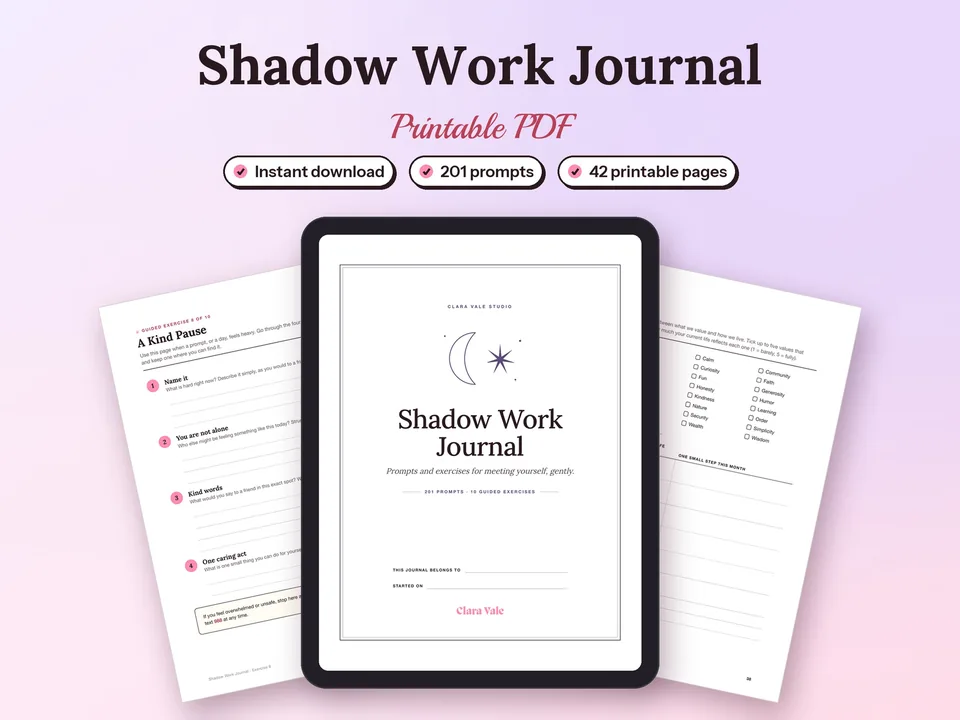
If shadow work is new to you, our guide to what shadow work is explains the idea in plain terms. For a full set of shadow work prompts with structure, the Shadow Work Journal has 201 gentle prompts and 10 guided exercises, including a Trigger Tracker and an Envy Decoder.
Journal prompts about relationships
These journal prompts cover partners, friends, family and the people you see every day.
- Who do I feel most relaxed around, and why?
- What’s a conversation I keep putting off?
- What do I need from my friends that I haven’t asked for?
- Which relationship has changed most this year?
- What did I learn about love from the people who raised me?
- How do I show care, and how do I like to receive it?
- Who would I like to see more of, and what’s stopping me?
- What’s a boundary I kept this month?
- What’s one thing I appreciate about my partner, friend or roommate that I haven’t told them?
- Where do I give more than I get, and is that fine with me?
- What does a good friend look like to me?
- Who do I miss, and what would I say to them?
Journal prompts about work and money
Work and money are where many people feel the most pressure and say the least. Journal prompts on these topics let you look at the numbers and the feelings side by side.
- What part of my job would I keep even if I didn’t need the money?
- What drained me at work this week?
- What’s a skill I’d like to be paid for someday?
- What did money mean in my house growing up?
- What purchase in the last month felt worth it, and which didn’t?
- How much is enough for me, in actual numbers?
- What would I try if I knew I couldn’t fail at it?
- When do I feel proud of my work?
- What’s one money worry I could turn into a plan this week?
- What does rest look like on a workday for me?
- Who at work do I learn the most from?
- What would I change about how I spend my weekday evenings?
Journal prompts for anxious days
On anxious days, long open-ended questions can make spinning thoughts spin faster. The journal prompts below are short and grounding. They’re for self-reflection, not a replacement for professional care.
- What am I worried about, in one sentence?
- Is this a problem I can act on today, or one I can only wait on?
- What’s the smallest next step I could take?
- What do I know for sure right now?
- What helped the last time I felt like this?
- What are five things I can see from where I’m sitting?
- What would I tell a friend with this exact worry?
- What can I let go of until tomorrow?
- Who could I text right now?
- What went okay today, despite the worry?
Research on journaling and anxiety is promising but modest. In a 2018 randomized controlled trial published in JMIR Mental Health, 70 adults with medical conditions and elevated anxiety were split between usual care and online positive-affect journaling, written in 15-minute sessions three days a week for 12 weeks. The journaling group reported less anxiety and fewer depressive symptoms after one month than the usual-care group, and higher well-being over the study.
That’s one small study, in one group of patients, using one style of journaling, so it supports journaling as a helpful habit rather than a treatment. If anxiety is getting in the way of sleep, work or relationships, a licensed therapist or your doctor is the right next step. In the US, you can call or text 988 to reach the 988 Suicide & Crisis Lifeline any time.
Year-end reflection questions
Year-end reflection questions work in late December, on your birthday or at any natural pause. Answer the look-back questions first, then the look-ahead ones.
- What were three moments from this year I want to remember?
- What surprised me most this year?
- What did I learn the hard way?
- Who mattered most to me this year?
- What did I finish that I’m proud of?
- What habit helped me most, and which one cost me?
- What am I ready to let go of before the new year?
- How did I take care of my health and energy?
- What do I want more of next year, and less of?
- What one word do I want for next year?
- What would make next year a good year, by my own definition?
- What will I tell myself a year from now when I read this?
Our Year-End Reflection Journal expands this into 188 undated prompts, 126 to look back and 62 to look ahead, with fill-in pages for your top 10 moments, a word of the year and a quarter-by-quarter plan.
Journal prompts for teens and students
These journal prompts work for middle school, high school and college, in class or at home. Keep sessions to about ten minutes and treat entries as private unless the writer chooses to share.
- What made me laugh this week?
- What’s something I’m better at than I was last year?
- Describe my perfect Saturday, hour by hour.
- What’s one thing I wish adults understood about being my age?
- Who do I look up to, and why?
- What’s a subject or topic I’d study even without a grade?
- What’s a mistake I learned something from?
- What does a good friend do that I want to keep doing too?
- If I could change one rule at school, what would it be?
- What am I curious about right now?
- What do I want to remember about this year when I’m older?
How to start journaling with these prompts
How to start journaling matters less than how to keep going. A few things make the habit stick:
- Attach it to something you already do. Morning coffee, the bus ride, the ten minutes before bed. A fixed slot beats waiting for free time.
- Use one prompt per session. Read it, set a timer for five or ten minutes, and write until it rings. If you finish early, ask “and why?” about your last sentence.
- Write messy. Spelling, grammar and handwriting don’t matter. The page is for you.
- Rotate themes. A check-in on busy days, gratitude or feelings on heavy days, self-discovery when you have a quiet hour.
- Reread once a month. Patterns show up across entries that you’d never spot in a single one: the same worry, the same person, the same Tuesday slump.
Paper or phone both work. Paper slows you down, which helps some people think. A phone is always with you, which helps others actually do it. If you’d rather type, 3 Pages Daily is a private journal for iPhone, iPad and Mac that keeps your entries on your device.
The 3-2-1 method and other quick formats
The 3-2-1 format comes from the classroom. Penn State’s teaching resource describes it as students writing three things they learned, two things they found especially interesting and one question they still have. There isn’t one official journaling version, so adapt the counts to your day. One daily version we like: three good moments, two feelings you noticed and one intention for tomorrow.
Two other short formats work well when time is tight:
- One line a day. Write a single sentence about the day. Over a year, it becomes a quick record you can scan in minutes.
- Question of the week. Pick one prompt from this list on Monday and answer it a little each day. By Sunday you have a full entry from five-minute sessions.
Keep a prompt ready for tomorrow
The journal prompts that help most are the ones that match where you are today, so keep this list nearby and pick by mood rather than in order. When you want to go deeper than a single list, our printable journals give each theme its own book, starting with the Self-Discovery Journal’s 210 deep questions, and the Shadow Work, Daily Gratitude and Year-End Reflection journals sit right below this post.
Questions people ask
What can I write in my journal?
Anything that's on your mind counts: what happened today, how you feel about it, what you're grateful for, a decision you're weighing, a memory, a worry or a plan. If the page feels too open, answer one short prompt, such as "What took up most of my attention today?", and let the answer lead to the next sentence.
What is the 3/2-1 method of journaling?
There's no single official version. It borrows the 3-2-1 reflection format teachers use, where you write three things, then two, then one. A classroom version asks for three things you learned, two that stood out and one question you still have. For a daily journal, try three good moments, two feelings and one intention.
Can journaling help with anxiety?
It can help some people. In a 2018 randomized trial of 70 adults with elevated anxiety, 12 weeks of short online positive-affect journaling was linked to less anxiety after one month than usual care. Journaling is a self-reflection habit, not a treatment, so if anxiety gets in the way of daily life, talk to a licensed mental health professional.
What are some good journal prompts for middle school students?
Short, concrete prompts work best for middle schoolers: What made you laugh this week? What's something you're better at than you were last year? Describe your perfect Saturday. What's one thing you wish adults understood about being your age? Who do you look up to, and why? Ten minutes and no grading keeps it honest.
How do I start journaling?
Pick one time of day you already have, like coffee or right before bed, and write for five minutes. Use a single prompt so you skip the blank-page freeze, write by hand or on your phone, and don't reread or edit. Aim for three or four days a week at first; a habit you keep beats a long entry you skip.
What are good self reflection questions?
Good self reflection questions are open and specific. Try: What do I want more of this month? When did I feel most like myself recently? What am I tolerating that I could change? What would I do if I trusted myself more? Questions that start with what, when and how lead further than yes-or-no ones.
How often should you journal?
As often as you can keep it up. A few minutes most days builds the habit fastest, but three entries a week is plenty for many people. In the 2018 positive-affect journaling trial, participants wrote for 15 minutes three days a week. Choose a rhythm that fits your week rather than a daily rule you'll break.