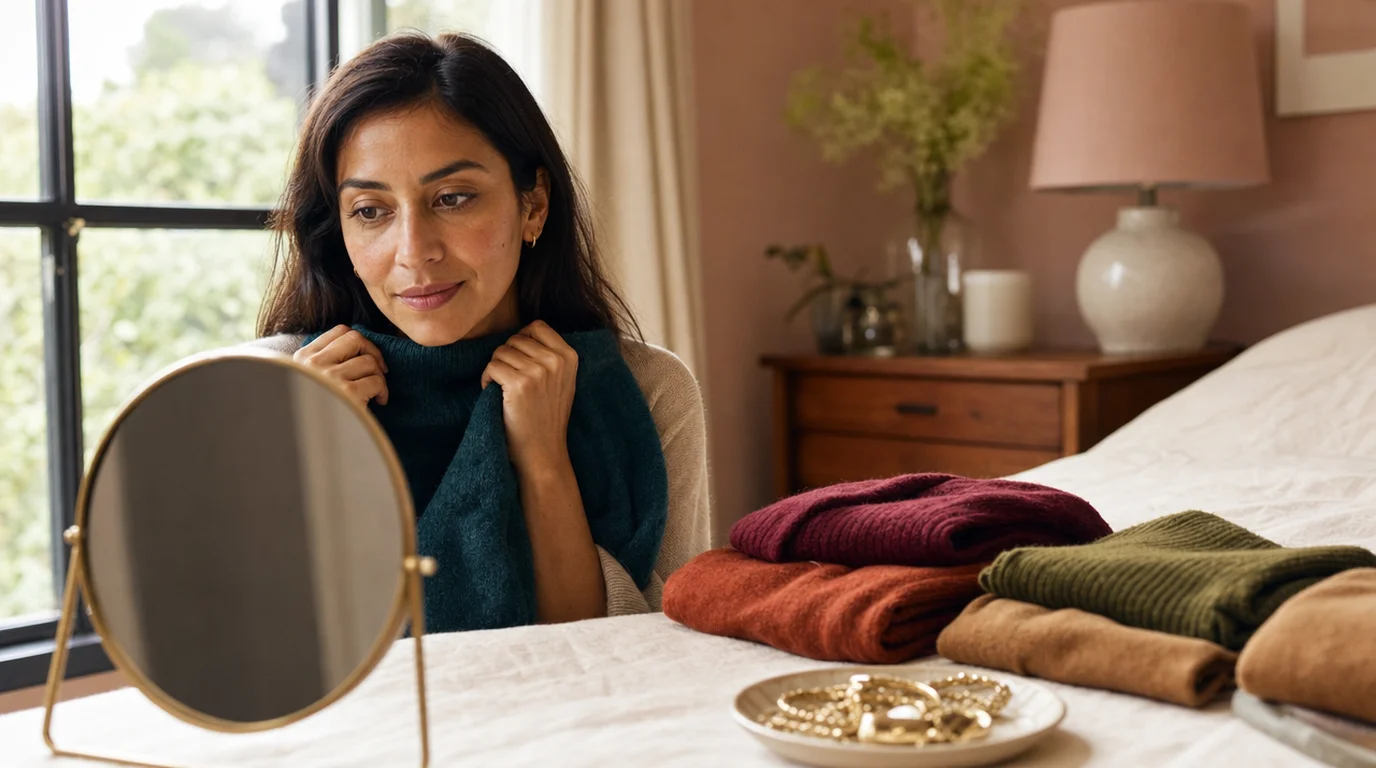

Dark hair, dark warm eyes, skin with a golden or bronze cast, and a face that goes gray in pastels: that’s the classic Deep Autumn. The deep autumn color palette is built for that coloring. It’s dark, warm and rich, full of wine, pine green, deep teal, rust and espresso, and it works in a closet, a makeup bag and a jewelry box alike.
The deep autumn color palette is a set of dark, warm, rich colors for people whose coloring is deep overall with a warm-leaning undertone. Its core shades are deep teal, pine green, wine, red pepper, aubergine and dark peacock, backed by warm neutrals like espresso, camel and oyster white, with antique gold instead of silver.
The deep autumn color palette, color by color
Our Deep Autumn palette has 26 colors in four groups: six best colors to wear near the face, six accents, six neutrals, and eight shades to wear sparingly. These are the exact swatches the palette card in our seasonal color analysis tool uses.
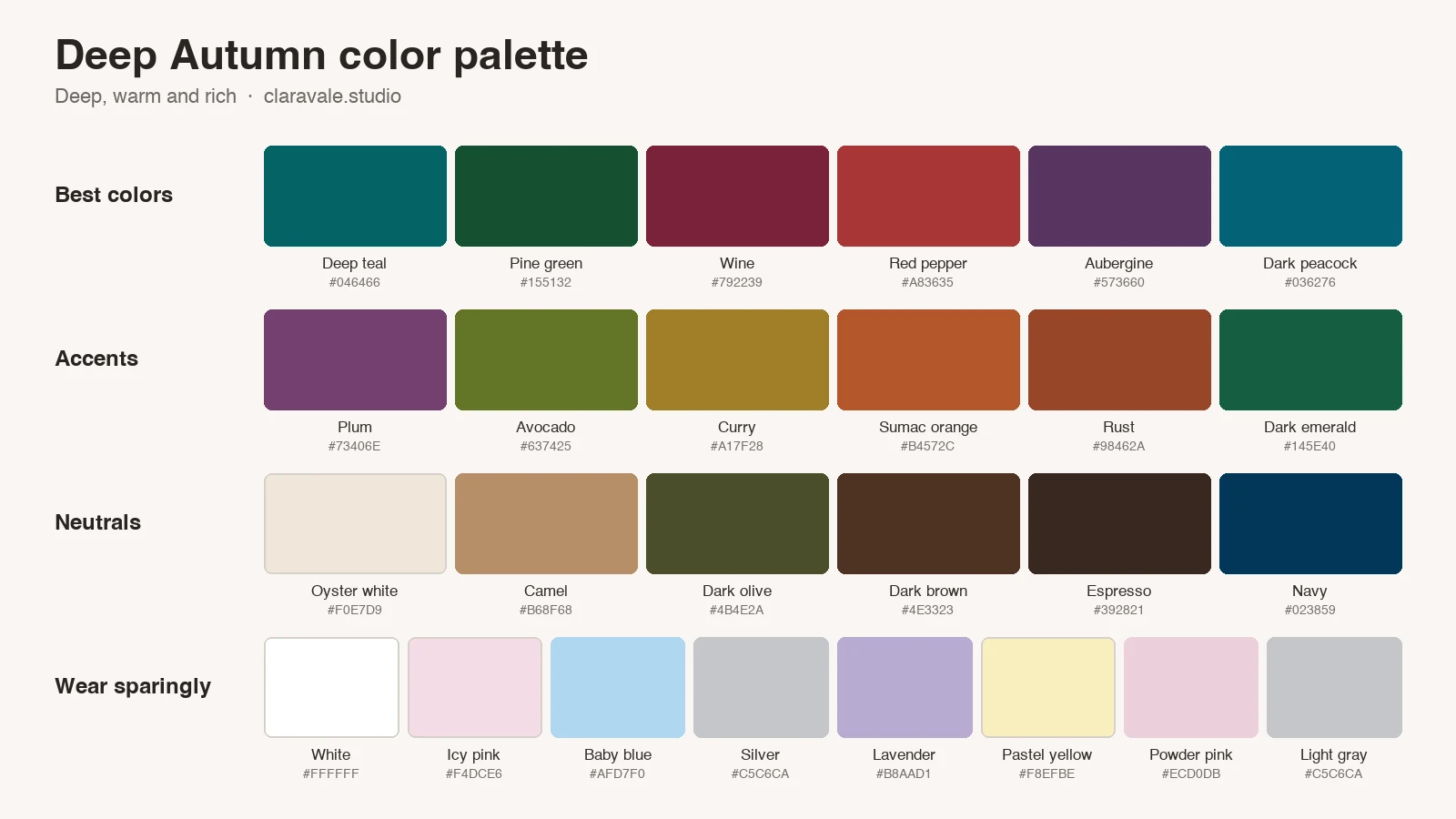
| Group | Colors (hex) |
|---|---|
| Best colors | Deep teal #046466, Pine green #155132, Wine #792239, Red pepper #A83635, Aubergine #573660, Dark peacock #036276 |
| Accents | Plum #73406E, Avocado #637425, Curry #A17F28, Sumac orange #B4572C, Rust #98462A, Dark emerald #145E40 |
| Neutrals | Oyster white #F0E7D9, Camel #B68F68, Dark olive #4B4E2A, Dark brown #4E3323, Espresso #392821, Navy #023859 |
| Wear sparingly | White #FFFFFF, Icy pink #F4DCE6, Baby blue #AFD7F0, Silver #C5C6CA, Lavender #B8AAD1, Pastel yellow #F8EFBE, Powder pink #ECD0DB, Light gray #C5C6CA |
Best colors go closest to your face: tops, scarves, dresses, collars. They carry the most depth, and a wine sweater or a pine green blouse will usually do more for a Deep Autumn than any lighter shade.
Accents are the spicier, earthier side of the palette. Curry, sumac orange and rust read as classic autumn colors. Use them in a print, a bag or a statement coat, or as one piece in an outfit built on neutrals.
Neutrals are the base of the wardrobe. Espresso is the deep autumn stand-in for black, oyster white replaces stark white, and camel and dark olive cover coats, trousers and bags. Navy is the one cooler neutral that still sits well, because it’s so dark.
What makes someone a Deep Autumn
Deep Autumn, also called Dark Autumn, is one of the 12 seasons of color analysis. It’s defined by three traits: deep overall, warm-leaning undertone, and medium to high contrast. Depth is the leading trait. Warmth comes second.
Typical Deep Autumn coloring looks like this:
- Hair: dark brown to near black, often with a red or golden glint in sunlight
- Eyes: dark brown, dark hazel, dark topaz or deep olive green
- Skin: golden, bronze, olive or deep warm brown, at any skin depth
The seasonal system grew out of the early 1980s, when Carole Jackson’s Color Me Beautiful (1980) turned four seasons into a popular way to describe a person’s coloring, as the history of color analysis on Wikipedia outlines. Later 12-season systems split each family into three, so every Autumn now leans soft, true or deep.
Deep Autumn is the darkest of the three Autumns. True Autumn is the warmest, with copper and golden-brown hair and colors like pumpkin and mustard. Soft Autumn is the most muted, with dusty, gentle shades; our soft autumn color palette guide covers that season in detail. A Deep Autumn wearing True Autumn’s pumpkin or mustard often looks a little washed out. The same person in wine or pine green looks rested and defined.
How to know if you’re a Deep Autumn
Three quick checks point toward Deep Autumn. Take each one in daylight, without makeup, with your natural hair color visible.
- Depth test. In a black-and-white photo of your face, your hair and eyes look dark and there’s clear contrast with your skin.
- Warmth test. Gold jewelry looks more natural on you than bright silver, and camel or rust near your face looks more flattering than cool gray or icy pink.
- Drape test. Hold a wine or deep teal fabric under your chin, then a pastel like baby blue or lavender. If the dark color makes your skin look even and your eyes clear, while the pastel makes you look tired or gray, depth is your strongest trait.
Here’s why the drape test works. Deep coloring sets up a strong value contrast between hair, eyes and skin. A dark color near the face matches that contrast, so the face looks balanced. A light, cool pastel shrinks the contrast and pulls attention to shadows and redness instead. That’s a contrast effect, not a rule about which colors are “good.”
If two drapes look equally good, compare Deep Autumn with its neighbors. Deep Winter (darker and cooler) and True Autumn (warmer and lighter) are the two seasons people most often swing between.
Gold or silver? The best metals for Deep Autumn
The metals of the deep autumn color palette are warm: antique gold, bronze and copper. Deep, slightly aged finishes look better than bright polished yellow gold, because they echo the depth of the palette. A hammered bronze cuff, an antique gold chain or copper earrings all fit.
Bright silver sits on the wear-sparingly list. Next to warm, deep coloring it can look cold and a little gray. If most of your jewelry is silver, mixed-metal pieces with a lot of gold in them are an easy bridge, and rose gold is a softer middle ground for a ring or a watch.
Eyeglass frames follow the same idea: tortoiseshell, dark brown, olive, burgundy and antique gold frames tend to look natural on a Deep Autumn.
Deep autumn makeup: blush, lips and eyes
Deep autumn makeup follows the deep autumn color palette for clothes: the same rich, warm range, scaled down to blush, lips and eyes.
- Blush: bronze and brick shades. Pink-based blushes can look chalky on warm, deep skin.
- Lips: deep terracotta, brick red and warm plum. For a darker evening lip, wine and deep berry-brown both work.
- Eyes: rich brown liner instead of jet black, with shadows in bronze, olive, plum, aubergine and warm gold. Brown-black mascara softens the look a touch.
- Base: pick a foundation with a golden or olive undertone. A pink-toned base will show up as a gray cast once it oxidizes.
A simple everyday set is a bronze blush, a terracotta lip and brown liner. For evenings, swap in a brick red or warm plum lip.
The best hair colors for a Deep Autumn
The best hair colors for a Deep Autumn are dark and warm: dark chocolate, espresso with warm lights, and deep auburn. Mahogany and dark chestnut follow the same logic.
Keep the overall depth close to your natural hair. Going much lighter breaks the contrast that defines the season. Add dimension with warm lights instead: copper, bronze, caramel or a deep golden brown, placed around the face.
Shades to skip are the ones that pull hair cool: ash brown, ash blonde, platinum and blue-black. They flatten warm skin and can make the under-eye area look darker. If you’re going gray, a warm gloss or golden lowlights can keep your hair in step with the palette while the gray grows in.
Colors a Deep Autumn should wear sparingly
The eight wear-sparingly colors in the deep autumn color palette share two traits: they’re light and they’re cool. White, icy pink, baby blue, silver, lavender, pastel yellow, powder pink and light gray all sit far from deep, warm coloring.
Wearing them sparingly doesn’t mean throwing them out. A few ways to keep them in the wardrobe:
- Keep them away from the face. Baby blue jeans, a lavender skirt or light gray trousers are fine with a deep autumn top.
- Add a buffer. A wine, rust or espresso scarf between a pastel and your face brings the depth back.
- Swap for the warm, deep version. Oyster white for white, camel for light gray, plum for lavender, dark peacock for baby blue, espresso for black.
Deep autumn vs deep winter
Deep Autumn and Deep Winter share their main trait, depth, and differ in their second one. Deep Autumn leans warm. Deep Winter leans cool. That makes them close neighbors, and the deep autumn color palette even shares a few colors: deep teal, aubergine, wine and navy appear in both.
| Deep Autumn | Deep Winter | |
|---|---|---|
| Traits | Deep, warm-leaning, medium to high contrast | Deep, cool-leaning, high contrast |
| Signature colors | Pine green, red pepper, rust, curry, dark peacock | Emerald, sapphire, burgundy, true red, deep magenta |
| Neutrals | Espresso, dark brown, camel, dark olive, oyster white, navy | Black, pure white, charcoal, cool gray, navy, plum gray |
| Metals | Antique gold, bronze, copper | Silver, platinum, white gold, gunmetal |
| Lips | Terracotta, brick red, warm plum | Deep berry, wine, true red |
| Hair | Dark chocolate, espresso with warm lights, deep auburn | Espresso, blue-black, cool dark brown |
| Wear sparingly | White, icy pink, baby blue, silver, lavender | Camel, beige, rust, mustard, peach, orange |
The fastest way to tell them apart is a pair of drapes: camel or rust against black and pure white. Camel and rust are deep autumn neutrals and sit on Deep Winter’s wear-sparingly list. Black and pure white anchor Deep Winter. If the warm pair makes your skin glow and the stark pair looks harsh, you’re likely a Deep Autumn. If camel turns you sallow and black looks crisp, Deep Winter is the better fit.
Find your season and build your palette
The deep autumn color palette comes down to three ideas: wear dark, warm, rich colors near your face; build on espresso, camel, dark olive and oyster white; and pick antique gold, bronze and copper over bright silver. If you’re not sure you’re a Deep Autumn, run a selfie or the eight-question quiz through our free seasonal color analysis tool. It runs in your browser, so your photo isn’t uploaded, matches you against all 12 seasons, lets you check the result with virtual draping, and gives you a downloadable palette for your season.
Questions people ask
What are some shades of Autumn colors?
Autumn colors are warm and rich: rust, pumpkin, mustard, olive, terracotta, brick, golden ochre, caramel and warm teal. Each Autumn season shifts the mix. True Autumn sits closest to that list, Soft Autumn mutes it, and Deep Autumn darkens it into wine, pine green, aubergine, deep teal and espresso. All three share warm neutrals like camel and cream instead of gray and stark white.
Are Autumns gold or silver?
Autumns are gold. Their warm undertone matches yellow metals, so gold, bronze, copper and brass sit naturally against the skin. Deep Autumn suits the deeper, slightly aged versions best: antique gold, bronze and copper. Bright polished silver tends to look cold and gray next to Autumn coloring, so keep it for small pieces or mixed-metal jewelry with plenty of gold in it.
What color hair should a deep Autumn have?
A Deep Autumn looks best with dark, warm hair: dark chocolate, espresso with warm lights, or deep auburn. Mahogany and dark chestnut fit the same idea. Keep the depth close to your natural shade and add warmth through copper or bronze tones. Ash brown, platinum and blue-black pull the hair cool and make the skin look flat.
Is deep autumn warm or cool?
Deep Autumn is warm-leaning, not strongly warm. Depth is its main trait, warmth comes second. That is why it borders Deep Winter, the same depth with a cool lean. Deep Autumns usually look best in colors that are both dark and warm, and they can borrow a few dark, slightly cool shades like deep teal, navy and aubergine.
Is dark autumn the same as deep autumn?
Yes. Dark Autumn and Deep Autumn are two names for the same season in the 12-season system. It describes coloring that is deep overall, warm-leaning in undertone and medium to high in contrast. Some color analysts and brands use one name, some the other, but the palette and the advice are the same.
Can a deep autumn wear black?
Deep Autumn is the Autumn season that handles black best, because it is so close to Deep Winter. Still, espresso and dark brown usually look softer and warmer near the face. If you love black, wear it in trousers, shoes or a coat, and add a deep autumn color like wine, teal or rust at the neckline.
What neutrals look best on a deep autumn?
The best deep autumn neutrals are oyster white, camel, dark olive, dark brown, espresso and navy. They replace the stark white, gray and black that anchor cooler wardrobes. Espresso works as a near-black, oyster white works as a soft white, and camel and dark olive make good coat, trouser and bag colors that go with every shade in the palette.