
A coworker’s offhand comment stays with you all evening. A friend’s confidence irritates you more than it should. You snap at someone you love, then wonder where that came from. Moments like these are where the answer to what is shadow work starts to get practical: they point at parts of you that usually stay out of view. Shadow work is a way of turning toward those parts with curiosity instead of shame, mostly with a pen and a few honest questions.
Shadow work is the practice of getting to know the parts of yourself you usually hide, push away or don’t notice. The idea comes from psychiatrist Carl Jung, who called those parts “the shadow.” In practice it means noticing strong reactions and repeating patterns, then writing about them honestly and kindly until they make sense.
What is shadow work?
Shadow work is self-reflection aimed at your blind spots. Everyone builds a picture of who they are: patient, generous, easygoing, capable. Traits that don’t fit that picture, like anger, envy, neediness or even ambition, don’t disappear. They get pushed out of awareness, and they tend to show up sideways, in overreactions, harsh judgments of other people or habits you can’t quite explain.
The work itself is simple to describe. You notice those moments, get curious about them and write them down. Over time, the notes show patterns, and the patterns show you what you’ve been keeping in the dark. The goal isn’t to fix or erase anything. It’s to see yourself more fully, so those hidden traits stop steering your choices without your consent.
That’s why shadow work for beginners looks so ordinary. There are no rituals and no special tools. Most of it is journaling, plus a habit of pausing when something stings.
Where the idea of the shadow comes from
The shadow is one of the central ideas in Carl Jung’s analytical psychology. Jung, a Swiss psychiatrist, described the psyche as having conscious and unconscious layers, and the shadow as the part of the unconscious made of what the conscious self rejects.
According to the encyclopedia entry on the shadow in psychology, Jung’s shadow is “an unconscious aspect of the personality that does not correspond with the ego ideal.” The same entry notes the shadow “may be positive or negative,” which means hidden strengths can live there too, not only flaws.
Two details from Jung’s thinking matter most in day-to-day shadow work:
- Projection. Jung observed that the shadow tends to be projected onto other people. A trait you can’t accept in yourself becomes the trait you notice, and dislike, in others. That’s why sharp judgments are such useful clues.
- The bright side of the shadow. Qualities you were told were “too much,” like being loud, ambitious or emotional, can end up in the shadow as well. Many people find that shadow work returns some of their best qualities to them.
Jung also used the shadow as a tool in long-term analysis with a trained analyst. The modern self-help version is lighter: a personal journaling practice built on his core idea, not a substitute for that clinical setting.
How do I figure out what my shadow is?
There’s no test that hands you a list. The shadow shows itself through clues, and the job is to collect them. In our work writing the 201 prompts for our shadow work journal, the same five clue types kept coming up:
| Clue | What it can look like | A question to ask |
|---|---|---|
| Outsized reactions | Fury over a small comment, tears that surprise you | What did this moment remind me of? |
| Strong judgments of others | “I can’t stand people who brag” | Where do I hide that trait, or wish I had it? |
| Repeating patterns | The same argument, the same kind of partner, the same burnout | What does this pattern give me, even now? |
| Deflected praise | Waving off “you’re so talented” | What would change if I believed it? |
| Envy | A pang when a friend shares good news | What do I want that I haven’t let myself want? |
Naming the feeling precisely helps more than it seems to. “Bad” or “upset” tells you very little. “Embarrassed,” “dismissed” or “resentful” points straight at the story underneath. Our free emotion wheel tool is a quick way to move from a vague feeling to a precise word before you start writing.
How to start shadow work: a beginner’s step-by-step
This routine takes ten to fifteen minutes. Do it two or three times a week rather than in one long session.
- Pick one moment. Choose something recent and small: a flash of irritation, a comment that stung, an urge to avoid someone. Small moments are easier to look at honestly.
- Write what happened, plainly. Facts only, as if describing a scene in a film. Who said what, where you were, what you did.
- Name the emotion. Find the most specific word you can. If two feelings were mixed, write both.
- Ask what it reminded you of. Strong reactions often echo something older: a role you played in your family, a rule you learned early, a fear you’ve carried for years.
- Look for the need underneath. Every shadow trait protects something. Anger can guard a boundary. Envy can point at a wish. Write what the reaction was trying to get for you.
- Close with kindness. End every session with one compassionate sentence to yourself, such as “It makes sense that I felt that way.” This step keeps the practice from sliding into self-criticism.
Once a week, reread your entries. Patterns rarely appear in a single page, but they’re often obvious across six or eight of them. Because these pages are personal, keep them somewhere only you can open: a notebook you put away, or a private journal app such as 3 Pages Daily, which keeps entries on your iPhone, iPad or Mac.
20 gentle shadow work prompts to begin with
These shadow work prompts are written for beginners. Use one per session, and skip any that don’t feel right today.
Noticing your patterns
- What situation reliably puts me in a bad mood, and what do those moments have in common?
- Which habit do I keep promising to change? What does it do for me right now?
- When do I say yes while meaning no?
- What do I tend to do when I feel ignored?
Triggers and projection
- Who irritated me most this week? What exactly did they do?
- Which trait in other people do I judge fastest? When have I shown a little of it myself?
- Describe a recent overreaction. If the feeling could speak, what would it say?
- What compliment do I find hardest to accept, and why?
Your inner critic
- What does my inner critic say most often? Whose voice does it sound like?
- What is the critic trying to protect me from?
- How would I answer that voice if it were speaking to a friend I love?
Family and early rules
- Which feelings were welcome in my home growing up, and which were not?
- What role did I play in my family: peacemaker, achiever, the easy one? Do I still play it?
- Which rule from childhood do I still follow without thinking?
Envy and the bright shadow
- Who do I envy right now? What do they have that I want?
- Which part of myself did I tone down to fit in?
- What would I try if nobody I know would ever find out?
Integration and self-compassion
- What part of me have I been at war with? What would a truce look like?
- What do I need more of this month, and how can I give it to myself?
- What would I like to say to my younger self about everything I wrote today?
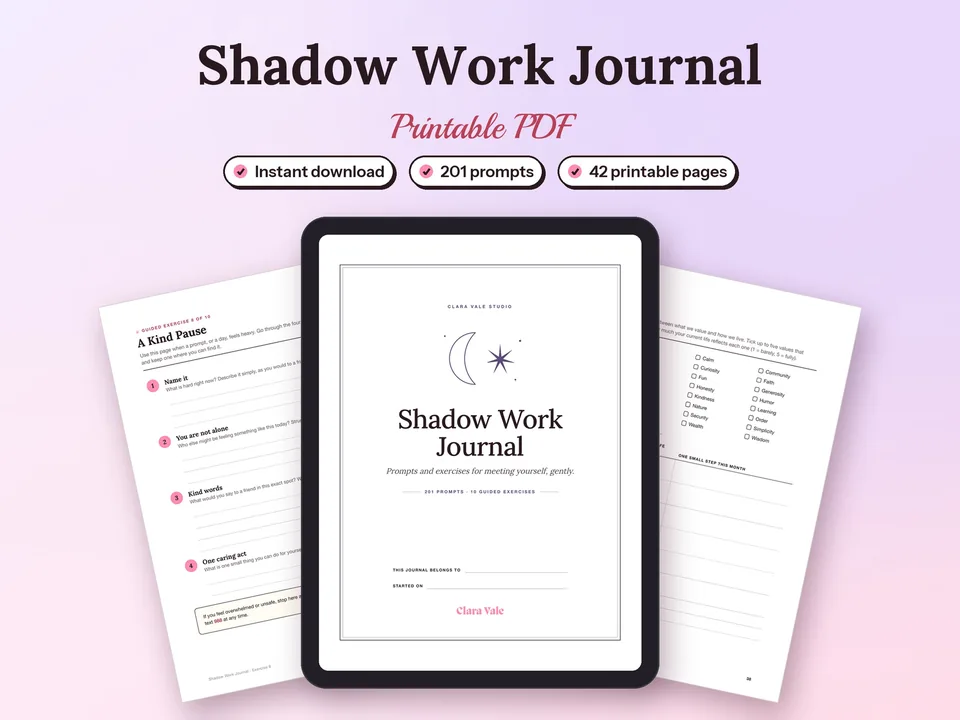
If these help and you want a longer path, our Shadow Work Journal Prompts & Exercises is a printable 42-page PDF with 201 numbered prompts and 10 guided exercises, including a Trigger Tracker, a Mirror Page for projection, an Envy Decoder and a Golden Shadow page. It opens with a plain introduction to Jung’s idea and works on paper or in GoodNotes and Notability.
How do you integrate your shadow self?
Seeing a pattern is the first half of shadow work. Integration is the second: accepting the trait as part of you and choosing what to do with it, instead of denying it or letting it run the show.
Here’s what that looks like with a common example. Say your notes show that you resent friends who rest without guilt. The shadow trait might be your own need for rest, filed away long ago as “lazy.” Integration doesn’t mean becoming someone else. It means admitting the need (“I’m tired, and I want permission to stop”), then meeting it in a healthy, deliberate way, like a protected evening off each week. The resentment usually softens once the need has a legitimate outlet.
The mechanism is straightforward. A trait you refuse to see can only act through you indirectly, as irritation, projection or a habit that undercuts you. A trait you’ve named and accepted becomes something you can make decisions about. That shift, from being driven by a pattern to choosing around it, is what integration means in practice.
Expect it to be slow. Most people revisit the same theme many times, each pass a little calmer than the last.
Shadow work is self-reflection, not therapy
Shadow work journaling is a self-reflection practice. It isn’t therapy, diagnosis or treatment, and it’s no replacement for working with a licensed professional. Some boundaries help keep it gentle:
- Stay with everyday material. Triggers, habits and relationships are good ground for self-guided work. Trauma, abuse and grief that still feels raw deserve a trained guide.
- Watch your nervous system. If writing leaves you shaky, numb, panicky or stuck in old memories for days, stop and take a break.
- See a professional when it keeps hurting. A licensed therapist or counselor can help when old pain keeps resurfacing, when low mood lasts for weeks, or when daily life gets hard to manage. Some clinicians draw on Jungian ideas; others use structured trauma therapies such as EMDR, an eight-phase treatment that Cleveland Clinic describes as best known for treating PTSD.
- Reach out in a crisis. In the US, call or text 988, or chat at chat.988lifeline.org. The 988 Suicide & Crisis Lifeline is available 24/7, and conversations are free and confidential.
Used this way, shadow work can sit comfortably next to other reflection habits. Many people pair it with lighter practices, like the ideas in our guide to journal prompts, so not every session goes deep.
Starting your shadow work practice
Shadow work comes down to three moves: notice the moments that sting, get curious about what they point to, and treat what you find with kindness. Pick one prompt from the list above, give it ten minutes tonight and end with a compassionate sentence. If you’d like questions that widen the lens beyond the shadow, to your values, strengths and plans, our Self-Discovery Journal Prompts offers 210 of them in a printable PDF.
Questions people ask
What is shadow work?
Shadow work is the practice of getting to know the parts of yourself you usually hide, push away or don't notice. The idea comes from Carl Jung, who called those parts the shadow. In everyday life it mostly means noticing strong reactions and repeating patterns, then writing about them honestly and kindly until they make sense.
How do I figure out what my shadow is?
Watch for clues rather than hunting for one big answer. Strong reactions that feel bigger than the moment, traits in other people that irritate you, compliments you can't accept and habits you keep repeating all point toward it. Write each clue down with what happened and what you felt. Patterns usually show up after a few weeks of notes.
How do you integrate your shadow self?
Integration means accepting a trait as part of you and choosing what to do with it, rather than denying it or letting it run the show. Name the trait, ask what it was trying to protect, find a healthy way to meet that need, and practice that choice in small moments. It is slow, repeated work, not a single breakthrough.
Is EMDR considered shadow work?
They are separate practices. EMDR (eye movement desensitization and reprocessing) is a structured, eight-phase therapy that a trained mental health provider uses mainly to treat trauma and PTSD. Shadow work is a self-reflection practice rooted in Carl Jung's ideas. Both can touch painful material, but EMDR is clinical treatment, while shadow work journaling is something you do on your own.
Is shadow work safe to do on your own?
Gentle shadow work, like journaling about everyday triggers and habits, is a form of self-reflection most people can do on their own. Go slowly and stop if a prompt brings up memories that feel overwhelming. Trauma, abuse and ongoing distress belong with a licensed therapist or counselor. In the US, call or text 988 if you are in crisis.
How do I start shadow work as a beginner?
Start small: set aside ten to fifteen minutes, pick one recent moment that stirred a strong feeling, name the emotion as precisely as you can and write what it reminded you of. Use one prompt per session, end with a line of self-compassion, and reread your notes weekly to spot patterns.