
How many emotions are there? Ask five sources and you’ll get five different answers: four, six, seven, eight, 27, or a wheel with 130 words on it. None of those numbers is wrong. Each one comes from a different way of counting, from facial expressions and evolution to video studies and the everyday words people use to describe how they feel. Below, we line up the major models side by side, explain primary vs secondary emotions, and show why a bigger feelings vocabulary is more useful than any single count.
There is no single agreed number of human emotions. Paul Ekman named six basic emotions (seven with contempt), Robert Plutchik proposed eight primary emotions, and a 2017 Berkeley study found 27 categories. Feelings wheels go further: the Roberts wheel opens seven core feelings into 130 words.
This post is for self-reflection and general education. It isn’t therapy or a diagnosis.
How many emotions are there? The answer by model
The count depends on what a researcher is counting. Some count facial expressions that people everywhere recognize. Some count the building blocks that mix into other feelings. Others count the distinct experiences people report. Here’s how the best-known models compare:
| Model | How many emotions | What it counts |
|---|---|---|
| Jack and colleagues (2014) | 4 basic | Early facial signals that merge fear with surprise, anger with disgust |
| Paul Ekman | 6 basic, 7 with contempt | Facial expressions recognized across cultures |
| Robert Plutchik (1980) | 8 primary | Building blocks that blend into other emotions |
| Cowen and Keltner (2017) | 27 categories | Feelings people reported while watching 2,185 videos |
| Roberts feelings wheel (2015) | 7 core, 130 words in total | Everyday words for naming a feeling |
The smallest count comes from a University of Glasgow team led by Rachael Jack. Their study of facial expressions found that fear and surprise look alike early on, and so do anger and disgust, which led them to argue for four basic emotions rather than six. The largest counts come from tools built for naming feelings, where precision matters more than a short list.
So the honest answer to how many emotions are there is “it depends on the question.” If you want the universal basics, the answer is six or seven. If you want words that help you describe a hard day, the answer runs into the hundreds.
Ekman’s six basic emotions (and the seventh)
Psychologist Paul Ekman studied facial expressions across cultures and found a small set that people everywhere recognize. According to the Paul Ekman Group, the six basic emotions are anger, surprise, disgust, enjoyment, fear and sadness, and his research shows the strongest evidence of a seventh: contempt.
That’s why “six” and “seven” both show up as answers. Many textbooks still teach the original six, with “happiness” in place of “enjoyment.” Ekman’s later work added contempt as the seventh.
The basic-emotions view treats these as distinct and universal, each with its own expression and purpose. Fear readies you to escape. Disgust keeps you away from something harmful. Anger pushes back against something that feels unfair.
The limit of this model is range. Six or seven labels can’t tell embarrassment from guilt or contentment from pride. That gap is where the larger models come in.
Plutchik’s wheel of emotions: eight primary emotions
Robert Plutchik took an evolutionary view and named eight primary emotions: anger, fear, sadness, disgust, surprise, anticipation, trust and joy. According to his Wikipedia biography, he first proposed his wheel and cone models in 1980.
The Plutchik wheel of emotions arranges the eight as four opposite pairs:
- Joy vs sadness
- Anger vs fear
- Trust vs disgust
- Surprise vs anticipation
Plutchik’s wheel works like a color wheel. Each primary emotion has milder and stronger forms, and neighbors blend into new feelings. Joy and trust next to each other combine into love, for example. That idea of blending is what makes the Plutchik model so useful: eight building blocks explain a much longer list of feelings without treating each one as separate.
The 27 emotions from the Berkeley study
In 2017, UC Berkeley researchers Alan Cowen and Dacher Keltner asked 853 people to report how they felt while watching 2,185 short video clips. As Berkeley News reported, the responses needed 27 distinct categories to describe them, not six.
The 27 include familiar emotions such as joy, fear and sadness, along with ones the basic models leave out: awe, nostalgia, empathic pain, awkwardness, entrancement, craving and aesthetic appreciation. The full list is in the FAQ at the end of this post.
The second finding matters as much as the number. The paper in PNAS, titled “Self-report captures 27 distinct categories of emotion bridged by continuous gradients,” found that many categories are linked by smooth gradients rather than sharp borders. Awe shades into peacefulness. Horror shades into sadness. Emotions behave less like separate boxes and more like a map with blurry edges between neighboring regions.
That’s a good reason to stop worrying about the “right” answer to how many emotions are there. If feelings blend into each other, the useful skill is finding the word that sits closest to what you feel.
Feelings wheels: 7 core feelings, 130 words
Feelings wheels count emotions for a practical job: helping you put a feeling into words. The original Feeling Wheel was published by Gloria Willcox in the Transactional Analysis Journal in 1982. Later versions built on her idea, and the one most people know today is the 2015 wheel by Geoffrey Roberts.
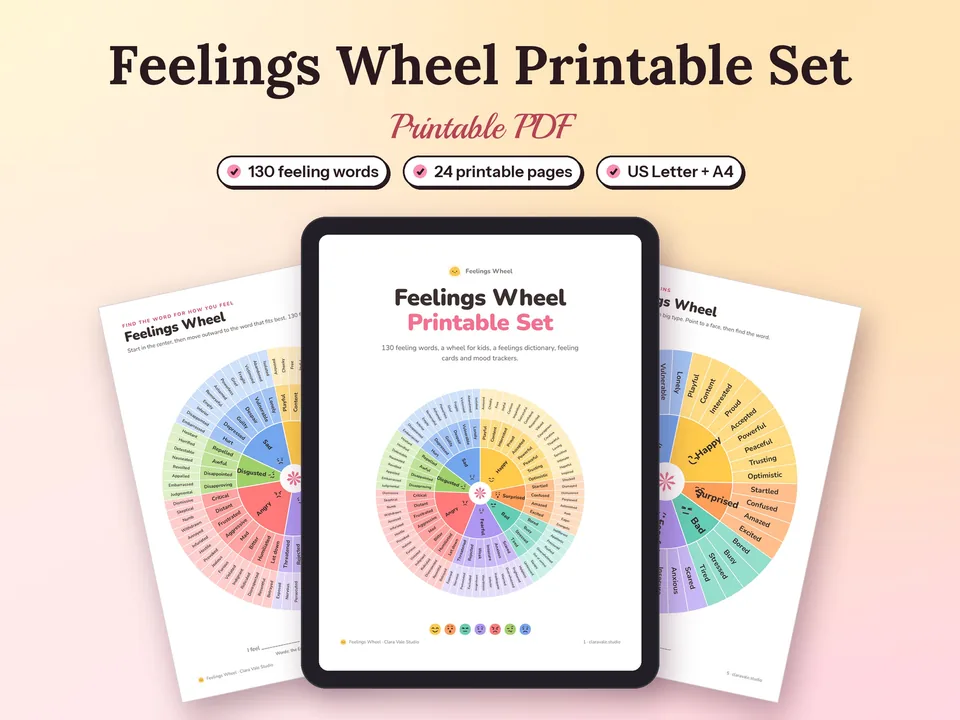
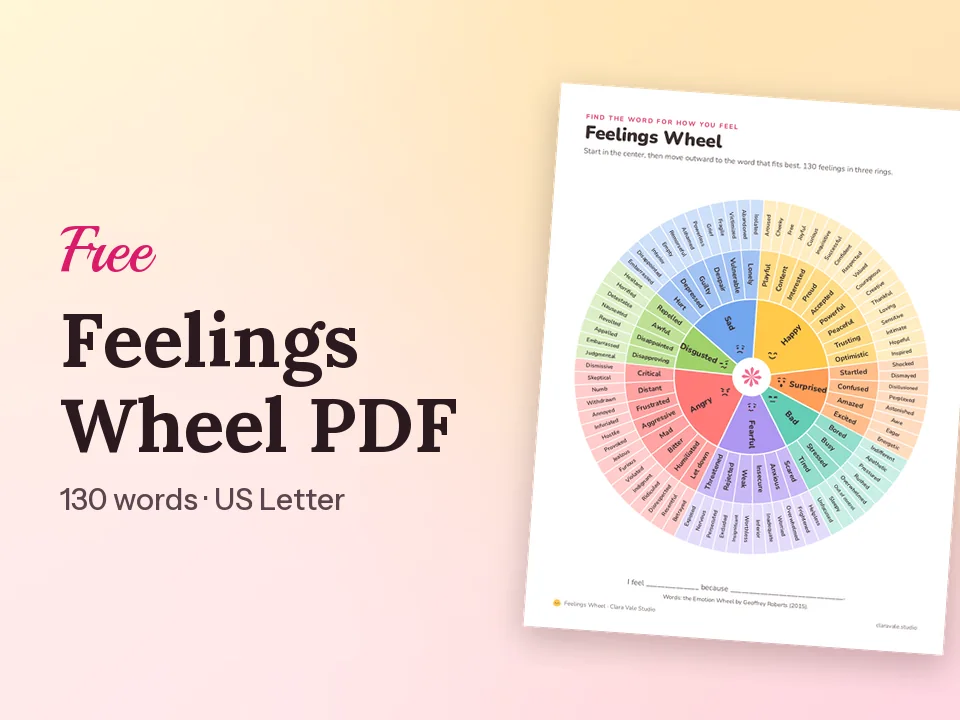
The Roberts wheel has three rings:
- 7 core feelings in the center: happy, surprised, bad, fearful, angry, disgusted and sad.
- 41 more specific feelings in the middle ring.
- 82 most specific words on the outer ring.
That’s 130 words in total. It’s the wheel behind our interactive emotion wheel, where you can tap a core feeling and zoom out to the exact word, with a plain-English meaning and a journal prompt for each one.
A wheel reads from the inside out. Start with fearful, move to anxious, then land on overwhelmed. Start with angry, move to frustrated, then land on annoyed. Each step narrows the feeling, and the outer word usually points to what you need next.
When we wrote meanings for all 130 words, four of them turned up in two places on the wheel: overwhelmed, inferior, embarrassed and disappointed. Embarrassed sits under disgusted and also under sad, inside hurt. That’s the Berkeley finding in miniature. The same word can belong to two families because real feelings overlap.
Primary vs secondary emotions
Primary emotions are your first, direct reaction to something. A car swerves toward you and you feel fear. A friend cancels on your birthday and you feel hurt. These reactions are quick and usually match the situation.
Secondary emotions are reactions to the first feeling, or feelings layered on top of it. Hurt turns into anger because anger feels less exposed. Anxiety turns into shame because you think you shouldn’t feel anxious. The secondary emotion is often the one you notice, and the primary one sits underneath.
The term “secondary emotions” also shows up in a second sense: blends of primary emotions, like Plutchik’s love from joy and trust. Both senses share one idea. Some feelings are simpler and come first, and others are built from them.
Here’s why the difference matters in daily life. Snapping at your partner after a hard day can look like anger. Look one ring further in and the primary emotion might be disappointment or feeling left out. Responding to the primary emotion usually works better than responding to the one on the surface.
Why naming emotions precisely helps
Psychologist Lisa Feldman Barrett coined the term “emotional granularity” in the 1990s for the ability to tell similar feelings apart. Someone with low granularity might say “I feel bad.” Someone with high granularity can tell disappointed from lonely from resentful.
The research behind this is encouraging. A 2022 editorial in Frontiers in Psychology summarizes studies linking high emotional granularity with less alcohol abuse, binge eating and physical aggression, and with regulating emotions more often. Those are associations rather than proof of cause, but they point the same way.
The mechanism is simple. A vague label gives you a vague next step. “Bad” doesn’t tell you much. “Overwhelmed” suggests taking something off your plate. “Lonely” suggests reaching out to someone. A precise word turns a feeling into information you can act on.
That’s also why the answer to how many emotions are there matters less than your vocabulary. Knowing that Ekman counted six is interesting. Having 130 words ready when you need one is useful.
A simple practice to build granularity:
- Pause and notice what your body is doing: tight chest, heavy limbs, a racing mind.
- Pick the closest of the seven core feelings.
- Move outward one ring, then another, until a word fits.
- Finish the sentence “I feel ___ because ___.”
Our free Feelings Wheel app turns this into a 10-second check-in on iPhone and iPad, with its own 124-word wheel and a private mood journal. If you’d rather work on paper, the Feelings Wheel Printable Set adds a feelings dictionary for all 130 words, 48 feeling cards and mood trackers.
If emotions often feel too big to name or manage, a licensed therapist or counselor can help. A feelings wheel is a self-reflection tool, not a replacement for care.
Find your word on the wheel
How many emotions are there? Six or seven if you count Ekman’s universal expressions, eight if you follow Plutchik, 27 if you follow the Berkeley data, and 130 words on a full feelings wheel. The more useful question is which word fits what you feel right now. To keep one within reach, print our free feelings wheel PDF and stick it on the fridge, in a journal or next to your desk.
Questions people ask
How many core emotions are there?
It depends on the model. Paul Ekman's research names six basic emotions, plus contempt as a seventh. Robert Plutchik's wheel has eight primary emotions. The feelings wheel by Geoffrey Roberts, used on our emotion wheel and printables, starts from seven core feelings: happy, surprised, bad, fearful, angry, disgusted and sad. All three are useful starting points rather than a final count.
What are the core emotions?
The most cited set is Ekman's: anger, surprise, disgust, enjoyment, fear and sadness, with contempt as a seventh. Plutchik's list is joy, trust, fear, surprise, sadness, disgust, anger and anticipation. On a feelings wheel, the core feelings sit in the center ring, and every more specific word on the outer rings belongs to one of them.
What is the difference between primary and secondary emotions?
A primary emotion is your first, direct reaction to something, such as fear when a car swerves toward you. A secondary emotion is a reaction to that first feeling, or a feeling layered on top of it, such as anger that covers hurt or shame about feeling anxious. Spotting the primary emotion underneath often makes the next step clearer.
What are the differences between positive and negative emotions?
Positive emotions, such as joy, calm or pride, feel pleasant. Negative emotions, such as fear, anger or sadness, feel unpleasant. Neither group is good or bad to have. Unpleasant emotions often carry useful information, such as a boundary being crossed or a loss that needs attention. Naming the exact feeling tells you more than sorting it as positive or negative.
Can you give me a list of positive and negative emotions?
Pleasant emotions include joyful, content, proud, hopeful, grateful, curious, amused, relieved, loved and peaceful. Unpleasant emotions include anxious, overwhelmed, frustrated, lonely, disappointed, embarrassed, jealous, resentful, bored and hurt. Our interactive emotion wheel lists all 130 words from the Roberts feelings wheel, grouped under seven core feelings, with a short meaning for each one.
How to identify your emotions?
Pause and notice what your body is doing, then pick the closest core feeling: happy, surprised, bad, fearful, angry, disgusted or sad. Move outward on a feelings wheel to a more specific word, and finish the sentence "I feel ___ because ___." If feelings stay hard to name or to manage, a licensed therapist or counselor can help.
What is emotional granularity?
Emotional granularity is the ability to tell similar feelings apart and name them precisely, such as telling disappointed from hurt or anxious from overwhelmed. Psychologist Lisa Feldman Barrett coined the term in the 1990s. Research reviews link higher granularity with handling difficult emotions better, which is one reason a feelings wheel with specific words is useful.
What are the 27 emotions?
The 27 categories from Cowen and Keltner's 2017 study are admiration, adoration, aesthetic appreciation, amusement, anger, anxiety, awe, awkwardness, boredom, calmness, confusion, craving, disgust, empathic pain, entrancement, excitement, fear, horror, interest, joy, nostalgia, relief, romance, sadness, satisfaction, sexual desire and surprise. The study found that many of them blend into each other.