
Depop fees are low for US sellers, but they’re spread across three places that are easy to mix up: a selling fee, a payment processing fee and an optional boosting fee. Each one is charged on a slightly different number. A $25 sweater and a $100 jacket end up paying very different shares, and a Boosted sale can more than triple what Depop takes. Below we break down each fee, run four common price points, and show how to set prices and shipping so the fees land where you expect.
Quick answer: As of November 2026, Depop charges US sellers a 0% selling fee. Each sale pays payment processing of 3.3% + $0.45 on the item price, shipping and sales tax. If a sale comes through a Boosted listing, Depop adds 12% of the item price. Most regular sales cost about 4% to 6% of the item price. To run your own prices, use the free Depop fee calculator.
What are Depop’s fees for US sellers?
Depop’s fees for US sellers come down to one fee you always pay and one you choose. Per Depop’s seller fees page, here’s the full list as of November 2026:
| Fee | Rate (US) | Charged on | When |
|---|---|---|---|
| Selling fee | 0% | n/a | Never, for US sellers |
| Payment processing | 3.3% + $0.45 | Item price + shipping + sales tax | Every sale |
| Boosted listing fee | 12% | Item price excluding tax (plus shipping if you use your own label) | Only sales from a boosted placement |
| Listing fee | $0 | n/a | Listing is free |
Selling fee. Depop’s 10% selling fee still applies in some other countries, but US sellers pay 0%. That’s the headline that makes Depop one of the cheapest resale apps in the US.
Payment processing. This is the fee on every sale. Depop runs payments itself, and the 3.3% + $0.45 covers card processing. The catch is the base: it’s the full amount the buyer pays, so shipping and sales tax raise the fee even though neither one is your income.
Boosted listings. Boosting gives a listing extra placement in search and the For You feed. Per Depop’s Boosted Listings help page, the 12% fee applies only when a buyer viewed, clicked or liked the boosted listing and then bought it within 28 days. Organic sales of a boosted item carry no boost fee.
Here’s the whole fee structure in one line: as of November 2026, Depop charges US sellers no selling fee, a payment processing fee of 3.3% plus $0.45 on the full order (item, shipping and sales tax), and a 12% fee on the item price for sales that come through a Boosted listing.
How Depop fees add up at $10, $25, $50 and $100
Percentages hide the fixed $0.45, so we ran four price points through the same formulas our Depop fee calculator uses. Assumptions: the buyer pays $6 shipping on a Depop shipping label (so the $6 covers the label), sales tax is 7% on item plus shipping, and your item cost isn’t counted yet.
| Item price | Buyer pays | Processing fee | You keep | Fee as % of price | Boosted sale: you keep |
|---|---|---|---|---|---|
| $10 | $17.12 | $1.01 | $8.99 | 10.1% | $7.79 |
| $25 | $33.17 | $1.54 | $23.46 | 6.2% | $20.46 |
| $50 | $59.92 | $2.43 | $47.57 | 4.9% | $41.57 |
| $100 | $113.42 | $4.19 | $95.81 | 4.2% | $83.81 |
The $25 sale, step by step:
- The buyer pays $25 + $6 shipping = $31, plus 7% tax = $33.17.
- Processing is 3.3% of $33.17 = $1.09, plus $0.45 = $1.54.
- You keep $25 − $1.54 = $23.46. The $6 shipping pays for the label.
- If the sale came through a boost, add 12% of $25 = $3.00. You keep $20.46.
Two patterns show up. Small items carry the heaviest fee share, because the fixed $0.45 and the 3.3% on shipping matter more when the item is cheap. And boosting changes the math far more than processing does: on a $100 item, the boost costs $12 while processing costs $4.19.
Why Depop’s processing fee is bigger than 3.3%
The rate reads as 3.3%, but the base is the buyer’s whole payment. On a $25 item, that base is $33.17, about a third larger than the item price. Add the fixed $0.45 and the real cost is 6.2% of what you earn on the item.
This is how card processing works across most marketplaces: the processor is paid on every dollar it moves, and sales tax and shipping are dollars it moves. Depop collects and remits sales tax for the state, so that tax money never reaches you, but it still sits inside the processing base.
Shipping works the same way. If you charge $10 shipping on a heavy coat, the processing fee rises by about $0.35 compared with a $0 shipping listing. Not huge, but it’s worth knowing when you compare a Depop label with your own carrier.
Depop fees for buyers: the Marketplace fee
Buyers pay their own fee, separate from yours. Per Depop’s Marketplace fee page, US buyers have paid a Marketplace fee since July 18, 2024: up to 5% of the item price plus a fixed amount of up to $1, excluding tax and shipping. The exact amount shows at checkout.
For sellers, two things matter. The Marketplace fee comes out of the buyer’s payment, so your earnings stay the same. And buyers see a total that’s a little higher than your listed price, which is one reason offers on Depop often come in a few dollars under asking. Price with a small cushion for that.
How to price around Depop fees
Because Depop’s standard fee is small, the bigger pricing decisions are about boosting, shipping and offers.
Work backward from what you want to keep. To keep $40 on a non-boosted sale with $6 shipping and 7% tax, list at about $42.15. If you plan to boost, list at about $48.14 to keep the same $40. The formula: (target + $0.45 + 3.3% of taxed shipping) ÷ (1 − 3.3% × 1.07), and subtract another 12% in the denominator for a boosted listing.
Boost where the 12% buys speed. Boosting is low-risk because the fee only applies to sales it produced. It makes the most sense on items that are slow to sell or priced under about $30, where 12% is a few dollars. On a $150 jacket, the same boost costs $18, so let strong pieces sell organically first.
Use Depop shipping labels when you boost. The 12% skips shipping on a Depop label but includes shipping when you arrange your own. On a boosted sale with $10 own-label shipping, that’s $1.20 more in fees.
Count free shipping as a price cut. Set shipping to $0 and the label comes out of your earnings. A $30 item with free shipping and a $6 label really nets you about $24 before processing.
Track cost, not just fees. The fee table above shows what you keep from Depop, not your profit. Our reseller profit calculator adds what you paid for the item and your supplies, and compares the same sale on Poshmark, Mercari and eBay.
How Depop payouts work
Each sale lands in your Depop Balance first, with fees already taken out. Per Depop’s How do I get paid? (US) help page, the money becomes available 2 business days after the item shows as delivered, or 10 business days after the sale, whichever comes first.
From there you withdraw to your linked bank account, and it can take up to 5 days to arrive. Your bank details need to match the ones on your Depop account, and Depop may ask you to verify your identity first. A refund can push your balance negative, which holds up payouts until it’s back above zero.
For cash flow, plan on one to two weeks between a sale and money in your bank. When we map out reselling budgets, that lag matters more than the 3.3%.
How Depop fees compare with Poshmark and Mercari
Depop’s processing-only model is the cheapest of the big US clothing apps for most sales. Poshmark takes a flat $2.95 under $15 and 20% at $15 and up, so a $50 sale costs $10 there against about $2.43 on Depop. Our Poshmark fees breakdown walks through that structure in detail.
The full Depop vs Poshmark comparison goes further, into buyers, shipping and what sells on each app.
The gap narrows on Boosted Depop sales. A boosted $50 item keeps $41.57, against $40 on Poshmark, so boosting everything gives back most of Depop’s fee advantage.
Keeping more of each Depop sale
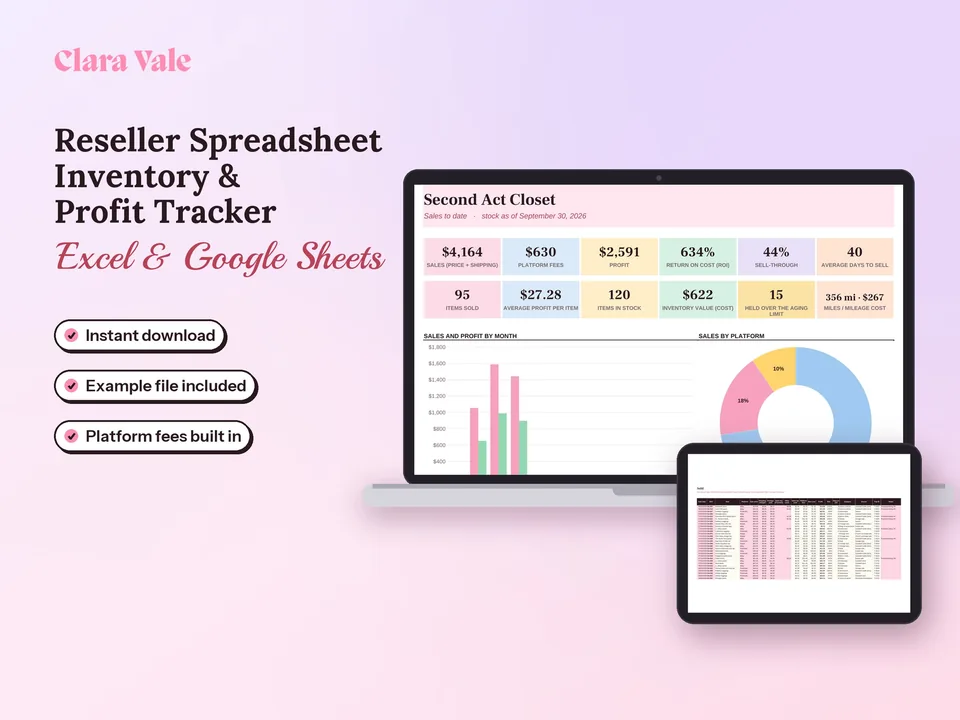
Depop fees for US sellers boil down to 3.3% + $0.45 on the whole order, plus 12% when a boost made the sale. Price small items with the fixed fee in mind, boost selectively, and count shipping you cover as part of your price. To see which of your items and platforms actually earn the most over time, our Reseller Spreadsheet logs each item’s cost, sale price, fees and profit in one place.
Questions people ask
How much does Depop take from $100?
On a $100 item with $6 buyer-paid shipping and 7% sales tax, Depop takes about $4.19 in payment processing (3.3% of the $113.42 order plus $0.45), so you keep $95.81. On the item alone, with no shipping or tax, the fee is $3.75. If the sale came through a Boosted listing, add $12 more.
How much does Depop take from $30?
With $6 shipping and 7% sales tax, the buyer pays $38.52 and Depop's processing fee is about $1.72, so you keep $28.28 of your $30. On the $30 item alone, the fee is $1.44. A Boosted sale adds 12% of the item price, or $3.60.
How much does Depop charge you to sell an item?
US sellers pay a 0% selling fee. Every sale carries payment processing of 3.3% plus $0.45, charged on the full amount the buyer pays: item, shipping and sales tax. Boosting is optional and costs 12% of the item price, only on sales that come through a boosted placement.
Why are Depop fees so high?
For US sellers, Depop's standard cost is close to a card processing rate, about 4% to 6% of most sales. The fees feel high when a sale is Boosted, which adds 12% of the item price, or on small items, where the fixed $0.45 is a big slice. On a $10 item, processing alone is about 10%.
Does Depop charge buyers a fee?
Yes. US buyers pay a Marketplace fee at checkout of up to 5% of the item price plus a fixed amount of up to $1, excluding tax and shipping. It comes out of the buyer's payment, so your earnings stay the same, and it's refunded in full if the item is refunded.
Does Depop take fees from shipping?
Partly. The 3.3% part of the processing fee applies to the shipping the buyer pays, along with the item and tax. The Boosted fee skips shipping when you use a Depop shipping label, and includes shipping when you arrange your own.
How much is the Depop Boost fee?
12% for US sellers, charged only when a buyer viewed, clicked or liked your boosted listing and bought it within 28 days. It's on the item price excluding tax, plus shipping if you ship with your own label. Processing still applies on top.