
The debt snowball method is the payoff plan people stick with when they have several debts and need to see progress fast. You pay the minimum on everything, aim every extra dollar at the smallest balance, and roll each freed-up payment into the next debt. Below, we walk through the five steps, then a full example with four debts and $970 a month, worked month by month, so you can see the payoff order, the debt-free date and exactly what the snowball costs in interest compared with the debt avalanche.
The debt snowball method is a debt payoff strategy where you list your debts from smallest to largest balance, pay the minimum on all of them, and put every extra dollar toward the smallest one. When it’s paid off, its payment rolls into the next smallest, so the amount you throw at each debt keeps growing.
This post is educational and is not financial advice. Examples use simplified interest math, as of October 2026.
What is the debt snowball method?
The debt snowball method is a way to order your debt payments. It doesn’t change what you owe or the interest rate. It changes which debt gets your extra money first. The answer is always the smallest balance, regardless of interest rate.
The name comes from what happens to your payment. Say your smallest debt has a $50 minimum and you add $300 a month. That’s $350 going to one debt. When it’s gone, you take that $350 and add it to the next debt’s minimum. Then the next. By the last debt, you’re paying everything you set aside for debt into a single account. Your total monthly payment stays the same the whole time; it just gets concentrated.
Dave Ramsey’s guide to the debt snowball made the method famous, and it’s Baby Step 2 in his plan: pay off all debt except your house. You don’t need to follow the rest of his plan to use it. The debt snowball works with any budget, as long as the monthly amount for debt stays fixed.
How to use the debt snowball method in 5 steps
- List every debt from smallest to largest balance. Include credit cards, store cards, car loans, student loans, medical bills and personal loans. Most people leave the mortgage out. Write down each balance, APR and minimum payment.
- Set one monthly amount for debt. Add up all the minimums, then add whatever extra you can pay every month. This total stays fixed until you’re debt-free. If you don’t know what’s realistic, run your take-home pay through the 50/30/20 rule first; the 20% slice covers savings and extra debt payments.
- Pay the minimum on every debt except the smallest. Missing a minimum costs late fees and can hurt your credit, so the minimums come first.
- Put everything left over on the smallest debt. All the extra money goes to one target until it hits zero.
- Roll the payment forward and repeat. When a debt is paid off, add its whole payment to the next smallest debt’s minimum. Keep going until the list is empty.
Two habits make or break the debt snowball method. First, stop adding new charges to the cards you’re paying down, or the snowball melts as fast as it grows. Second, keep a small cash cushion. Ramsey’s version asks you to be current on all bills and have $1,000 saved before you start, so a surprise car repair doesn’t land back on a credit card.
A debt snowball example, worked month by month
Here’s the debt snowball method applied to a household with four debts, $25,400 in total. These are the same numbers that load by default in the free debt snowball calculator below this post, so you can follow along.
| Debt | Balance | APR | Minimum |
|---|---|---|---|
| Store card | $1,900 | 17.99% | $50 |
| Medical bill | $4,200 | 0% | $140 |
| Credit card | $6,800 | 26.99% | $170 |
| Car loan | $12,500 | 7.9% | $310 |
| Total | $25,400 | $670 |
The minimums add up to $670. The household adds $300 a month on top, so the fixed debt budget is $970 a month. Each month, every balance grows by its APR ÷ 12, the minimums are paid, and the rest goes to the target debt.
Months 1 to 6: the store card. It gets $350 a month ($50 minimum + $300 extra). It’s paid off in month 6, after $97 of interest.
Months 7 to 13: the medical bill. The store card’s $350 rolls over, so the medical bill now gets $490 ($140 + $350). At 0% interest every dollar comes off the balance. It’s gone in month 13, and the leftover that month starts on the credit card.
Months 14 to 25: the credit card. It now gets $660 ($170 + $490). Paid off in month 25.
Months 26 to 31: the car loan. It gets the full $970. Debt-free in month 31.
| Snowball order | Payment while it’s the target | Paid off in month |
|---|---|---|
| Store card | $350 | 6 |
| Medical bill | $490 | 13 |
| Credit card | $660 | 25 |
| Car loan | $970 | 31 |
Total interest with the debt snowball method: $4,661 over 31 months. Paying only the minimums, the same debts would take 104 months and $13,782 of interest. The snowball saves about $9,121 and more than six years.
One detail in this example is easy to miss. While the credit card waits its turn, its $170 minimum barely covers the interest. In month 1 the card charges about $153 of interest ($6,800 × 26.99% ÷ 12), so only $17 of the payment touches the balance. After a full year the card has only dropped from $6,800 to $6,568. That’s the price of the debt snowball method, and it’s exactly where the avalanche does better.
We also ran the same debts with no extra money at all, just $670 a month with each paid-off minimum rolled forward. That alone gets the household out of debt in 53 months with $9,515 of interest, against 104 months and $13,782 for minimums only. The rollover itself does a lot of the work, even before you find an extra dollar.
Debt snowball vs avalanche: what the difference costs
The debt avalanche uses the same five steps but sorts the list by interest rate, highest APR first. With the same $970 a month, the order becomes credit card, store card, car loan, and the 0% medical bill last.
| Debt snowball method | Debt avalanche | |
|---|---|---|
| Order | Smallest balance first | Highest APR first |
| First debt paid off | Month 6 (store card) | Month 18 (credit card) |
| Debt-free | Month 31 | Month 30 |
| Total interest | $4,661 | $3,652 |
The debt avalanche saves $1,009 and one month here. That’s real money, about 4% of the $25,400 owed. It wins because it kills the 26.99% card first instead of letting it sit at the minimum for a year.
The debt snowball’s payoff is timing. Its first win comes at month 6. The avalanche household makes payments for a year and a half before a single account closes, and in this example it pays the 0% medical bill slowly the whole way. If you’ve tried paying off debt before and quit, those early closed accounts are what the snowball is selling.
The research backs the motivation side. In a Kellogg School of Management study of nearly 6,000 debt settlement clients, David Gal and Blake McShane found that the share of accounts closed predicted completing the program better than the share of dollars repaid. The researchers caution that the two are highly correlated, and they don’t claim dollars stop mattering. The finding, published in the Journal of Marketing Research in 2012, suggests that closing small accounts early helps people keep going.
The gap between the two methods depends on your list. When your smallest debt also has the highest APR, the debt snowball method and the avalanche pick the same order and cost the same. When a big, high-rate card sits behind small, cheap debts, the gap grows. Running both side by side with your own numbers is the only way to know whether the snowball’s quick wins cost you $50 or $2,000.
When another payoff plan fits better
The debt snowball method suits most households with three or more debts and a steady income. A few situations call for something else:
- One large high-rate debt with a few tiny ones. If a $15,000 card at 29% sits behind three small balances, the avalanche can save thousands. A middle path works well here: clear one tiny debt for momentum, then switch to highest APR first.
- A 0% promotional rate that’s about to end. A balance transfer card at 0% until a set date should usually be paid down before the rate jumps, even if it isn’t the smallest.
- Debt you can’t pay the minimums on. The snowball assumes you can cover every minimum. If you can’t, call your lenders about hardship plans or talk with a nonprofit credit counselor before choosing an order.
- No emergency savings at all. Without a cushion, the next surprise goes back on a card. Build a small fund first, then start.
How to track your debt snowball
To run the debt snowball method you need three numbers for each debt: balance, APR and minimum payment. Then you need a schedule that shows what to pay on each debt every month, and a place to log what you actually paid, since statement balances drift from any plan. If the extra $300 a month is the hard part, a yearly budget spreadsheet shows which categories keep running over, so you can find it.
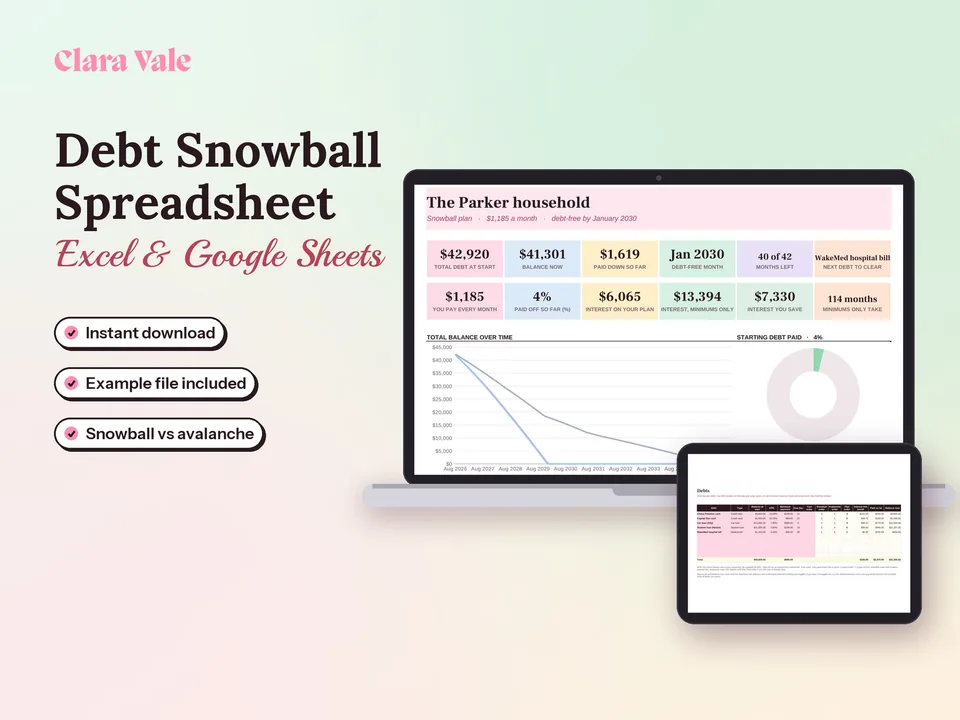
For a quick answer, the free calculator handles up to four debts and shows the snowball, avalanche and minimums-only results together. For a longer list, our Debt Snowball Spreadsheet & Payoff Planner covers up to 10 debts in Excel or Google Sheets. It builds a 120-month schedule, lets you pick snowball, avalanche or a custom order, compares snowball and avalanche side by side, and includes a payments log plus printable color-in trackers. In our example file, five debts with $300 extra a month show how the snowball grows as each one closes.
Start your debt snowball this month
The debt snowball method comes down to three moves: list your debts smallest to largest, pay one fixed amount every month, and roll each paid-off payment into the next debt. In our example, that turns 104 months of minimum payments into 31 months, and the first debt is gone by month 6. The avalanche saves more interest when a high-rate debt is large, so check both before you commit. Put your own balances into the debt snowball calculator and see your debt-free month.
Questions people ask
Does the debt snowball really work?
Yes, as long as you keep paying the same total every month. The math comes from rolling each paid-off payment into the next debt, and the motivation comes from closing accounts early. A Kellogg study of nearly 6,000 debt settlement clients found the share of accounts closed predicted finishing the program better than the share of dollars repaid.
How long will it take to pay off $30,000 in debt?
It depends on your payment and interest rate. At a 22% APR, $30,000 takes about 44 months with $1,000 a month and about 26 months with $1,500. At 0% interest, $1,000 a month clears it in 30 months. Spread across several debts, the debt snowball method lands close to these numbers because the total payment stays the same.
How to pay $30,000 debt in one year?
You need about $2,500 a month at 0% interest, or about $2,808 a month if the whole balance carries a 22% APR. Most households only reach that by adding income, selling something, or cutting spending hard for 12 months. Put every extra dollar on one target debt at a time so each payoff frees up more cash.
Is debt avalanche or snowball better?
The debt avalanche costs less interest whenever your highest-rate debt is not also your smallest. In our $25,400 example it saves $1,009 and one month. The debt snowball gives you the first paid-off debt a year sooner, at month 6 instead of month 18. Pick the one you will keep paying every month.
Should you include your mortgage in the debt snowball?
Most people leave it out. Dave Ramsey's version covers all debt except your house, and a mortgage is usually the largest, lowest-rate and longest debt you have. Snowball everything else first: credit cards, car loans, student loans, medical bills and personal loans. Once those are gone, extra mortgage payments are a separate decision.
What do you need before starting the debt snowball?
Be current on every bill, so no account is past due, and keep a small cash cushion so a flat tire doesn't go on a credit card. Ramsey suggests $1,000 as a starter emergency fund. Then list your debts with their balances, APRs and minimum payments, and decide on one fixed monthly amount for debt.
Is the debt snowball method good for credit scores?
Paying every bill on time and lowering card balances both tend to help your score over time. The debt snowball does both. One caution: once a credit card is paid off, keeping the account open usually helps more than closing it, since closing it shrinks your available credit. Just stop using it for new charges.