

Cool skin, dark ash or black hair, clear eyes and a face that looks crisp in black and white: that’s the classic True Winter. The true winter color palette is built for that coloring. It’s cool, clear and bold, full of royal blue, emerald, magenta, true red and icy tints, and it covers clothes, makeup, hair and jewelry alike.
The true winter color palette is a set of cool, clear, high-contrast colors for people with a cool undertone and crisp, striking coloring. Its core shades are emerald, royal blue, royal purple, magenta, true red and burgundy, with icy accents like icy lavender and icy lemon, neutrals of pure white, gray, charcoal, black and navy, and silver instead of gold.
The true winter color palette, color by color
Our True Winter palette has 26 colors in four groups: six best colors to wear near the face, six accents, six neutrals, and eight shades to wear sparingly. These are the exact swatches the palette card in our seasonal color analysis tool uses.
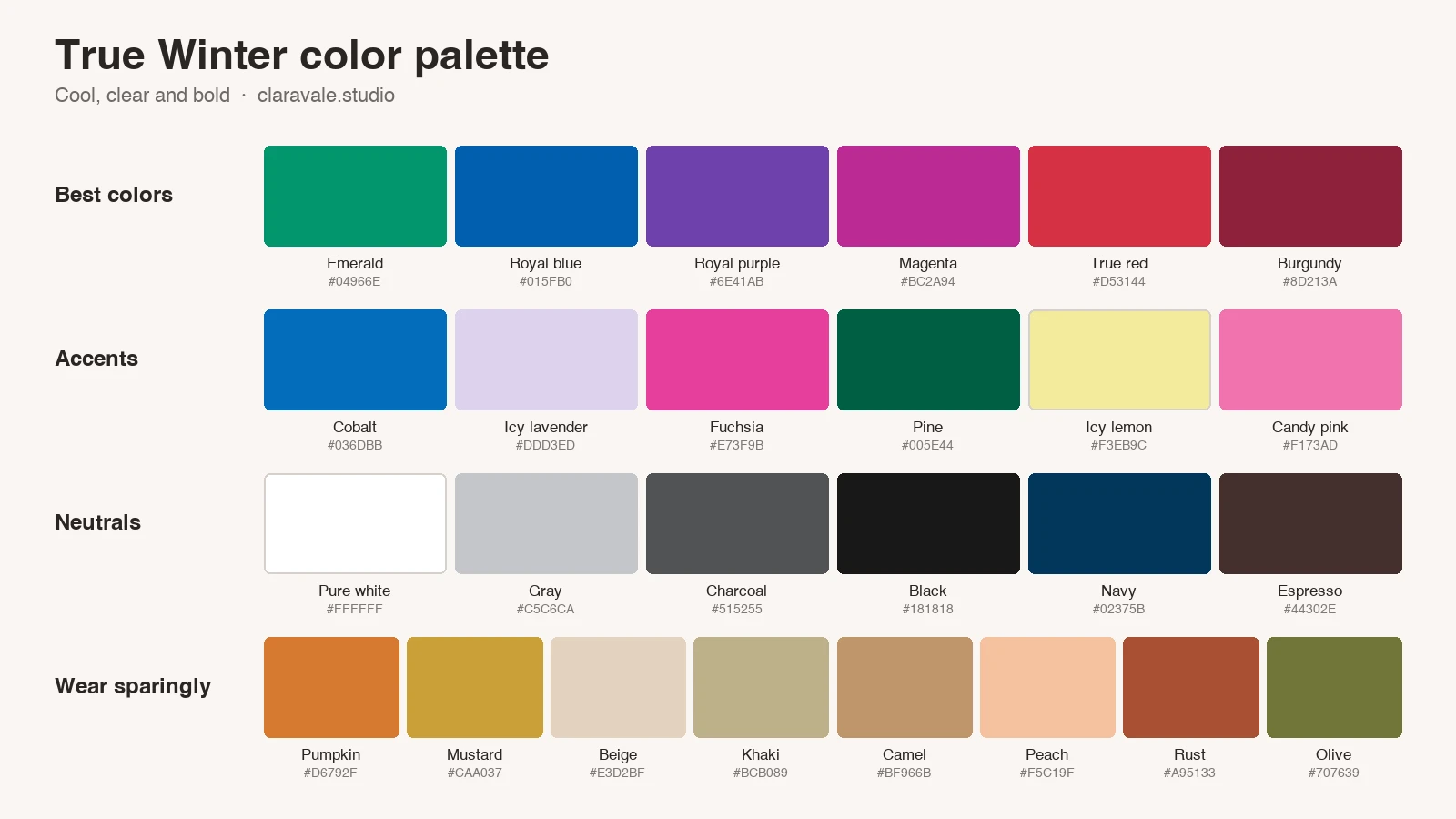
| Group | Colors (hex) |
|---|---|
| Best colors | Emerald #04966E, Royal blue #015FB0, Royal purple #6E41AB, Magenta #BC2A94, True red #D53144, Burgundy #8D213A |
| Accents | Cobalt #036DBB, Icy lavender #DDD3ED, Fuchsia #E73F9B, Pine #005E44, Icy lemon #F3EB9C, Candy pink #F173AD |
| Neutrals | Pure white #FFFFFF, Gray #C5C6CA, Charcoal #515255, Black #181818, Navy #02375B, Espresso #44302E |
| Wear sparingly | Pumpkin #D6792F, Mustard #CAA037, Beige #E3D2BF, Khaki #BCB089, Camel #BF966B, Peach #F5C19F, Rust #A95133, Olive #707639 |
Best colors go closest to your face. They’re the purest, bluest version of each hue: a green with no yellow in it, a red with no orange, a purple that leans blue. A royal blue sweater or a true red dress shows off True Winter contrast better than any muted shade.
Accents split into two kinds. Cobalt, fuchsia, pine and candy pink are saturated colors for prints, bags and statement pieces. Icy lavender and icy lemon are the “icy” tints that set Winter apart from Summer: very light, very cool, and clean rather than dusty. Worn as a shirt under a black jacket, they look like a colored white.
Neutrals are the base. Pure white and black lead, charcoal and navy soften the contrast for everyday wear, gray covers knitwear and trousers, and espresso is the one brown, so dark it reads almost black.
What makes someone a True Winter
True Winter, also called Cool Winter, is one of the 12 seasons of color analysis. It’s defined by three traits: a cool undertone, clear and crisp coloring, and high contrast. Cool is the leading trait. True Winter sits in the middle of the Winter family, cooler than both Deep Winter and Bright Winter.
Typical True Winter coloring looks like this:
- Hair: cool dark brown, blue-black or dark ash, sometimes silver early, with no red or gold glints
- Eyes: clear, cool and bright: icy blue, gray-blue, cool dark brown or black-brown with a sharp white around the iris
- Skin: cool or blue-pink at any depth, from porcelain to deep brown, often looking rosy or slightly gray rather than golden
Seasonal color analysis treats color in three dimensions: hue, value and chroma. The Wikipedia overview of color analysis describes chroma as “the difference between a pure hue and a pure grey.” True Winter coloring scores high on chroma and at the cool end of hue, so its palette uses clean colors with no gray or gold mixed in.
When we built the palettes for our tool, we placed each of the 12 seasons in its own region of lightness, chroma and undertone, and the site checks that no palette drifts into a neighbor’s territory. For True Winter, that region is the coolest end of the undertone scale with high chroma, which is why the palette has icy tints and jewel brights but no earthy shades.
How to know if you’re a True Winter
Three checks point toward True Winter. Do them in daylight, without makeup, with your natural hair visible.
- Coolness test. Silver and platinum look natural on you, while yellow gold looks brassy. Pure white near your face looks clean rather than harsh.
- Contrast test. In a black-and-white photo, your hair and brows stand out clearly against your skin, and the whites of your eyes look bright.
- Drape test. Hold royal blue or true red under your chin, then camel or peach. If the cool, clear color makes your skin look smooth and your eyes bright, while the warm shade makes you look yellow or tired, coolness is your strongest trait.
Here’s why it works. Cool coloring has blue or pink in the skin. A cool color near the face repeats that undertone, so the skin looks even. A warm color like camel adds yellow, which shows up as sallowness or shadows. High contrast adds a second layer: soft colors lack the punch to match strong hair and eye color, so the face can look faded next to them.
If two drapes look equally good, compare True Winter with its neighbors: Deep Winter (darker), Bright Winter (clearer) and True Summer (cool but soft).
Neutrals in the true winter palette
| Neutral | Hex | Use it for |
|---|---|---|
| Pure white | #FFFFFF | Shirts, tees, a crisp collar under a dark knit |
| Gray | #C5C6CA | Knitwear, light trousers, summer suiting |
| Charcoal | #515255 | Suits, everyday trousers, a softer black |
| Black | #181818 | Coats, evening wear, tailoring |
| Navy | #02375B | Jeans, blazers, outerwear |
| Espresso | #44302E | Boots, bags, a dark brown that reads almost black |
The classic True Winter outfit is black and white with one bright: a black blazer, a white shirt and a magenta or royal blue scarf. For softer days, swap black for charcoal or navy. Gray works best when it’s a clean, cool gray; a beige-leaning greige reads warm and belongs to other seasons.
Metals and accessories for True Winter
The metals of the true winter color palette are silver, platinum and white gold. Bright, polished finishes suit the clear palette, and so do diamonds, crystals and cool gemstones like sapphire, amethyst and emerald.
Yellow gold sits further from cool coloring. If most of your jewelry is gold, keep it on your hands and wrists and wear silver closer to your face, or choose mixed-metal pieces where silver leads. Glasses frames in black, silver, navy, clear crystal or a cool burgundy look natural on a True Winter.
True winter makeup and lipstick
True winter makeup follows the same cool, clear palette as the clothes.
- Blush: cool pink. A clear pink flush matches True Winter better than peach or bronze.
- Lips: true red, fuchsia or berry. A blue-based red is the signature True Winter lipstick. Cool pink works for everyday wear.
- Eyes: black or navy liner, with shadows in charcoal, silver, navy, plum and cool taupe.
- Base: match your undertone exactly; a foundation with a pink or neutral base usually suits cool skin better than a golden one.
A simple everyday set is a cool pink blush, a berry lip and black liner. For evenings, a true red lip with black liner is the look the season is known for.
The best hair colors for a True Winter
The best true winter hair colors are cool dark brown, blue-black and silver. Keep the tone cool. A blue-black gloss, cool espresso or dark ash brown all fit, while copper, golden caramel and honey highlights pull warm.
True Winters often look striking as they go gray, because silver and white hair keep the cool tone and the contrast with dark brows. If you’re coloring gray, a cool silver gloss is often more flattering than a warm brown dye. Lighter blonde shades shrink the contrast, so if you go lighter, choose icy or platinum tones rather than golden ones.
Colors to wear sparingly
The eight wear-sparingly colors in the true winter color palette are warm, earthy or muted: pumpkin, mustard, beige, khaki, camel, peach, rust and olive. They sit at the warm end of hue and the gray end of chroma, the opposite of cool, clear Winter coloring.
Ways to keep them in the wardrobe:
- Wear them below the waist. Khaki trousers or camel boots work under a royal blue or white top.
- Add a buffer. A black, white or emerald scarf between a warm color and your face restores the contrast.
- Swap for the cool version. Pure white for beige, gray for khaki, charcoal for camel, burgundy for rust, pine for olive, candy pink for peach.
True Winter vs Deep Winter and Bright Winter
The three Winters share a cool lean and high contrast. They differ in which trait leads.
| True Winter | Deep Winter | Bright Winter | |
|---|---|---|---|
| Leading trait | Cool | Deep | Clear |
| Signature colors | Royal blue #015FB0, magenta #BC2A94, true red #D53144 | Sapphire #004787, burgundy #821431, aubergine #552963 | Electric blue #045CBB, cyan #0FCDED, fuchsia #FA01A0 |
| Icy accent | Icy lavender, icy lemon | (none; all dark) | Icy lilac |
| Metals | Silver, platinum, white gold | Silver, platinum, white gold, gunmetal | Polished silver, platinum, bright white gold |
| Hair | Cool dark brown, blue-black, silver | Espresso, blue-black, cool dark brown | Dark brown to black, glossy |
| Borders | True Summer | Deep Autumn | Bright Spring |
To tell True Winter from Deep Winter, hold royal blue against sapphire. If royal blue looks bright and right, stay with True Winter; if it looks loud and sapphire looks better, read our deep winter color palette guide.
To tell True Winter from Bright Winter, hold royal blue against cyan. Cyan and canary yellow are Bright Winter’s near-neon shades; if they make your eyes pop rather than overpower you, the bright winter color palette may fit better.
True Winter vs True Summer
True Winter’s other neighbor is True Summer, the coolest Summer. Both share a cool undertone, but True Summer is soft and medium in contrast, so its colors are dusty: dusty blue #5F8AB2 and raspberry #B45A78 instead of royal blue and true red. If black and pure white look harsh on you and dusty blue looks better than royal blue, look at the true summer color palette.
Building a true winter capsule
A small capsule gets more out of the palette than a closet of single pieces.
- Start with black, white and charcoal. A black coat, white shirts and charcoal trousers are the backbone.
- Pick three best colors for tops. Royal blue, emerald and true red cover blue, green and red.
- Add one icy tint. An icy lavender or icy lemon shirt gives a soft option that still looks clean.
- Add one statement accent. A fuchsia or cobalt bag, scarf or dress for color.
Prints should be crisp and high contrast: black-and-white stripes, polka dots, houndstooth, or a jewel-tone geometric on black. Blurry watercolors and earthy paisleys look softer than True Winter coloring.
Find out if you’re a True Winter
The true winter color palette comes down to three ideas: wear cool, clear, saturated colors near your face; build on black, pure white, charcoal and navy; and choose silver, platinum and white gold. If you’re not sure you’re a True Winter, our free seasonal color analysis tool runs in your browser on a selfie or a short quiz, compares you against all 12 seasons, lets you check the result with virtual draping, and gives you a downloadable palette.
Questions people ask
Is true winter the same as cool winter?
Yes. True Winter and Cool Winter are two names for the same season in the 12-season system. It describes coloring with a cool undertone, clear, crisp features and high contrast. Cool is its leading trait, which is why its palette holds the iciest, bluest versions of every color: royal blue, magenta, true red, icy lavender and pure white, worn with silver and platinum.
What hair color is best for a true winter?
The best true winter hair colors are cool dark brown, blue-black and silver. Keep the depth close to your natural shade and keep the tone cool, with a blue or violet gloss rather than golden or copper highlights. True Winters often go gray beautifully, because silver and white hair stay cool and keep the high contrast with dark brows and clear eyes.
What lipstick colors suit a true winter?
True Winter lipsticks are cool and clear: a blue-based true red, fuchsia, berry and cool pink. Pick shades with a blue or pink base and a clean, saturated color. Orange-reds, coral, peach and brown nudes tend to look muddy on cool, high-contrast coloring. For a quieter everyday lip, a cool berry stain gives color without the full drama of red.
Can Winters wear lavender?
Winters can wear lavender when it's icy and clear. True Winter's palette includes icy lavender #DDD3ED as an accent, and Bright Winter has a similar icy lilac. Both are very light, cool tints that read like a colored white. Dusty, grayed lavender is more of a Summer color. On a Winter, keep it as a light accent and pair it with black, navy or royal purple.
Can Winters wear brown?
Winters look best in the darkest, coolest browns. True Winter's palette has an espresso #44302E neutral that reads almost black, and it works for coats, boots and bags. Warm, golden browns are harder: camel, khaki and rust all sit on the True Winter wear-sparingly list. When a brown looks red, gold or earthy, swap it for charcoal or navy near the face.
What is the difference between true winter and deep winter?
True Winter is the coolest and clearest Winter, so its colors are brighter and icier: royal blue, magenta, cobalt, icy lavender and fuchsia. Deep Winter is darker and leans slightly less cool, with sapphire, burgundy, aubergine, pine and ink blue. Both use black, pure white and silver. If bright, icy colors look sharp on you, look at True Winter; if they look loud and dark jewel tones look right, Deep Winter fits.
Can true winters wear gold?
True Winter suits cool metals best: silver, platinum and white gold. Yellow gold can look brassy against cool, high-contrast coloring, especially in large or shiny pieces. If you love gold, wear it away from the face, such as in a ring or a watch, or choose mixed-metal pieces where silver dominates. White gold gives the look of fine jewelry in a cool tone.