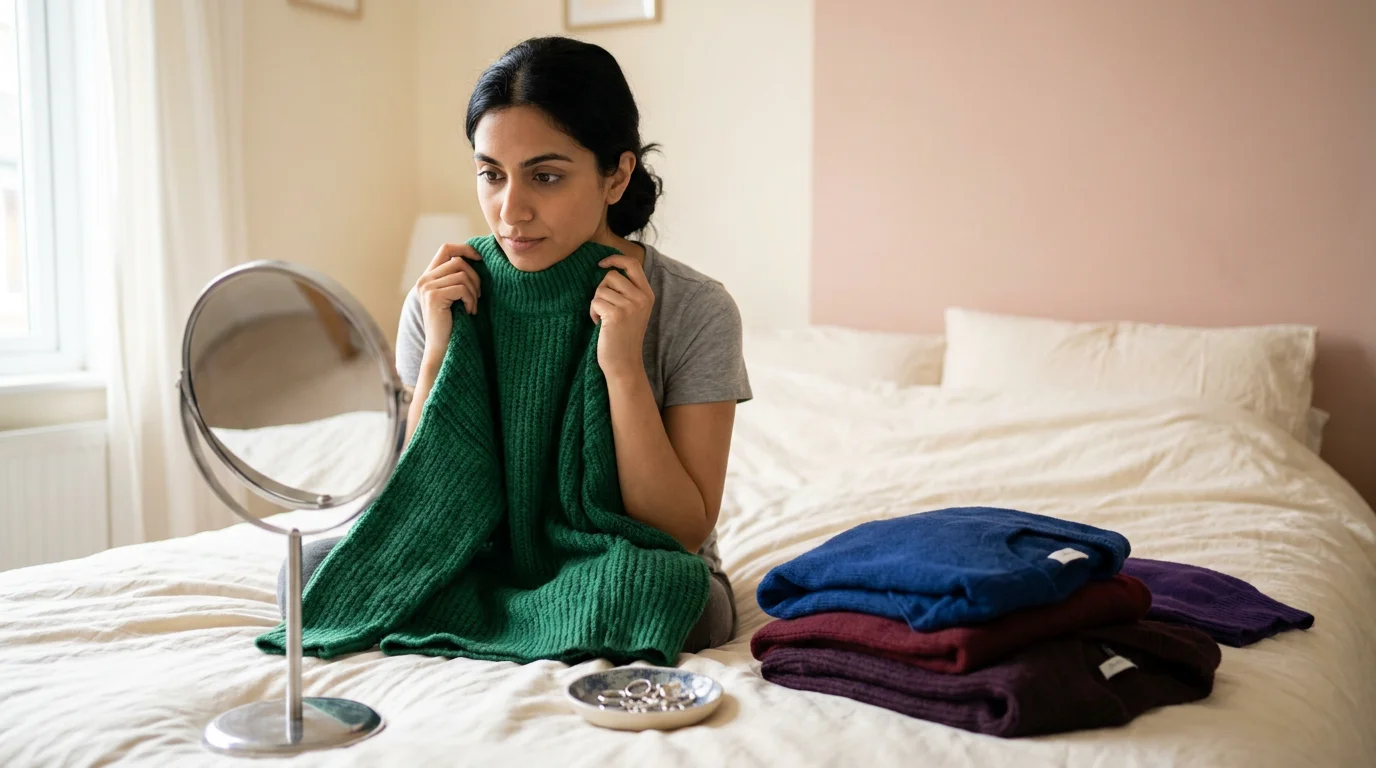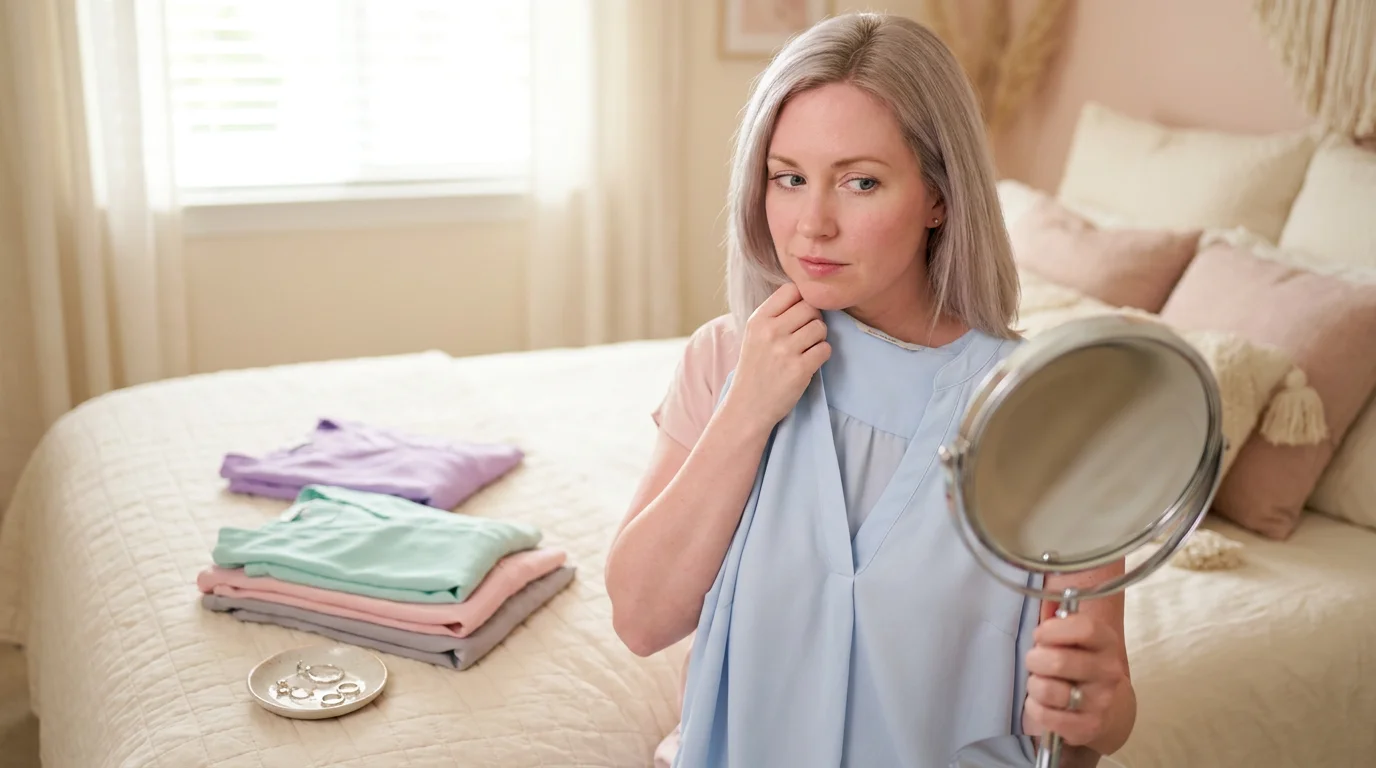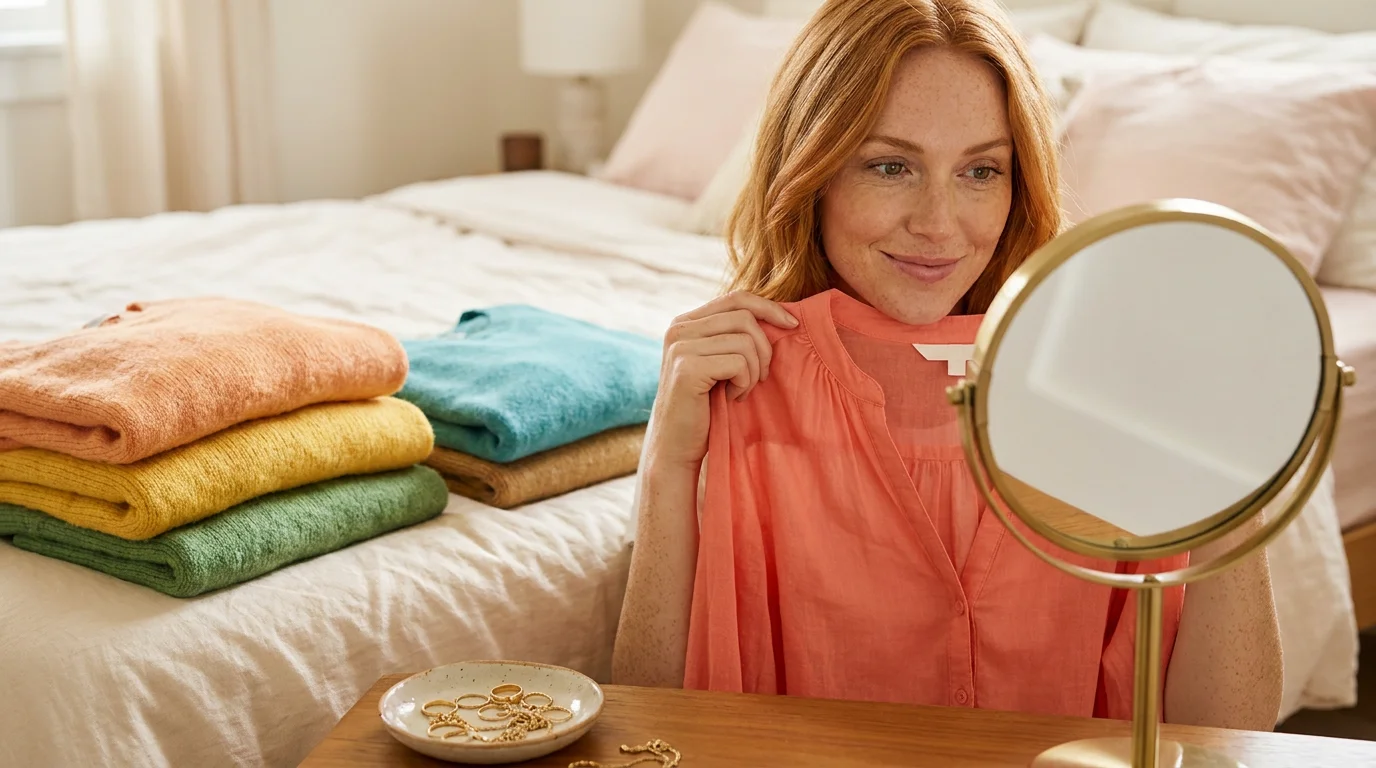

Golden or copper hair, warm bright eyes, skin with a golden glow and often freckles, and a face that looks gray in cool, dusty shades: that’s the classic True Spring. The true spring color palette, also called the warm spring color palette, is built for that coloring. It’s warm, clear and lively, full of coral, apricot, sunflower, leaf green and warm turquoise, and it works in a closet, a makeup bag and a jewelry box alike.
The true spring color palette is a set of warm, clear, lively colors for people whose coloring is warm overall, with clear features and light to medium depth. Its core shades are coral, apricot, sunflower, leaf green, warm turquoise and tomato red, backed by warm neutrals like ivory, camel and golden brown, with yellow gold instead of silver.
The true spring color palette, color by color
Our True Spring palette has 26 colors in four groups: six best colors to wear near the face, six accents, six neutrals, and eight shades to wear sparingly. These are the exact swatches the palette card in our seasonal color analysis tool uses.
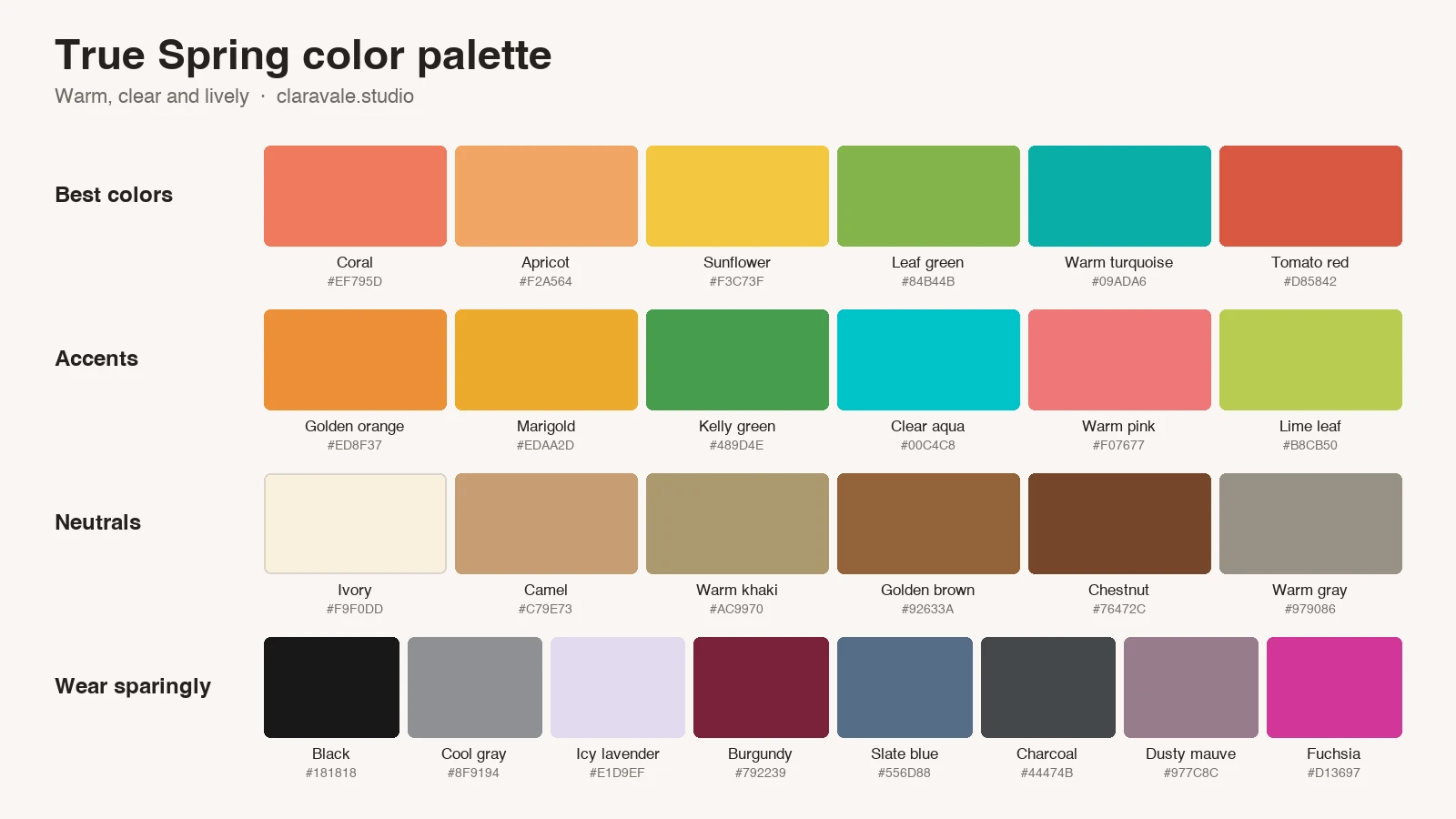
| Group | Colors (hex) |
|---|---|
| Best colors | Coral #EF795D, Apricot #F2A564, Sunflower #F3C73F, Leaf green #84B44B, Warm turquoise #09ADA6, Tomato red #D85842 |
| Accents | Golden orange #ED8F37, Marigold #EDAA2D, Kelly green #489D4E, Clear aqua #00C4C8, Warm pink #F07677, Lime leaf #B8CB50 |
| Neutrals | Ivory #F9F0DD, Camel #C79E73, Warm khaki #AC9970, Golden brown #92633A, Chestnut #76472C, Warm gray #979086 |
| Wear sparingly | Black #181818, Cool gray #8F9194, Icy lavender #E1D9EF, Burgundy #792239, Slate blue #556D88, Charcoal #44474B, Dusty mauve #977C8C, Fuchsia #D13697 |
Best colors go closest to your face: tops, scarves, dresses, collars. They’re warm and clear at the same time, and a coral top or a warm turquoise dress will usually do more for a True Spring than any cool or muted shade.
Accents turn up the energy. Golden orange and marigold lean into the warmth, kelly green and lime leaf add fresh greens, and clear aqua and warm pink keep things bright. Use them in a print, a bag or a summer dress, or as the one bold piece in an outfit built on neutrals.
Neutrals are the base of the wardrobe. Ivory replaces stark white, camel and warm khaki cover coats and trousers, and golden brown and chestnut are the true spring stand-ins for black. Warm gray is the one gray that sits well, because it has a yellow-beige cast rather than a blue one.
What makes someone a True Spring
True Spring, also called Warm Spring, is one of the 12 seasons of color analysis. It’s defined by three traits: warm undertone, clear and lively coloring, and light to medium depth. Warmth is the leading trait. Clarity comes second.
Typical True Spring coloring looks like this:
- Hair: golden blonde, strawberry blonde, copper, caramel or warm golden brown
- Eyes: warm and bright, such as golden hazel, warm green, turquoise, clear blue or light topaz brown
- Skin: golden, peachy or warm beige to warm brown, often with golden freckles, at any skin depth
The seasonal approach goes back to books like Carole Jackson’s Color Me Beautiful (1980), which, as the history of color analysis on Wikipedia notes, framed personal coloring through the four seasons as “a more poetic way to describe your coloring.” Later 12-season systems split each family into three, so every Spring now leans light, true or bright.
True Spring is the warmest of the three Springs and sits in the middle for depth and intensity. Light Spring is lighter and more delicate, with peach, butter yellow and fresh mint; our light spring color palette guide covers it. Bright Spring is more vivid and contrasting, with poppy red, bright kelly and even black. A True Spring wearing Light Spring’s pastels can look a little faded. The same person in coral or sunflower looks warm and lively.
How to know if you’re a True Spring
Three quick checks point toward True Spring. Take each one in daylight, without makeup, with your natural hair color visible.
- Warmth test. Yellow gold looks clearly better on you than silver, and camel or ivory near your face looks more flattering than cool gray or stark white.
- Clarity test. Your eyes look bright rather than smoky, and warm clear colors like coral make your skin look fresh, while muted ones like dusty mauve make it look dull.
- Drape test. Hold a coral or sunflower fabric under your chin, then a cool one like icy lavender, burgundy or cool gray. If the warm color makes your skin look even and golden, while the cool one brings out redness or a gray cast, warmth is your strongest trait.
Here’s why the drape test works. A warm undertone means the skin carries more yellow and golden pigment. A warm color near the face repeats that undertone, so the skin looks even and healthy. A cool color sets up a contrast in temperature, and the eye picks up the difference as sallowness, redness or shadow.
If two drapes look equally good, compare True Spring with its neighbors. Light Spring (lighter and softer) and Bright Spring (more vivid and contrasting) share its clarity, while True Autumn shares its warmth with a richer, earthier feel.
Gold or silver? The best metals for True Spring
The metals of the true spring color palette are warm: yellow gold, brass and copper. Bright, polished finishes suit the season better than heavily antiqued ones, because they echo the clarity of the palette. A shiny gold chain, brass earrings or a copper cuff all fit.
Cool silver can look gray next to golden skin. If most of your jewelry is silver, mixed-metal pieces with plenty of gold in them make an easy bridge. Warm, clear stones like coral, turquoise, citrine, amber and peridot sit naturally on a True Spring.
Eyeglass frames follow the same idea: golden tortoiseshell, honey, warm brown, gold metal and clear warm colors like coral or turquoise tend to look natural.
True spring makeup: blush, lips and eyes
True spring makeup follows the true spring color palette for clothes: the same warm, clear range, scaled down to blush, lips and eyes.
- Blush: coral and warm peach. A clear, warm flush looks fresher than a cool pink or a heavy bronze.
- Lips: tomato red, coral and warm peach. For a nude, pick a warm peachy beige rather than a mauve-toned one.
- Eyes: bronze and golden-brown shadows, with warm brown liner. Warm green, teal or copper liner adds color for evenings.
- Base: pick a foundation with a golden or peachy undertone. Leave some freckles showing; they’re part of the season’s warmth.
A simple everyday set is a coral blush, a warm peach lip and golden-brown shadow. For evenings, swap in a tomato red lip.
The best hair colors for a True Spring
The best hair colors for a True Spring are warm and golden: golden blonde, copper, caramel and warm auburn. Strawberry blonde and golden brown follow the same logic.
Keep the overall depth near your natural hair, and add dimension with warm lights: honey, gold or copper, placed around the face. True Springs are the season most likely to suit a bright copper or red without it looking harsh.
Shades to skip are the ones that pull hair cool: ash blonde, ash brown, platinum and blue-black. They flatten golden skin and can make freckles look muddy. If you’re going gray, golden or caramel lowlights keep your hair in step with the palette while the gray grows in.
Colors a True Spring should wear sparingly
The eight wear-sparingly colors in the true spring color palette share one trait: they’re cool. Black, cool gray, charcoal, slate blue and icy lavender are cold neutrals and pastels, while burgundy, dusty mauve and fuchsia are cool, blue-based reds and pinks.
Wearing them sparingly doesn’t mean throwing them out. A few ways to keep them in the wardrobe:
- Keep them away from the face. Black jeans, charcoal trousers or a slate blue skirt are fine with a true spring top.
- Add a buffer. A coral, apricot or warm turquoise scarf between a cool color and your face brings the warmth back.
- Swap for the warm version. Chestnut for black, warm gray for cool gray, golden brown for charcoal, clear aqua for slate blue, tomato red for burgundy and warm pink for fuchsia.
True spring vs true autumn
True Spring and True Autumn share their main trait, warmth, and differ in their second one. True Spring is clear and lively. True Autumn is rich and earthy. Both palettes use yellow gold, copper and brass, both include camel and warm khaki neutrals, and both keep black, cool gray and fuchsia on the wear-sparingly list.
| True Spring | True Autumn | |
|---|---|---|
| Traits | Warm, clear and lively, light to medium depth | Warm, rich and earthy, medium depth |
| Signature colors | Coral #EF795D, sunflower #F3C73F, leaf green #84B44B, warm turquoise #09ADA6 | Rust #AB4F31, mustard #C09836, olive #6F772F, warm teal #037A79 |
| Light neutral | Ivory #F9F0DD | Cream #F6E6CD |
| Dark neutrals | Golden brown #92633A, chestnut #76472C | Coffee #735944, chocolate #633E29, dark olive #5C5B3A |
| Metals | Yellow gold, brass, copper | Yellow gold, copper, bronze, brass |
| Lips | Tomato red, coral, warm peach | Brick, cinnamon, coral |
| Hair | Golden blonde, copper, caramel, warm auburn | Copper, auburn, golden brown, chestnut |
The fastest way to tell them apart is a set of paired drapes with the same warmth and different clarity: sunflower against mustard, coral against terracotta, warm turquoise against warm teal. If the clear version makes you look fresh and the earthy one looks heavy or muddy, you’re likely a True Spring. If the clear version looks loud and the earthy one makes your skin glow, True Autumn is the better fit; our true autumn color palette guide lists all of its colors.
Within the Spring family, compare True Spring with Bright Spring too. If saturated colors like poppy red and bright kelly suit you even better than coral and leaf green, and black looks crisp on you, our bright spring color palette guide is the next one to read.
How to build a true spring capsule wardrobe
A small capsule built on the palette goes further than a closet of scattered “good” colors. A simple approach:
- Pick two neutrals as the base. Ivory and chestnut cover light and dark. Add camel for a coat and warm khaki for trousers.
- Pick three best colors for tops. Coral, warm turquoise and leaf green cover warm, cool and green.
- Add one or two accents. Marigold and clear aqua mix with everything above.
- Mix within the palette. Every color in a season’s palette shares the same warmth and clarity, so they go together without much planning.
Prints follow the same idea. Cheerful, clear prints suit a True Spring: florals in coral and leaf green on ivory, gingham in apricot, or stripes in warm turquoise and camel. Keep heavy, dark prints and cool black-and-white graphics for accessories.
Find your season and build your palette
The true spring color palette comes down to three ideas: wear warm, clear, lively colors near your face; build on ivory, camel, warm khaki and chestnut; and pick yellow gold, brass and copper over silver. If you’re not sure you’re a True Spring, run a selfie or the eight-question quiz through our free seasonal color analysis tool. It runs in your browser, so your photo isn’t uploaded, matches you against all 12 seasons, lets you check the result with virtual draping, and gives you a downloadable palette for your season.
Questions people ask
What colors should a true Spring wear?
A True Spring looks best in warm, clear, lively colors: coral, apricot, sunflower, leaf green, warm turquoise and tomato red, plus accents like golden orange, marigold, kelly green, clear aqua, warm pink and lime leaf. For neutrals, ivory, camel, warm khaki, golden brown, chestnut and warm gray all work. Yellow gold, brass and copper are the best metals.
What are the different seasonal color palettes?
The 12-season system has three palettes for each of the four seasons. Spring: Light, True and Bright Spring. Summer: Light, True and Soft Summer. Autumn: Soft, True and Deep Autumn. Winter: Deep, True and Bright Winter. Each season is named for its leading trait, such as lightness, warmth, clarity, softness or depth, and borders two neighbors that share some of its traits.
Can Spring season wear black?
Bright Spring is the Spring that wears black best; black is one of its six neutrals. Light Spring and True Spring look fresher in warm dark neutrals. For a True Spring, chestnut and golden brown do the job of black, and camel or warm khaki cover coats and trousers. If you love black, wear it below the waist and put coral, apricot or warm turquoise near your face.
What color lipstick for Spring color palette?
Spring lipsticks are warm and clear. True Spring looks best in tomato red, coral and warm peach. Light Spring suits lighter versions like clear warm pink, peach and light coral. Bright Spring wears the most vivid shades, such as clear coral, watermelon and poppy red. All three look fresher in glossy or satin finishes than in flat, dusty matte shades.
Is true spring the same as warm spring?
Yes. True Spring and Warm Spring are two names for the same season in the 12-season system. It describes coloring with a warm undertone, clear and lively features, and light to medium depth. Some color analysts use one name and some the other, but the palette and the advice are the same: warm, clear colors with plenty of energy.
Is true spring warm or cool?
True Spring is warm, the warmest of the three Springs. Warmth is its leading trait, clarity comes second and depth sits in the light to medium range. That's why its neighbors are Light Spring and Bright Spring, which share the clarity, and why it sits across the warm side of the wheel from True Autumn, which shares the warmth with a richer, earthier feel.
What hair color suits a true spring?
True Springs look best with warm, golden hair: golden blonde, copper, caramel and warm auburn. Strawberry blonde and golden brown follow the same idea. Keep the depth near your natural shade and add warmth with golden, honey or copper highlights. Ash tones, platinum and blue-black pull the hair cool and make golden skin look flat.