
Some weeks you can get to the gym three times. Some weeks it’s five. And some people train in a garage with a pair of dumbbells and 40 minutes after the kids go to bed. A workout split is how you turn whichever of those you have into a weekly workout plan, so each session has a job and every muscle gets trained and rested on a schedule. Below we match each split to the number of days you have, then give a sample week for the four most common ones.
A workout split is a way of dividing strength training across the week by body part or movement pattern. Choose it by the days you can train: 2 to 3 days suits full body, 4 days suits upper/lower, and 5 to 6 days suits push/pull/legs or a body-part split. Aim to train each muscle at least twice a week.
How to choose a workout split by the days you have
The number of days you can train every week, not just in a good week, decides the workout split. Start there, then adjust for experience and how much time each session can take.
| Days per week | Best-fit workout split | Each muscle trained | Session length |
|---|---|---|---|
| 2 | Full body | 2x per week | 45 to 60 min |
| 3 | Full body | 3x per week | 45 to 60 min |
| 4 | Upper/lower | 2x per week | 50 to 70 min |
| 5 | Upper/lower + 1 full body, or bro split | 1x to 3x per week | 50 to 75 min |
| 6 | Push/pull/legs, run twice | 2x per week | 45 to 75 min |
Two research findings shape that table. The first is a floor for health. The CDC’s guidelines for adults call for muscle-strengthening activity on at least 2 days a week that works all major muscle groups, listed as legs, hips, back, abdomen, chest, shoulders and arms. Any split in this guide covers that.
The second is about muscle growth. A 2016 meta-analysis of ten studies by Schoenfeld, Ogborn and Krieger in Sports Medicine found that, when total weekly volume was equal, training a muscle group twice a week produced better growth than once a week. The authors concluded that major muscle groups should be trained at least twice a week to maximize growth, and left open whether three times beats two.
Experience matters too. The American College of Sports Medicine’s position stand on progression suggests 2 to 3 training days a week for novices, 3 to 4 for intermediate lifters with about six months of steady training, and 4 to 5 for advanced lifters. So if you’re new, a 3-day split is plenty, and it leaves room to recover and learn the lifts.
3-day full-body workout split
Full body trains every major muscle group in each session. Three sessions a week means each muscle gets three short doses of work, with a rest day after each one. Alternating two workouts, A and B, keeps the week from feeling repetitive.
| Day | Workout | Sample exercises |
|---|---|---|
| Monday | Full body A | Goblet squat, dumbbell bench press, seated cable row, Romanian deadlift, plank |
| Tuesday | Rest or easy cardio | 30-minute walk |
| Wednesday | Full body B | Leg press, overhead press, lat pulldown, hip thrust, dead bug |
| Thursday | Rest or easy cardio | 30-minute bike ride |
| Friday | Full body A | Same as Monday, aim for one more rep or a little more weight |
| Saturday | Active rest | Hike, swim or yoga |
| Sunday | Rest |
Next week, start with B on Monday, so each workout gets the same number of turns over two weeks. This workout split is the most forgiving of the four. Miss Wednesday, and Friday still trains every muscle. That’s why it’s the most common weekly workout plan for beginners, busy parents and anyone training at home.
When we built the example file for our workout planner, this is the split we filled in: ten weeks of a 3-day full-body plan, with cardio on off days and a weekly weigh-in. Three sessions fit around a full week of work and family, and the steady log made it easy to see each lift creep up.
4-day upper/lower workout split
An upper/lower workout split divides the body in half. Upper days cover chest, back, shoulders and arms. Lower days cover quads, hamstrings, glutes, calves and core. Each half gets two sessions a week, which meets the twice-a-week mark from the Schoenfeld review with fewer exercises per session than full body.
| Day | Workout | Sample exercises |
|---|---|---|
| Monday | Upper (strength) | Bench press, barbell row, overhead press, pull-up or lat pulldown, biceps curl |
| Tuesday | Lower (strength) | Back squat, Romanian deadlift, walking lunge, calf raise, hanging knee raise |
| Wednesday | Rest or easy cardio | 30 to 40 minutes of walking or cycling |
| Thursday | Upper (volume) | Incline dumbbell press, chest-supported row, lateral raise, cable fly, triceps pushdown |
| Friday | Lower (volume) | Leg press, hip thrust, leg curl, split squat, side plank |
| Saturday | Active rest | Long walk or easy swim |
| Sunday | Rest |
Many people make the first upper and lower days heavier (fewer reps, more weight) and the second pair lighter with more reps. Keep the heavy lower day and the next lower day at least two days apart, so your legs recover before the next squat session.
Push/pull/legs workout split
Push/pull/legs, often shortened to PPL, groups muscles by what they do. Push days train chest, shoulders and triceps. Pull days train back, rear shoulders and biceps. Leg days train the whole lower body. Run once through, it’s a 3-day workout split. Run twice, it’s a 6-day weekly workout plan that trains each muscle twice.
| Day | Workout | Sample exercises |
|---|---|---|
| Monday | Push | Bench press, overhead press, incline dumbbell press, lateral raise, triceps dip |
| Tuesday | Pull | Deadlift or rack pull, pull-up, cable row, face pull, hammer curl |
| Wednesday | Legs | Squat, Romanian deadlift, leg press, leg curl, calf raise |
| Thursday | Push | Incline bench, dumbbell shoulder press, cable fly, triceps extension |
| Friday | Pull | Barbell row, lat pulldown, rear-delt fly, barbell curl |
| Saturday | Legs | Front squat or hack squat, hip thrust, walking lunge, leg extension |
| Sunday | Rest |
Six days is a lot for most schedules. If you have three or four days, a full-body or upper/lower split will train each muscle more often than a single round of PPL. The 6-day version suits lifters with some experience who enjoy shorter, focused sessions and recover well.
5-day bro split
The bro split gives each major body part its own day. It’s the classic bodybuilding week, and it’s popular because each session is simple: one body part, four or five exercises, lots of sets.
| Day | Workout | Sample exercises |
|---|---|---|
| Monday | Chest | Bench press, incline dumbbell press, cable fly, push-up |
| Tuesday | Back | Deadlift, pull-up, barbell row, single-arm dumbbell row |
| Wednesday | Legs | Squat, leg press, Romanian deadlift, leg curl, calf raise |
| Thursday | Shoulders | Overhead press, lateral raise, rear-delt fly, shrug |
| Friday | Arms and core | Barbell curl, close-grip bench press, hammer curl, cable crunch |
| Saturday | Rest or easy cardio | |
| Sunday | Rest |
The trade-off is frequency. Each muscle gets one main session a week, with some indirect work (triceps help on chest day, biceps on back day). Based on the 2016 frequency review, a 5-day upper/lower/full-body week, or upper/lower plus one extra upper day, trains each muscle twice with the same five gym days. If you love the bro split, it still works. It just asks a bit more of each session.
How to create a workout plan from your split
A split is only the frame. To turn it into a weekly workout plan you can follow, fill in these pieces once and reuse them every week:
- Pick the days. Write the training days into your week first, the same way you’d book a meeting. Leave at least one day between two hard sessions for the same muscles.
- Choose five or six exercises per session. Lead with compound lifts (squat, hinge, press, row, pull-down), then add one or two smaller exercises.
- Set sets and reps. The ACSM suggests loads in the 8 to 12 rep range for novices. Two to four sets per exercise is a common starting point.
- Plan cardio around it. The CDC’s 150 weekly minutes of moderate activity breaks down neatly into 30 minutes on five days, and walks or easy rides on rest days count.
- Write it down and log it. A plan you can see is a plan you’ll follow. A log tells you when it’s time to add weight.
If your weeks are already crowded, block the sessions into a weekly planner template alongside work and family, so training gets a fixed slot instead of whatever time is left over.
Progression and rest: how a workout split keeps working
Any workout split stops paying off if the weights never change. The fix is progressive overload: doing a little more over time. The ACSM’s position stand on progression models in resistance training recommends raising the load by 2 to 10% once you can do one or two reps more than your target on the current weight. On a 100 lb squat, that’s a jump of 2 to 10 lb.
A simple way to apply that is double progression. Pick a rep range, such as 8 to 12. Stay at one weight until you hit 12 reps on every set, then add weight and drop back to 8. Repeat. Upper-body lifts usually move up in smaller steps than lower-body lifts.
Rest is where the training turns into strength. Muscles recover between sessions, which is why each split above leaves a day or more before the same muscles work hard again. Signs that you need more rest include lifts going backward for a week or two, sore joints, or poor sleep. A lighter week, with fewer sets and the same weights, often fixes it.
If you’re new to exercise, pregnant, or managing a heart condition, joint problem, diabetes or another health condition, check with your doctor before you start a new program. This guide is general fitness information, not medical advice.
Start with the split you can keep
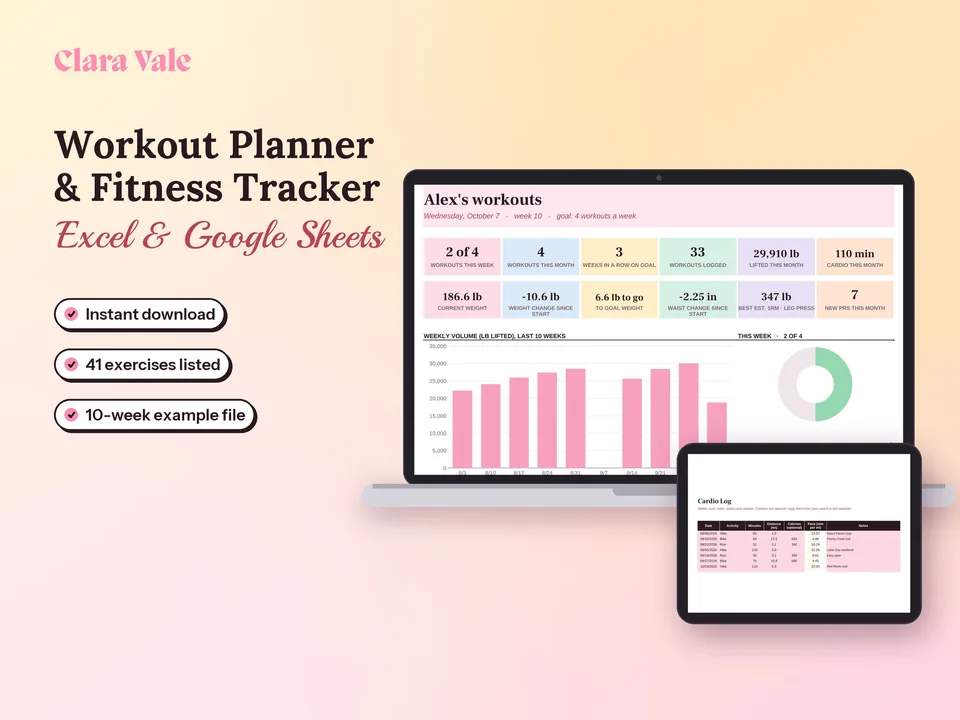
Pick the workout split that matches the days you can train, not the days you wish you had. For most people that’s a 3-day full-body plan or a 4-day upper/lower plan, both of which train each muscle twice a week. Give it eight to twelve weeks, add weight when the reps get easy, and rest between hard days. To plan the week and see your progress, our Workout Planner and Fitness Tracker Spreadsheet for Excel and Google Sheets holds up to four workouts a week, logs every set with volume, an estimated one-rep max and new personal records, and charts your cardio and body weight on one dashboard. To see the change in the mirror as well, our free Progress Camera app lines up a progress photo in the same pose every time and puts your first and latest side by side.
Questions people ask
What is the best workout split?
The best workout split is the one that matches the days you can train every week. For most people that means a 3-day full-body split or a 4-day upper/lower split, because both train each muscle at least twice a week. Push/pull/legs and the 5-day bro split suit people who have more gym days and enjoy longer, more focused sessions.
How many days a week should I workout?
The CDC recommends that adults get 150 minutes of moderate aerobic activity a week plus muscle-strengthening activity on at least 2 days that works all major muscle groups. For strength training, 2 to 3 days suits beginners, and 3 to 5 days suits people with more experience. Pick a number you can keep for months, then build from there.
Should I do cardio on rest days?
Yes, light to moderate cardio on rest days works well for most people. A brisk walk, an easy bike ride or a swim adds to the 150 weekly minutes the CDC recommends without taxing the muscles you lifted with the day before. Keep hard intervals or long runs away from the day before a heavy leg session so your legs stay fresh.
What is a workout split?
A workout split is a way of dividing your strength training across the week by body part or movement. A full-body split trains everything in each session. Other splits, such as upper/lower or push/pull/legs, give each workout a focus, so each muscle group gets a full session and then a few days of rest before you train it again.
How do I create a workout plan?
Start with the number of days you can train every week, then choose the split that fits that number. Give each day five or six exercises, starting with big compound lifts such as squats, presses and rows. Set a rep range, often 8 to 12 for beginners, write the plan into a weekly schedule, and log every set so you know when to add weight.
What is a good weekly workout plan for beginners?
A 3-day full-body plan on Monday, Wednesday and Friday is a common starting point. Each session covers a squat or leg press, a push, a pull, a hinge such as a Romanian deadlift, and a core exercise. The rest days in between give muscles time to recover, and you can fill them with walks or easy cardio.
Is a bro split good for building muscle?
A bro split can build muscle, and many lifters enjoy its long, focused sessions. Its trade-off is frequency: each muscle gets one main session a week. A 2016 meta-analysis found that training a muscle twice a week produced more growth than once a week when total volume was equal, so splits that repeat each muscle twice usually make better use of the same gym time.