
The top third of a resume gets read first, and the summary sits right there. A good one tells a recruiter in two lines who you are and why you fit the job they’re filling. The trouble is that it’s the hardest part to write about yourself, which is why most summaries drift into “motivated team player.” These resume summary examples cover the situations that make it hardest: switching careers, starting with no experience, coming back after time at home, moving into management, and freelancing alongside a job.
A resume summary is a 2–3 line pitch at the top of your resume. The formula: who you are (title or field) + years of experience or a key skill + one piece of proof with a number + the role you want next. Example: “Payroll specialist with 5 years in multi-state payroll for 400+ employees, with zero late runs since 2023. Seeking a payroll lead role.”
Every number in the examples below is illustrative. Treat them as a pattern, then swap in your own figures before the resume leaves your desk.
Short resume summary examples at a glance
Need something fast? Here are six short resume summary examples, one per situation covered later in the post. Each one follows the same four-part formula.
- Career changer: “Former high school science teacher moving into instructional design, with 8 years building lesson plans for 150+ students a term and an Articulate Storyline certificate. Ready to design training for a corporate learning team.”
- Student: “Marketing student at a state university graduating May 2027, who grew a campus club’s Instagram from 300 to 2,100 followers in one semester. Seeking a social media internship.”
- Returning parent: “Office manager returning after a 5-year career break, with 7 prior years running scheduling, billing and vendors for a 12-person dental practice. Refreshed QuickBooks skills in 2026.”
- Mid-career: “Registered nurse with 6 years in a 30-bed med-surg unit, precepting 9 new graduate nurses. Looking to join a cardiac step-down team.”
- Manager: “Operations manager leading a 22-person warehouse team, cutting order errors from 2.1% to 0.6% in 18 months. Seeking a regional operations role.”
- Freelancer: “Freelance copywriter with 40+ clients in B2B software since 2021, writing landing pages that lifted trial sign-ups by up to 30%. Open to an in-house content lead role.”
The four-part resume summary formula
Every example in this post is built from the same four parts, in the same order. Once you see them, you can write your own in about ten minutes.
| Part | What it answers | Example phrase |
|---|---|---|
| 1. Who you are | What do you do? | “Bilingual customer success manager” |
| 2. Years or key skill | How much depth? | “with 6 years in SaaS onboarding” |
| 3. Proof with a number | How well? | “kept net revenue retention above 105% for 3 years” |
| 4. What you want | Where next? | “Seeking a team lead role in fintech.” |
Why the number matters: a recruiter reading “excellent communicator” has nothing to picture. “Trained 14 new hires” gives scale, and scale is what separates you from every other applicant who also communicates well. If you don’t have a revenue or percentage figure, count something: people, tickets, projects, clients, students, weeks saved.
The fourth part is about the role, not your wish list. “Seeking a team lead role in fintech” helps the reader file you. “Seeking a company that values my growth” tells them what you want from them, and Duke’s career center specifically warns against summaries that focus on what you hope to gain (Duke Career Hub).
Career changer resume summary examples
A career change summary does one job the rest of the resume can’t: it connects your old work to the new role before the recruiter sees an unrelated job title. Lead with the target field, then name the skills that carry over.
- “Former restaurant general manager moving into HR, with 9 years hiring and scheduling teams of 40+ and a SHRM-CP certification earned in 2026. Seeking an HR generalist role in hospitality.”
- “Retail store manager transitioning to project coordination, having run 3 store remodels on time and $18K under budget. Google Project Management Certificate, 2026.”
- “Paralegal turned UX researcher, bringing 5 years of client interviews and document review to user research. Completed 3 usability studies for a nonprofit app during a UX bootcamp.”
- “Military logistics specialist (8 years, U.S. Army) moving into supply chain analysis, with experience tracking $2M in equipment across 4 bases. Proficient in Excel and SAP.”
Notice the pattern: the new field comes first, the old job comes second as evidence. That order keeps the reader’s attention on where you’re going.
Resume summary examples for students and no experience
Students and first-time job seekers often wonder whether a summary is worth the space. Duke’s career center actually lists undergraduates among the cases where a summary may not be needed, so treat it as optional. Write one when you have something specific to say: a target role, a project with a result, or a skill like a second language. If you’re still deciding what else goes on the page, our guide on resume vs CV covers which format fits your application.
- “Computer science student (graduating 2027) who built a class-scheduling app used by 600 classmates. Seeking a summer software engineering internship.”
- “Recent nursing graduate (BSN, 2026) with 540 clinical hours across pediatrics and ICU rotations. NCLEX-RN passed. Seeking a new-grad residency program.”
- “High school senior with 2 years at a family-run bakery handling the register and opening shifts. Fluent in English and Spanish. Looking for a part-time customer service role.”
- “Self-taught bookkeeper with no formal job experience yet, who manages the books for two family businesses in QuickBooks Online. Seeking an entry-level accounts payable role.”
For no-experience summaries, school projects, volunteering, family businesses and part-time work all count as proof. The number just needs to be true.
Returning parent resume summary examples
A returning parent’s summary should name the gap briefly and move straight to what you’ve kept current. One clause about the break is enough. The rest of the space belongs to your skills.
- “Marketing coordinator returning after a 4-year caregiving break, with 6 prior years running email campaigns for a 50,000-subscriber list. Completed HubSpot’s email marketing certification in 2026.”
- “Elementary teacher re-entering the classroom after 3 years at home, with 7 years teaching grades 2–4 and current state licensure. PTA volunteer coordinator for 120 families.”
- “Accounts receivable specialist with 8 years of experience, returning to work after raising two children. Brought collections under 35 days at a previous employer. Up to date on NetSuite.”
The volunteer and certification details do real work here. They show the skills stayed in use during the break.
Mid-career resume summary examples by field
Mid-career summaries can lean on depth: years in the field, a specialty, and one result that’s hard to argue with. Here are examples across common fields.
- Accounting: “Staff accountant, CPA, with 6 years closing month-end books for multi-entity firms; shortened close from 10 days to 6. Seeking a senior accountant role in manufacturing.”
- Nursing: “ICU registered nurse with 7 years in a 24-bed Level I trauma unit and CCRN certification. Charge nurse on 3 shifts a week. Looking for a clinical educator position.”
- Software: “Backend engineer with 5 years in Python and Go, who cut API response times by 40% for a 2M-user app. Seeking a senior role on a payments team.”
- Sales: “B2B account executive with 6 years selling logistics software, closing 118% of quota over the last 3 years. Looking for an enterprise AE role.”
- Teaching: “Middle school math teacher with 9 years of experience, whose students’ state test pass rate rose from 58% to 74% over 3 years. Seeking an instructional coach role.”
- Customer service: “Customer support specialist with 4 years in SaaS help desks and a 96% satisfaction score across 9,000 tickets. Ready to move into customer success.”
- Administrative: “Executive assistant with 8 years supporting C-suite leaders, managing calendars across 4 time zones and planning 20+ offsites. Seeking a chief of staff track role.”
- Marketing: “Content marketer with 6 years in B2B tech, growing organic traffic from 15K to 90K monthly visits in 2 years. Looking for a content lead role.”
Manager and leadership resume summary examples
Manager summaries should show the size of what you led and what changed because you led it. Team size, budget and one business result usually cover it.
- “Engineering manager leading 3 teams (18 engineers) at a Series C startup, shipping a mobile app rebuild 6 weeks early. Seeking a director of engineering role.”
- “Restaurant group operations director overseeing 7 locations and $14M in annual sales, cutting food cost from 34% to 29%. Looking for a VP of operations role.”
- “Nurse manager for a 32-bed telemetry unit with 60 direct reports, reducing first-year turnover from 28% to 15%. Seeking a director of nursing position.”
Freelancer and side hustle resume summary examples
Freelance work and side hustles are real experience, and the summary is the place to say so. Name the business, the client count or revenue, and the skill a full-time employer would want.
- “Freelance graphic designer since 2020 with 60+ small business clients, from logos to full brand kits. Seeking an in-house brand designer role.”
- “Etsy shop owner selling hand-poured candles since 2022, with 3,400 orders and a 4.9-star rating. Brings product photography, pricing and inventory skills to an e-commerce coordinator role.”
- “Full-time bookkeeper who also runs a weekend tax-prep side business serving 45 households a season. Enrolled Agent candidate seeking a tax associate role.”
- “Virtual assistant for 6 coaching businesses, managing inboxes, Kajabi courses and launch calendars. Looking to bring that systems work to an operations coordinator role.”
If your side hustle and full-time job point in different directions, pick the one that matches the job post and let the other live in the experience section.
Before and after: four resume summary rewrites
Most weak summaries are missing the same thing: proof. Here’s how the formula fixes common drafts.
Before: “Hard-working and motivated professional seeking a challenging role where I can grow my skills.” After (33): “Inventory analyst with 3 years at a regional grocery chain, cutting spoilage write-offs by $60K a year. Seeking a demand planning role.”
Before: “Experienced teacher looking to transition into a new career in corporate training.” After (34): “Former 5th-grade teacher moving into corporate training, with 10 years designing lessons for mixed-ability groups and 2 district-wide workshops led for 80 teachers.”
Before: “Recent graduate with a degree in communications and strong people skills.” After (35): “Communications graduate (2026) who wrote and pitched 12 press releases for a city arts festival, earning 5 local news stories. Seeking a PR assistant role.”
Before: “Results-driven manager with a proven track record of success.” After (36): “Retail district manager over 9 stores and 140 staff, lifting same-store sales 11% in 2025. Looking for a regional manager role.”
What changed each time: a vague adjective became a job title, and “proven track record” became one specific number. “I” and “my” disappeared too.
How to write a professional summary in 2026
The basics haven’t changed much, and the advice from university career centers is consistent. The University of Arizona’s career center recommends keeping a summary statement to 2–3 lines on the page, calling out a few top skills and accomplishments, and working in words and phrases from the job description (University of Arizona Student Engagement & Career Development). It also suggests skipping first person and starting straight with your role, as in “Creative Mechanical Engineering major…”
That job-description advice matters more than it looks. When an employer screens with an applicant tracking system, recruiters often search it for terms from the posting. If the ad says “accounts payable” and your summary says “AP,” a keyword search can miss you. Use the employer’s wording for your title and one or two core skills.
A few habits we’ve found make the biggest difference when rewriting summaries:
- Rewrite it for each job. Change the target role and swap the proof point to the one that best matches the posting. It takes five minutes.
- Keep it to one result. Two numbers in a two-line summary start to read like a spreadsheet.
- Match the rest of the page. Every claim in the summary should be backed up by a bullet below it.
- Read it aloud. If it sounds like something any applicant could say, add a detail only you can claim.
When you send a lot of tailored versions, keep track of which summary went to which employer. Our job application tracker logs each application with its source and status and shows which versions are getting replies.
Start with one example and make it yours
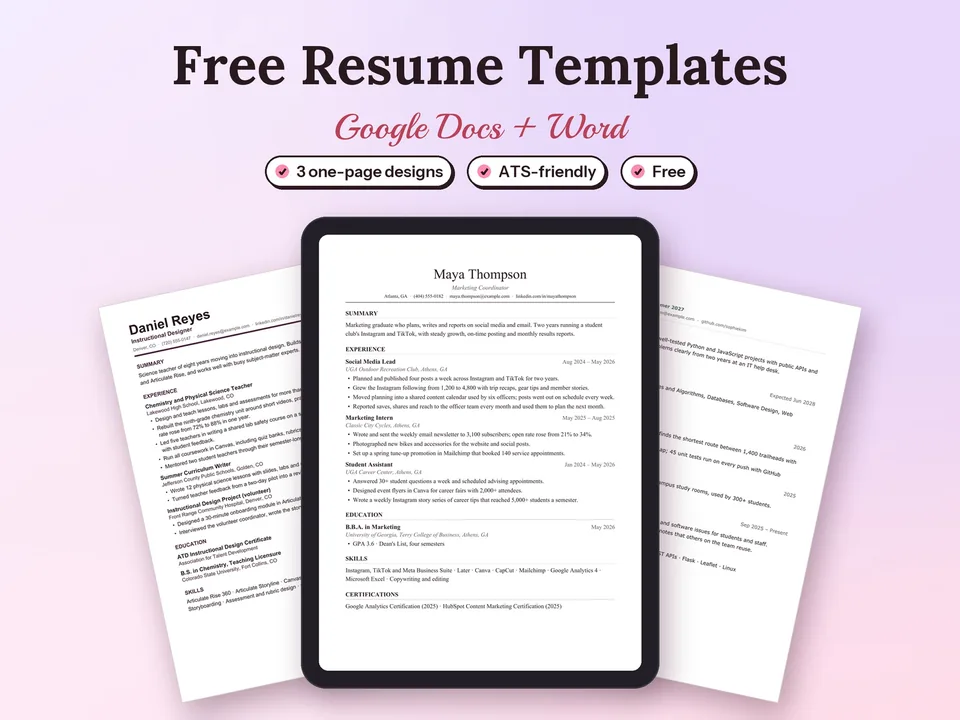
Pick the example closest to your situation, keep the four-part structure, and replace every detail with your own: your title, your years, your number, your next role. Then read it next to the job post and swap in their wording. If you’d like to see it on a finished page, our free resume builder shows a live one-page preview as you type, lets you customize the sections and downloads to Word or PDF with no sign-up. Prefer Google Docs? Our free resume templates open in your own Drive with one click.
Questions people ask
What is an example of a short summary about yourself?
A short summary fits on two lines: who you are, one strength with proof, and the role you're aiming for. For example: "Customer support specialist with 4 years in SaaS help desks, holding a 96% satisfaction score across 9,000 tickets. Ready to bring that patience and product knowledge to a customer success role." Swap in your own title, numbers and target job.
How should I write a professional summary on my resume in 2026?
Keep it to 2–3 lines at the top of the page, under your contact details. Open with your job title or field, add years of experience or a key skill, prove it with one number, and name the role you want. Mirror two or three words from the job post, drop pronouns like I and my, and rewrite it for each application.
What is an example of a good personal summary?
A good personal summary sounds like a specific person, not a template. Compare "Hard-working team player seeking growth" with "Bilingual retail supervisor who trained 14 new hires in a year and cut weekend checkout waits by a third." The second names a skill, a result and a context, so a recruiter can picture the work you'd do.
What is an example of a good summary?
A good resume summary answers what a recruiter wants to know in two lines: what you do, how well you do it, and where you want to do it next. "Staff accountant, CPA, with 6 years closing month-end books for multi-entity firms; moved close from 10 days to 6. Looking for a senior accountant role in manufacturing." Every phrase there carries information.
Should a resume summary be written in first person?
Resume summaries are usually written in implied first person: drop I, me and my, and start with your title or a strong adjective. "Registered nurse with 5 years in pediatric care" reads cleaner than "I am a registered nurse." The University of Arizona's career center gives the same advice, suggesting you simply start with a phrase like your major or role.
How long should a resume summary be?
Two to three lines, or two to three sentences, is the standard most university career centers give. That's roughly 30 to 60 words. If you need more room to list qualifications, switch to a short Summary of Qualifications with three or four bullets instead of stretching the paragraph.
Do I need a resume summary if I have no experience?
It's optional. Some career centers suggest undergraduates skip it and let education and projects speak. A summary earns its place when it adds context the rest of the page can't: a target role, a relevant project with a result, or a skill like a second language. If it only repeats your degree, leave the space for experience bullets.