
The letter’s written, the resume’s ready, and now the first line stalls you. Dear who? The job post names no one, “To Whom It May Concern” sounds stiff, and “Hey there” is clearly wrong. Learning how to address a cover letter takes five minutes, and the greeting is the first thing a hiring manager reads, so it’s worth getting right.
To address a cover letter, write “Dear” plus the hiring manager’s full name, such as “Dear Jordan Lee,” or a title and last name, such as “Dear Ms. Patel.” If you can’t find a name, use “Dear Hiring Manager” or a team greeting like “Dear Marketing Team.” Avoid “To Whom It May Concern” and “Dear Sir or Madam.”
How to address a cover letter
The best way to address a cover letter is to a named person. Indeed’s guide to addressing a cover letter advises “addressing the hiring manager directly” and says that if you have the full name but aren’t sure of the person’s gender, you should “begin with ‘Dear’ followed by their first and last name.” That one rule covers most applications.
Here is how the choice plays out in practice.
When you know the name
- Dear Jordan Lee (full name, safest choice)
- Dear Ms. Patel or Dear Mr. Okafor (when you know the title they use)
- Dear Dr. Chen or Dear Professor Alvarez (when the person holds that title)
When you don’t know the name
- Dear Hiring Manager
- Dear Marketing Team or Dear Finance Department
- Dear Head of Customer Success (the job title of the person you’d report to)
- Dear Brightwater Recruiting Team (the company’s hiring team)
A named greeting tells the reader you looked. A role or team greeting tells them you know where your letter is going. Either beats a blanket greeting that could open any letter to any company.
How to find the hiring manager’s name
Before you address a cover letter to a generic reader, spend five to ten minutes looking for a name. Work through these places in order, and stop when you find a name.
- The job post. Read it to the end. Many postings name the recruiter or say “reporting to the Director of Operations.” Also check the email address you’re told to send to, since [email protected] gives you the name.
- The company website. Look at the About, Team or Leadership pages for the head of the department you’re applying to.
- LinkedIn. Search the company, open its People tab and filter by the department or a keyword like “marketing.” For a coordinator role, the manager or director of that team is usually the person reading.
- A targeted web search. Try “[company] head of marketing” or “[company] recruiter” with the city.
- Ask. Indeed’s guide suggests calling or emailing the company: “Explain that you’re applying for a job and would like to address your cover letter to the correct person.” A front desk or HR inbox will often just tell you.
If two names come up, such as a recruiter and a team lead, address the person who will decide on the hire, which is usually the team lead. If the posting is handled by a large recruiting team and no one is named, a team greeting is the honest choice.
Cover letter greetings ranked from best to avoid
Not every salutation lands the same way. This ranking runs from the most personal to the ones that make a letter feel copied and pasted.
| Rank | Greeting | When to use it |
|---|---|---|
| 1 | Dear Jordan Lee | You know the full name. Works for anyone, any gender. |
| 2 | Dear Ms. Patel / Dear Mr. Okafor | You know the name and the title the person uses. |
| 3 | Dear Dr. Chen / Dear Professor Alvarez | The person holds an academic, medical or similar title. |
| 4 | Dear Jordan | Casual industries, startups, or you’ve already met. |
| 5 | Dear Head of Customer Success | No name, but you know the role you’d report to. |
| 6 | Dear Marketing Team | No name, but you know the department. |
| 7 | Dear Brightwater Hiring Team | No name or department, but you know the company. |
| 8 | Dear Hiring Manager | Standard fallback. Polite and gender-neutral. |
| 9 | Dear Recruiter / Dear Recruiting Team | The posting comes from a recruiter or agency. |
| 10 | Greetings | Neutral but bland. Fine in a pinch. |
| Avoid | To Whom It May Concern | Stiff and impersonal. |
| Avoid | Dear Sir or Madam | Outdated and assumes gender. |
| Avoid | Dear Mrs. / Dear Miss | Guesses at marital status. |
| Avoid | Hi, Hey, Hello there | Too casual for a job application. |
| Avoid | Dear Sir, Gentlemen | Assumes the reader’s gender. |
“To Whom It May Concern” alternatives
Advice differs on this one. The Howe Writing Center at Miami University still suggests “Whom It May Concern” followed by a colon when you don’t know your reader, while Indeed calls “To Whom It May Concern” and “Dear Sir or Madam” “outdated and overly formal.” Both work grammatically. The difference is tone: a reader who sees “To Whom It May Concern” knows the letter wasn’t written for them. Swap in any of ranks 5 to 9 above and the letter reads as if it was.
Gender-neutral cover letter salutations
When you’re unsure which title someone uses, leave the title out. “Dear Jordan Lee” or “Dear Sam Rivera” is correct for anyone, and it’s what most career advisers now treat as the default. Other gender-neutral options:
- Full name: Dear Alex Morgan
- Professional title: Dear Dr. Morgan, Dear Professor Morgan, Dear Chef Morgan
- Job title: Dear Engineering Manager, Dear Director of Admissions
- Team: Dear Product Team, Dear Hiring Committee
- Mx.: Dear Mx. Morgan, when the person lists Mx. on their profile or email signature
Check the person’s LinkedIn profile or company bio for pronouns before using Mr. or Ms. If nothing is listed, the full name is the safe and respectful choice. It also saves you from the most common greeting mistake on names like Jordan, Taylor, Robin or Sam.
Cover letter header format, with an example
When you address a cover letter on paper or as a PDF, the greeting sits under a header block that tells the reader who you are and who the letter is for. Miami University’s writing center lays the block out in this order: your address “at the very top, followed by one blank line,” then the date “followed by one blank line,” then the employer’s name and position, “the company name and the address on separate lines,” and one more blank line before the greeting.
In a modern cover letter, your header usually swaps the street address for your city, phone, email and LinkedIn URL. Here’s a formatted example:
Maya Thompson
Denver, CO 80205
(720) 555-0148 · [email protected]
linkedin.com/in/mayathompson

October 19, 2026

Jordan Lee
Head of Customer Success
Brightwater Software
1450 Market Street, Suite 300
Denver, CO 80202

Dear Jordan Lee:
A few rules keep the header clean:
- Your block: name, city and state, phone, email, and a LinkedIn or portfolio link. A full street address is optional now.
- Date: spell out the month (October 19, 2026), and use the date you send the letter.
- Employer block: the person’s name, their job title, the company, then the street address and city on separate lines. If you have no name, start with the company name.
- Match your resume: use the same name styling, font and contact details as your resume header so the two pages look like a set.
- Punctuation after the greeting: a colon (“Dear Jordan Lee:”) is the formal business-letter choice and the one Miami’s handout recommends. A comma (“Dear Jordan Lee,”) is common in email and less formal letters. Pick one and keep it consistent.
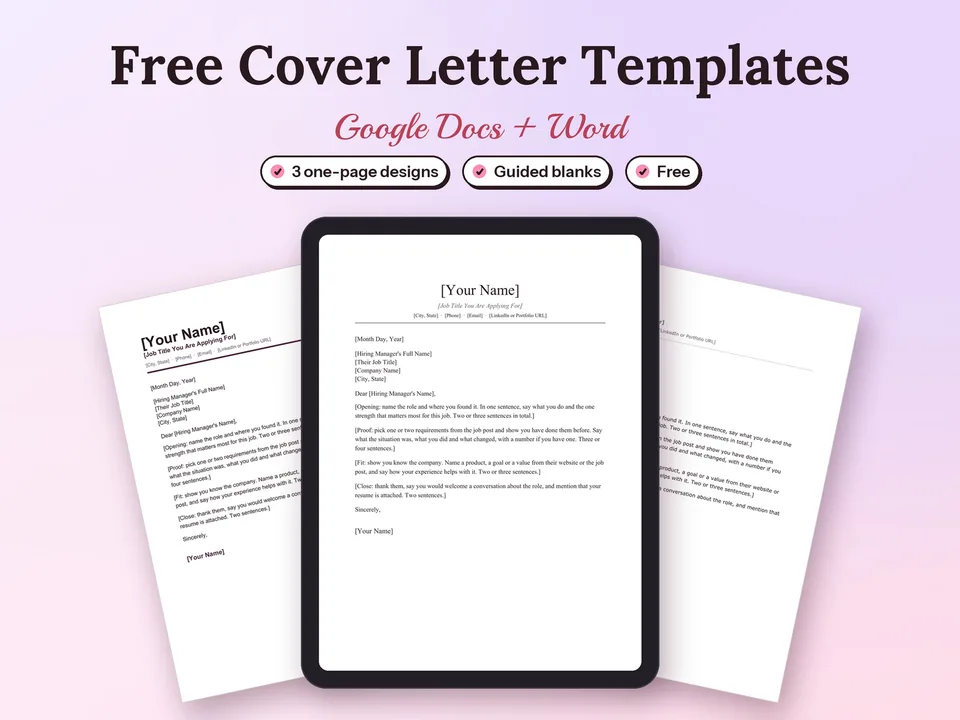
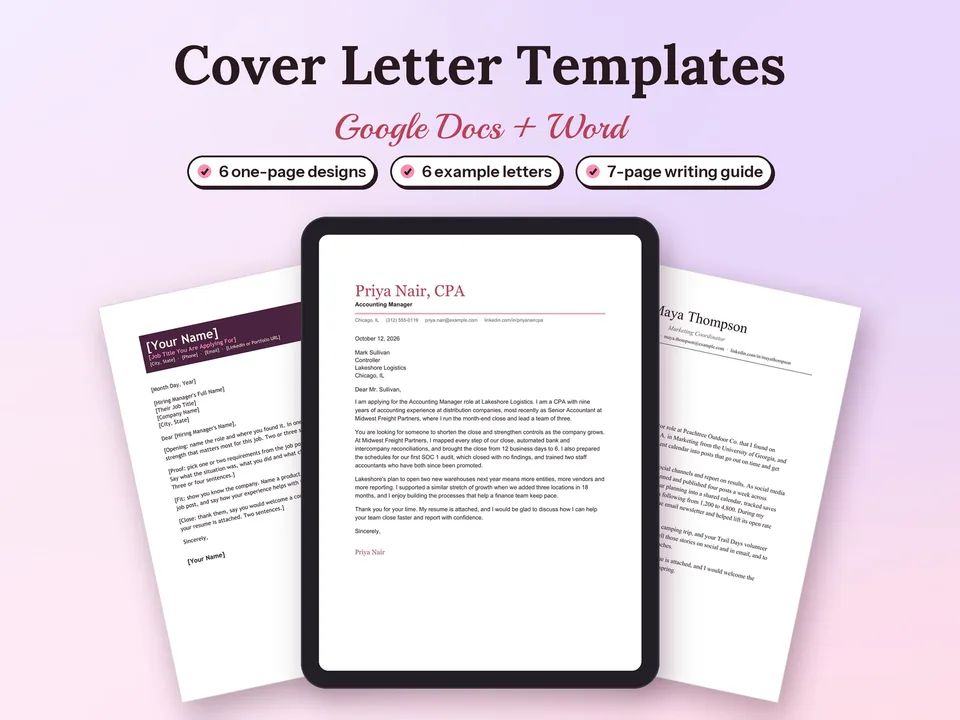
Our free cover letter templates already lay out this header, with a [bracket] on each line for your details and the employer’s, so the spacing comes out right in Google Docs or Word.
How to address an email cover letter
When you address a cover letter sent as an email, the address block moves around. The greeting stays the same, but the header drops out of the body.
- Subject line: put the job title and your name, such as “Customer Success Manager application, Maya Thompson.” Add the job ID if the posting has one.
- Greeting: the same ranking applies. “Dear Jordan Lee,” or “Hi Jordan,” for a less formal company. Use a comma after the greeting in email.
- No employer address block: skip the date and the company’s mailing address. The email’s To line already does that job.
- Your contact details go at the bottom: put your full name, phone, email and LinkedIn URL in the signature under your sign-off.
- Keep it short: an email body of about 150 to 250 words reads well on a phone. Our guide on how long a cover letter should be breaks down the word budget for email and online text boxes.
If you attach a separate cover letter file as well, the attached letter keeps the full header from the section above, and the email body becomes a two- or three-sentence note introducing it.
Common mistakes when addressing a cover letter
In our work on cover letter templates, the same few greeting errors come up again and again. Each one is easy to fix before you hit send.
- Misspelling the name. Copy it from LinkedIn or the company site, and check accents and hyphens.
- Leaving the last company’s name in. If you reuse a letter, the greeting and header are the first lines to change. Search the document for the old company’s name before every send.
- Guessing a title. “Dear Mr. Taylor” for a woman named Taylor Brooks is a bad first impression. Use the full name when unsure.
- Using the first name only in a formal field. Law, finance, government and academia lean formal. Use the full name or a title there.
- Mixing a colon and a comma. Choose one style and use it in the greeting every time.
- Addressing a generic HR inbox by name. If the posting says “send to [email protected]” with no name, a team greeting is the accurate one.
The sign-off at the other end of the letter needs the same care. Our guide on how to end a cover letter covers closing lines and sign-offs that match the tone of your greeting.
Address your cover letter and finish it in one place
The greeting comes down to three moves: look for a name for five to ten minutes, use “Dear” plus the full name when you find it, and use the team, job title or “Dear Hiring Manager” when you don’t. Put it under a clean header block with your details, the date and the employer’s address, and keep the punctuation consistent.
To write the whole letter with the header and greeting already in place, open our free cover letter builder. It guides you through four short paragraphs in a one-page design, keeps you in the 250 to 400 word range, and downloads the letter as a Word file or PDF.
Questions people ask
How do I start a cover letter if I don't know the name?
Use "Dear Hiring Manager" or address the team or role that's hiring, such as "Dear Marketing Team" or "Dear Head of Customer Success." Before you settle on that, check the job post, the company's team page and LinkedIn for the name, or call or email the company and ask who is hiring for the role. A role-based greeting reads warmer than "To Whom It May Concern."
What is the proper address format for a cover letter?
Put your name and contact details at the top, then a blank line, the date, another blank line, and the employer's block: the reader's name and title, the company name, and the street address with city, state and ZIP on separate lines. Leave one more blank line, then the greeting, such as "Dear Jordan Lee:" in a formal letter.
How do I start off a cover letter?
Start with a greeting to a named person, such as "Dear Ms. Patel" or "Dear Jordan Lee," then open the first paragraph with the job title and your strongest reason for applying. One sentence on what you'd bring to the role works better than a sentence about yourself, so lead with a result or skill that matches the job post.
What are the three golden rules in writing the cover letter?
Address it to a real person whenever you can, tailor it to the specific job and company, and keep it short: one page, about 250 to 400 words. A named greeting shows you did your homework, tailoring shows fit, and brevity respects a busy reader who may skim dozens of letters for the same role.
Is it OK to say Dear Hiring Manager on a cover letter?
Yes. "Dear Hiring Manager" is the standard fallback when you've looked and can't find the reader's name. It's polite, gender-neutral and current. It ranks below a named greeting because it's generic, so use it after you've checked the job post, the company website and LinkedIn, and consider a team or job-title greeting if you know which department is hiring.
Should I use To Whom It May Concern on a cover letter?
It's better to pick something warmer. "To Whom It May Concern" still appears in some university handouts, but many career advisers, including Indeed, call it outdated and overly formal. "Dear Hiring Manager," "Dear Recruiting Team" or a job-title greeting such as "Dear Engineering Manager" does the same job and sounds like it was written for this application.
How do you address a cover letter when you know the name?
Write "Dear" followed by the person's first and last name, such as "Dear Sam Rivera." If you know the title they use, "Dear Mr. Rivera," "Dear Ms. Rivera" or "Dear Dr. Rivera" also works. Skip "Mrs." and "Miss," which guess at marital status, and use the first name alone only in a casual industry or when you already know the person.
How do you address a cover letter to a company?
When no person or department is named, address the company's hiring team: "Dear [Company] Hiring Team" or "Dear [Company] Recruiting Team." In the header, list the company name and its mailing address under the date. This keeps the greeting specific to the employer even without a contact name.