
The greeting is written, the job post is open in another tab, and the cursor is blinking under “Dear Ms. Patel.” The first sentence is where most cover letters stall, and where most hiring managers decide whether to keep reading. Learning how to start a cover letter well means writing two or three sentences that tell the reader what you want, why you’re a fit and why them. The rest of the letter gets easier once those lines exist.
To start a cover letter, write an opening paragraph of two or three sentences and about 40 to 60 words. Name the exact job you’re applying for, give your strongest reason or proof for it (a result, a skill or a referral), and connect that reason to something specific about the company.
How to start a cover letter: the three-part opening
The opening paragraph comes right after the greeting. If you’re still deciding between “Dear Ms. Patel” and “Dear Hiring Manager,” our guide on how to address a cover letter covers the salutation and header. Everything below is about the lines that follow it.
A strong opening does three jobs, in this order:
- The role. Name the exact job title, and the company if it isn’t obvious from the greeting.
- Your strongest reason or proof. One result, skill or connection that matches the job post. A number helps.
- The connection to the company. A product, goal, customer group or person that links your reason to them.
Put together, it looks like this:
I’m applying for the Customer Success Manager role at Northwind. In four years at Lumen Health, I raised our renewal rate from 81% to 93% across 120 accounts, and Northwind’s move into mid-size clinics is the customer base I’ve spent those years serving.
That’s 46 words, and the reader already knows the job, the proof and the reason for this company.
University career centers teach the same structure. Georgetown’s Cawley Career Education Center tells applicants to “indicate the reason you are writing, the specific position for which you are applying, and how you heard about the opening” in the first paragraph. MIT’s career office adds that the opening should “provide an overview of the main strengths and skills you will bring to the role,” per its guide on how to write an effective cover letter.
Why this order works: a hiring manager who reads cover letters in a stack reads the first lines most closely. Leading with the role sorts your letter into the right pile, and putting proof in the same paragraph means the reader meets your best evidence before deciding whether to read on.
Write your opening in four steps
The quickest way to learn how to start a cover letter is to stop writing the first sentence first. Build the opening from the job post instead.
- Find the top requirement. Highlight the three requirements the job post repeats or lists first. Your opening answers the first one.
- Pick one proof point. Choose the result from your resume that best matches that requirement. “Cut month-end close from 10 days to 6” beats “strong attention to detail.”
- Find one company detail. A product launch, a mission line, a customer group, a recent project, or the name of the person who referred you. Two minutes on the company’s website is usually enough.
- Write it, then cut. Draft the three parts, then trim to 40 to 60 words. Delete any phrase that would fit every company’s letter equally well.
A common first-draft pattern: the opening says what you want, and the best result sits buried in the second paragraph. The fix is usually to move that result up into the first sentence.
Cover letter opening examples by situation
Here are 25 opening lines you can adapt. Swap in your own role, result and company detail; the structure is what carries over.
Experienced, applying for a similar role
- “I’m applying for the Senior Data Analyst position at Harbor Bank. At Coastline Credit Union, I built the loan-risk dashboard our lending team now uses daily, and your post’s focus on self-serve reporting is the work I most want to keep doing.”
- “Your Operations Manager opening caught my attention because it centers on the problem I’ve spent five years solving: getting orders out the same day. At Brightline Supply, I cut average fulfillment time from 38 hours to 14.”
- “I’d like to bring my eight years of pediatric nursing to the Charge Nurse role at Riverside Children’s. I currently lead a 12-bed unit, and Riverside’s family-centered care model is the reason I’m applying.”
- “In my three years as a marketing coordinator at Fable & Co., our email list grew from 8,000 to 41,000 subscribers. I’m applying for your Email Marketing Specialist role to do the same for Greenleaf’s new subscription line.”
Referral
- “Priya Shah, a senior engineer on your platform team, suggested I apply for the Backend Developer role. She knows my work from two years together at Kestrel, where I led the move of our payments service to Go.”
- “After talking with Marcus Lee about Atlas’s expansion into the Midwest, I’m applying for the Regional Sales Manager position. He mentioned the team needs someone who has opened new territories, and I’ve opened three for Corvid Foods since 2022.”
- “Dana Ruiz, who managed me at Northstar for four years, recommended I reach out about your Project Coordinator opening. She can speak to the 30-plus office moves I scheduled and delivered on time.”
Career change
- “After eight years teaching high school chemistry, I’m applying for the Instructional Designer role at Brightpath Learning. I’ve designed lessons for 150 students a year, and the pass-rate gains from my redesigned units are the kind of measurable learning your team builds.”
- “I’m moving from restaurant management into HR, and your People Operations Coordinator role fits the part of my job I’ve liked most: hiring and training. I’ve onboarded more than 60 staff across two locations at Olive & Ember.”
- “Five years as a paralegal taught me to read dense contracts quickly and spot what’s missing. I’m applying for the Contract Analyst role at Vertex Software to use those skills where contracts drive the business.”
Entry level or student
- “I’m a senior studying accounting at Ohio State, and I’m applying for your Audit Associate position for fall 2027. Last summer I interned at Miller & Grant, where I tested internal controls for three nonprofit clients.”
- “As a recent graduate in communications from UC Davis, I’m applying for the Junior Content Writer role at Sprout. I ran our student paper’s social accounts, growing Instagram followers from 900 to 6,200 in one year.”
- “Your Marketing Assistant internship asks for someone comfortable with data and design. As a business major at Rutgers, I’ve done both, building the analytics report and the event flyers for our 400-member entrepreneurship club.”
- “I’m applying for the Lab Technician position at Novagen. My biology degree included 200 hours of hands-on lab work, including PCR and cell culture, and Novagen’s work on rare-disease testing is why I chose to apply here first.”
Internal move or promotion
- “I’d like to be considered for the Team Lead role in Customer Support. In my two years on the team, I’ve trained nine new agents and kept our satisfaction score above 94%, and I want to keep building the team I already know.”
- “After three years in Finance at Aster, I’m applying for the open FP&A Analyst position. I already build the monthly variance report your team uses, and moving into planning is the natural next step for that work.”
- “I’m applying for the Product Marketing Manager opening on the Growth team. As a sales engineer here, I’ve run 200-plus demos of the analytics product, so I know which messages land with customers and which don’t.”
Returning to work
- “After three years at home with my children, I’m ready to return to accounting, and your Staff Accountant role is the position I’m most excited about. Before my break, I managed accounts payable for a $40 million manufacturer.”
- “I’m applying for the Registered Nurse position on your med-surg unit. I took two years away from nursing to care for a family member, renewed my license and BLS certification this spring, and bring six years of floor experience.”
- “Your Office Manager role calls for someone who can run a busy front desk and keep the books. I did both for nine years at Pine Street Dental before stepping away to relocate, and I’m now back in Denver and ready to start.”
Cold application, no posted job
- “I’m writing to ask whether Lumen Studio has room for a motion designer on its brand team. Your recent campaign for Field Notes is the kind of work I’ve been doing for agencies for six years, and I’d love to bring it in-house.”
- “Wildroot’s growth into 40 new stores this year likely means more pressure on your supply chain. I’m a logistics planner who cut freight costs 12% at Tandem Grocers, and I’d welcome the chance to help.”
- “I’ve followed Northfield Library’s adult literacy program since it launched, and I’d like to ask about openings for a program coordinator. I currently run a volunteer tutoring program with 45 tutors and 120 learners.”
Email cover letter
- “Hi Ms. Okafor, I’m applying for the Graphic Designer role posted on LinkedIn. My portfolio, linked below, includes the packaging redesign that lifted shelf sales 18% for Bright Oat.”
- “Hello Jordan, Sam Patel mentioned you’re hiring a Bookkeeper for the Austin office. I’ve kept the books for four small businesses at once for the past five years, and my resume is attached.”
In an email, the subject line carries the job title (for example, “Graphic Designer Application: Maya Hernandez”), so the first line can go straight to your strongest reason. Keep the whole email to about 150 to 200 words.
Weak cover letter openings to avoid, with rewrites
Knowing how to start a cover letter also means knowing which first lines to drop. The most common weak openings share one problem: they spend the first sentence on information the reader already has. Here’s how to fix them.
| Weak opening | Why it falls flat | Rewrite |
|---|---|---|
| “My name is Alex Kim and I am applying for…” | Your name is already at the top and bottom of the letter | “I’m applying for the Payroll Specialist role at Cedar, where I’d bring five years of multistate payroll experience.” |
| “I am writing to express my interest in the position.” | Ten words that say only what the letter obviously is | “Your Account Executive opening is the next step after three years of beating quota at Relay.” |
| “To whom it may concern, I saw your job posting.” | Generic greeting plus a line with no role and no reason | “Dear Hiring Team, I’m applying for the Front-End Developer role I found on your careers page.” |
| “I am the perfect candidate for this job.” | A claim with no proof, and the reader decides that | “I’ve shipped four React apps used by 50,000 people, which matches the first requirement in your post.” |
| “I have always been passionate about marketing.” | Passion without evidence sounds like every other letter | “I’ve run paid social budgets of $30,000 a month, and Greenleaf’s launch plan is the campaign I’d want to own.” |
| “Although I don’t have much experience…” | Opens with a weakness instead of a strength | “My internship at Harbor PR gave me 10 weeks of press-list building and pitch writing.” |
A quick test for any opening line: cover the company name and read it again. If the sentence would work just as well for a different employer, it needs one more specific detail.
How long should the first paragraph be?
Keep the opening paragraph to two or three sentences and about 40 to 60 words. That’s the share it gets in a one-page letter of 250 to 400 words, with the proof paragraph taking the biggest slice. Our guide on how long a cover letter should be breaks down the word budget for all four paragraphs.
Short openings work because of how cover letters get read: fast, often next to the resume, with the reader looking for one reason to keep going. A 120-word opening buries that reason under setup. If your first paragraph runs long, the usual culprit is a sentence that restates your resume. Move it to the proof paragraph or cut it.
A few format notes for the first lines:
- Name the role exactly as the job post does, including any job ID the employer asks for.
- Put the referral first when you have one. A name the reader recognizes earns the most attention in the first sentence.
- Save the “why this company” detail for one clause. The full explanation belongs in the third paragraph.
- Match the tone to the field. A law firm and a design startup both want specifics, but the startup will welcome a warmer first line.
From the first line to the last
Once the opening is set, the rest of the letter follows the same pattern: one proof paragraph, one paragraph on why this company, and a short close. When you reach the end, our guide on how to end a cover letter has closing lines and sign-offs to match.
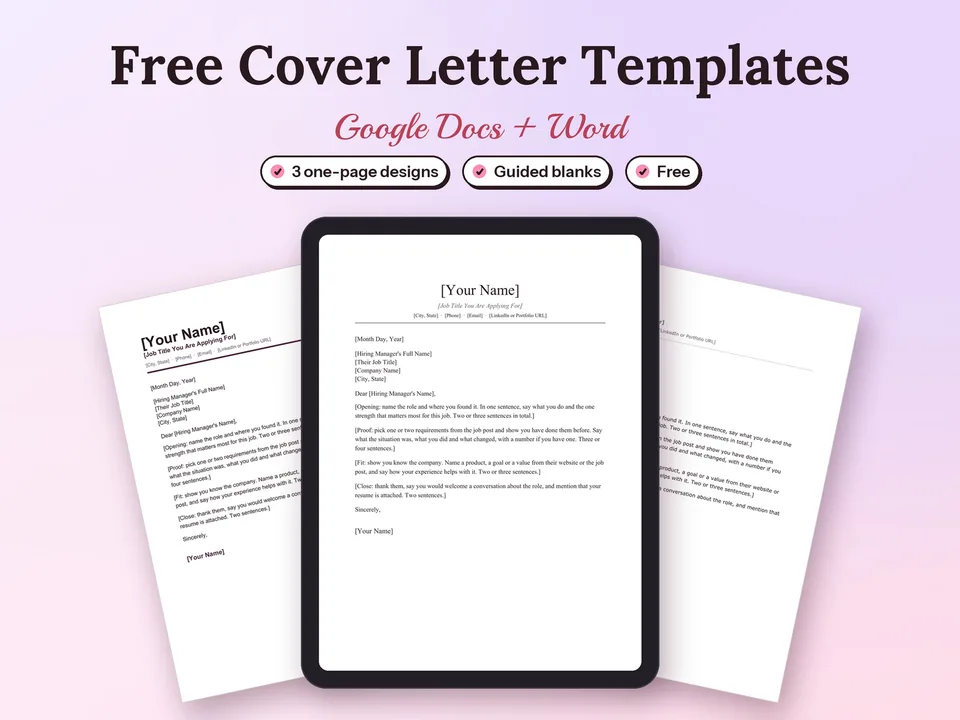
For a finished layout, the free cover letter templates put a [bracket] in each line telling you what to write.
So, how to start a cover letter in one line: name the role, lead with your best proof, and tie it to the company, all in 40 to 60 words. To write all four paragraphs in one place, with word count guidance and a one-page design you can download as Word or PDF, try our free cover letter builder.
Questions people ask
How do I start off a cover letter?
After the greeting, start with one sentence that names the exact job and gives your strongest reason for it, such as a result or a skill the job post asks for. Add a second sentence that connects you to the company: a product, a goal or the person who referred you. Two or three sentences and 40 to 60 words is enough.
How do I start a cover letter if I don't know the name?
Use a greeting such as "Dear Hiring Manager" or "Dear [Team Name] Hiring Team," then go straight into the opening paragraph. A missing name changes only the salutation, so the first sentence still names the role and your best reason for it. Before you settle, check the job post, the company's team page and LinkedIn for the hiring manager's name.
What should you not include in a cover letter?
Leave out anything that repeats your resume line by line, salary expectations unless the employer asks, complaints about a past employer, and personal details unrelated to the job. In the opening, skip lines like "My name is" and "I am writing to apply for," which spend words on what the reader already knows. Use that space for a result or a reason.
How do I write a simple cover letter for a job application?
Write four short paragraphs. The opening names the role and your best reason for it. The second gives one result that matches a requirement in the job post. The third explains why this company. The close thanks the reader and asks for a conversation. Keep it to one page, about 250 to 400 words, and change the details for every job.
What is the purpose of a cover letter?
A cover letter explains why you want this specific job and why you fit it, in a way a resume can't. It gives a reason for applying, context for a career change or a gap, and one or two results told as a short story. The opening paragraph carries most of that weight, because it decides whether the reader keeps going.
What's the difference between a CV and a cover letter?
A CV or resume lists your experience, education and skills in a fixed format, and the same document often goes to many employers. A cover letter is a one-page letter written for one job, explaining why you want it and connecting your best results to what that employer needs. Most applications ask for both, with the letter on top.