
A job post asks for your CV, and you have a resume. Or you’re applying to a university, a lab, or a company in London, and you’re not sure whether the document you already have is the right one. The short version of resume vs CV is that the answer depends on two things: the country you’re applying in and the kind of job you want.
In the US and Canada, a resume is a one-to-two-page summary tailored to each job, and a CV (curriculum vitae) is a complete, longer record of an academic or research career. In the UK, Ireland and most of Europe, “CV” is simply the everyday name for the job-application document an American would call a resume.
What’s the difference between a resume and a CV?
The difference between a resume and a CV comes down to purpose. A resume is a selection: the experience, skills and results that matter for one particular job, cut to fit one or two pages. A CV, in its American academic sense, is a full record: every degree, publication, presentation, grant, teaching post and award, in order, with nothing left out because it’s off-topic.
That’s why the two grow differently over a career. A resume stays roughly the same length for decades, because older and less relevant lines drop off as new ones come in. An academic CV keeps growing, since every new paper and conference talk gets added.
The guidance from William & Mary’s graduate career center puts the length gap plainly: resumes are limited to one to two pages, while CVs have no length limit, and an experienced professor might have a 20-page CV. The same handout notes that CVs are used in academic and research settings, and that outside the US the word CV often means the same thing as resume, with formatting that varies by country.
So “CV” carries two meanings. Outside North America it’s the general word for the document. Inside North America it’s the long academic version.
Resume vs CV: side-by-side comparison
This table compares a US resume, a US academic CV and the CV used for most jobs in the UK and Europe.
| US resume | US academic CV | UK / European CV | |
|---|---|---|---|
| Used for | Most jobs in the US and Canada | Faculty posts, research, grad school, fellowships, grants, many medical roles | Most jobs in the UK, Ireland and Europe |
| Typical length | 1 page, 2 with long relevant experience | No limit; grows over a career | Up to 2 A4 pages |
| Content | Selected roles, results and skills for one job | Every degree, publication, talk, grant, award and teaching post | Selected roles, education and skills for one job |
| Tailored to each job? | Yes | Lightly (section order and emphasis) | Yes |
| Opens with | Summary | Education | Personal statement (profile) |
| Paper size | US Letter | US Letter | A4 |
| Photo and date of birth | Left off | Left off | Left off in the UK |
The UK column follows Prospects, the UK’s graduate careers site, which recommends keeping a CV to two A4 pages, says a photo is only for acting or modelling work, and calls date of birth irrelevant. Read the third column again and it looks a lot like the first: in day-to-day use, a UK CV and a US resume are close cousins, with A4 paper and British spelling being the main visible changes.
Resume vs CV by country: which one to send
United States and Canada. Send a resume unless the job is academic, scientific or clinical. Corporate job ads written by international teams sometimes say “CV” when they mean resume; a one-to-two-page resume answers those well.
United Kingdom and Ireland. Send a CV, which in practice means a resume-style document of up to two A4 pages that opens with a short personal statement. Swap US spelling for UK spelling (“organised,” “programme”) and set the page to A4.
Europe. “CV” is the standard word. The Europass CV, run by the European Union, describes itself as one of the best-known CV formats in Europe and lets you create and share CVs in 31 languages. Many employers accept any clean, well-organized CV, so Europass is one option among several.
Everywhere else. Read the job post closely and match its word. If a posting from a global company asks for a CV and lists two pages as the limit, it means a resume-style CV. If it asks for publications, it means the academic kind.
Resume vs CV by field
Within the US, the field settles the resume vs CV question more reliably than the word in the ad.
Use a CV for: university faculty positions, postdoctoral roles, PhD and master’s applications, research fellowships, grant applications, and many physician, scientist and clinical research jobs. These readers want the complete record, because publications and funding history are the evidence they hire on.
Use a resume for: business, tech, marketing, finance, retail, hospitality, government, nonprofit work and most healthcare jobs outside research. These readers skim. W&M’s handout points out that recruiters typically take six seconds or less on a first pass, which is why a resume puts its strongest results near the top of page one.
Higher-education staff jobs sit in between. Roles like admissions, advising, student affairs and university administration usually ask for a resume, even though the employer is a university. Faculty roles at the same university ask for a CV.
What goes in each document
A resume and a CV share a core (contact details, education, experience), but the sections around that core differ.
A US resume usually runs: contact details, a two-to-three-line summary, experience, education, skills. Each job gets three to five bullets that show results. If the summary is the hardest part to write, our resume summary examples show how to fit your strongest point into two lines.
A US academic CV usually runs: contact details, education (with dissertation title and advisor), research interests, publications, presentations, grants and fellowships, teaching experience, awards, service, professional memberships and references. Entries are listed without the long results-driven descriptions a resume uses.
A UK CV runs much like a resume, with a few naming changes. Prospects lists contact details, personal statement, education, work experience, skills and achievements, interests and references, and suggests moving work experience above education once you have plenty of it. It also notes that you can leave referees’ names off at the application stage.
How to turn a CV into a resume
Going from a long academic CV to a US industry resume is mostly cutting and rewriting.
- Pick the target job first. Highlight every requirement in the posting. That list decides what stays.
- Add a summary at the top. Two or three lines that say what you do, at what level, and the strength that fits this job.
- Turn research into results. “Published four papers on protein folding” becomes “Designed and ran 30+ lab experiments; findings published in four peer-reviewed journals.”
- Collapse the long lists. Replace full publication and conference lists with one line, such as “Four peer-reviewed publications and six conference talks.”
- Cut to one or two pages. Drop teaching, service and awards that don’t connect to the job, then check the page count.
When we built our free resume builder, we made it show “Fits on one page” while the layout fits and flag the moment it runs over, because staying inside the page is the step people trip on most when they shorten a CV.
How to turn a US resume into a UK or European CV
Going the other way is lighter work. A US resume is most of the way to a UK CV already.
- Change the page size to A4. In Google Docs, use File, then Page setup. In Word, use Layout, then Size.
- Rename “Summary” to “Personal statement” and write it in a slightly fuller three-to-four-line paragraph.
- Switch to UK spelling and date formats (18 October 2026, not October 18, 2026).
- Keep it to two pages. Use any extra room for one or two more relevant roles.
- Leave out the photo and date of birth for UK applications. For other European countries, check the employer’s own instructions.
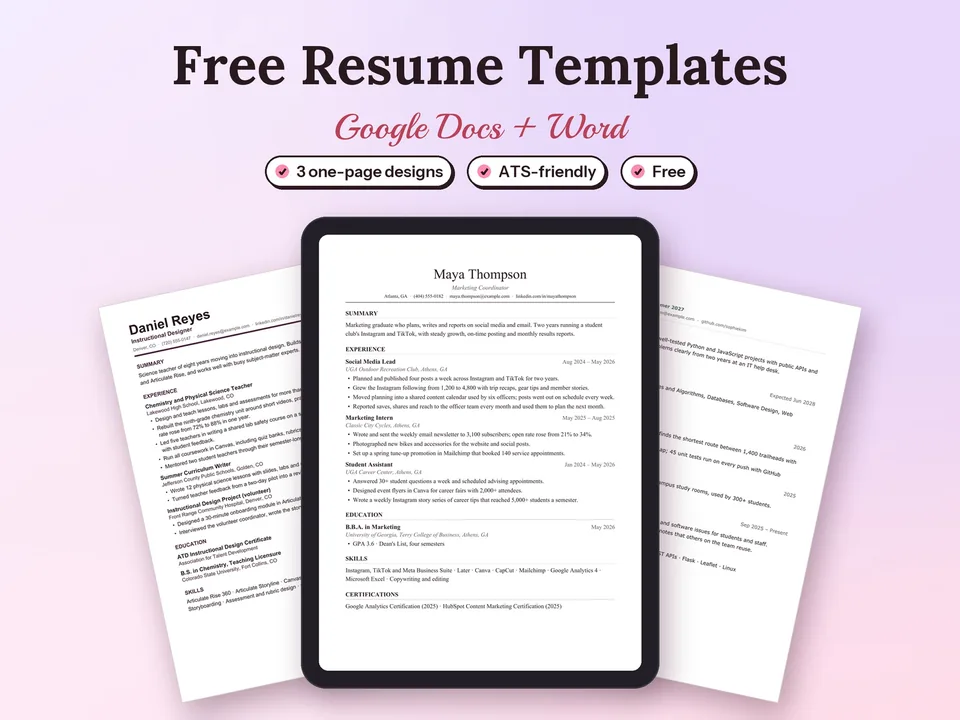
If you’d rather start from a finished layout, our free Google Docs resume templates come in three single-column designs; make a copy, set A4 in Page setup, and you have a clean UK-style CV. Sending a cover letter with it? Our guide on how long a cover letter should be covers the length rules for both sides of the Atlantic.
Get your resume or CV ready
Resume vs CV comes down to three checks: where the job is, what field it’s in, and what the posting asks for. In the US, a resume fits almost everything except academic and research roles. In the UK and Europe, “CV” is the everyday word and the document looks a lot like a US resume on A4 paper.
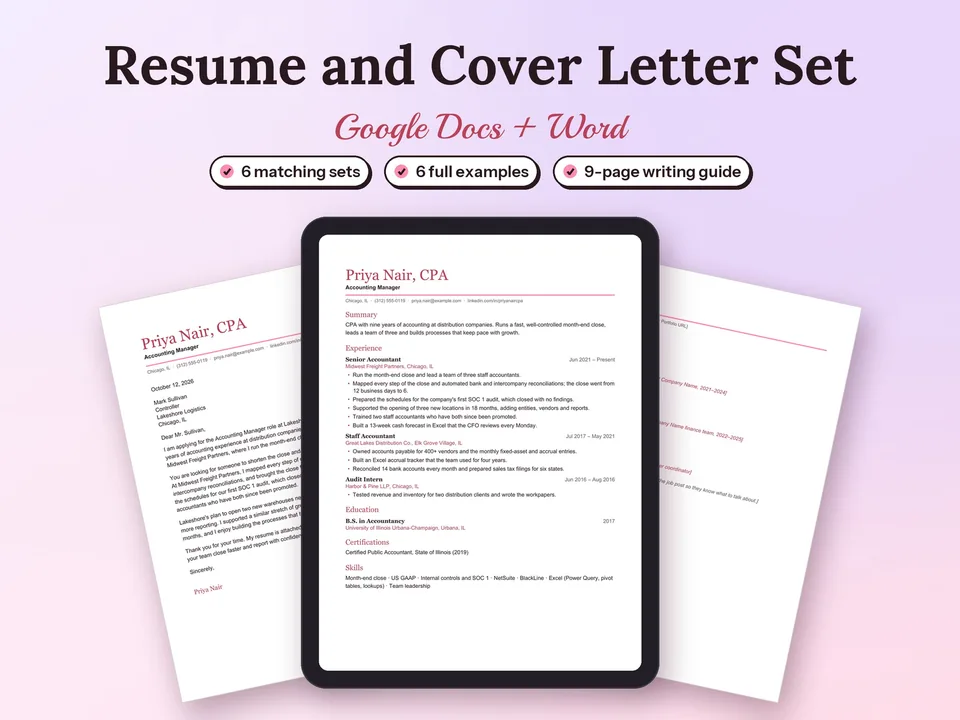
For a one-page resume you can download as Word or PDF today, try our free resume builder with no sign-up. For a matching resume, cover letter and references page in six designs, with filled-in examples and a writing guide, see the Resume and Cover Letter Templates for Google Docs.
Questions people ask
How long should a resume be?
One page suits students, new graduates and most people with under ten years of experience. Two pages is fine for a long, relevant career or a graduate degree. William & Mary's graduate career guide puts resumes at one to two pages, and if everything fits on one, keep it to one.
What does "CV" stand for in a resume?
CV stands for curriculum vitae, Latin for "course of life." In the UK, Ireland and most of Europe, a CV is the everyday job-application document a US employer would call a resume. In the US and Canada, a CV usually means the longer, complete record used for academic, research and medical roles.
What font should I use for a CV?
Pick a plain, widely installed font such as Arial, Calibri or Times New Roman, in 10 to 12 point for body text and 14 to 16 point bold for headings. That is the guidance from Prospects, the UK graduate careers site. Use one font throughout so the page reads as a single, tidy document.
What is another name for a resume?
The most common other name is CV, short for curriculum vitae, which is what the UK, Ireland and much of Europe call the same document. You will also see it spelled résumé, with accents. In the US, CV usually points to the longer academic version.
Is a CV the same as a resume?
It depends on the country. In the UK and Europe the two words name the same job-application document. In the US and Canada they are different documents: a resume is a tailored one-to-two-page summary, and a CV is a full academic record of every degree, publication, grant and talk, with no page limit.
Should I send a CV or a resume to a US employer?
Send a resume for almost every US job, including business, tech, retail, healthcare administration and nonprofit roles. Send a CV when the opening is academic or research-based: faculty posts, postdocs, graduate school, fellowships, grants and many physician and scientist roles. When the posting says CV for a corporate job, a one-to-two-page resume is usually what it wants.