
You’ve written your cover letter, and now it looks long. Or short. A friend says one page, a job board says half a page, a Reddit thread says nobody reads past the first paragraph. So how long should a cover letter be? There’s a clear standard, and once you know the number you can plan the letter paragraph by paragraph instead of guessing.
A cover letter should fit on one page: three or four short paragraphs and 250 to 400 words, with about 250 to 300 words the sweet spot for most jobs. Shorter versions of 150 to 200 words work in an email body or an online text box. Academic faculty letters are the main exception, at up to two pages.
How long should a cover letter be?
A cover letter should be one page or less, in three or four paragraphs, and between 250 and 400 words. That’s the range Indeed’s career guide on cover letter length gives “unless the employer has specified otherwise,” along with 1-inch margins and 12-point type. At that size, 250 to 400 words fills half a page to a full page.
Some advisers now push shorter. Coursera’s guide says cover letters “increasingly” should be a half page, around 250 words. Both sources agree on the ceiling: one page.
Here’s how the common lengths read in practice:
| Length | Words | Verdict |
|---|---|---|
| Email body or text box | 150–200 | Fine for those formats, thin as an attached letter |
| Half page | 200–300 | The sweet spot for most applications |
| Full page | 300–400 | Acceptable; check that every paragraph earns its place |
| Over a page | 450+ | Too long outside academia |
Word count matters less than what each paragraph does. A 380-word letter with one sharp example beats a 250-word letter of general claims. Still, a fixed range gives you a quick test: if the letter is past 400 words, something in it is repeating the resume.
A word budget for each paragraph
The easiest way to hit the right cover letter length is to budget words by paragraph before you write. We build our templates and the free builder around four paragraphs, each with one job:
| Paragraph | Job | Word budget |
|---|---|---|
| 1. Opening | Name the role and your strongest reason for it | 40–60 |
| 2. Proof | One requirement from the job post, one result | 80–120 |
| 3. Fit | Why this company, tied to your experience | 50–80 |
| 4. Close | Thanks, a next step, resume attached | 25–40 |
| Total | about 195–300 |
The proof paragraph gets the biggest share because it carries the evidence. Everything else supports it. Add a header with your contact details, the date and a greeting, and a 250-word body still lands comfortably on one page.
When you need more room, for a senior role or a career change, let the proof paragraph grow to two short examples or add a fifth paragraph that explains the switch. That pushes the letter toward 350 to 400 words, which is still within the standard.
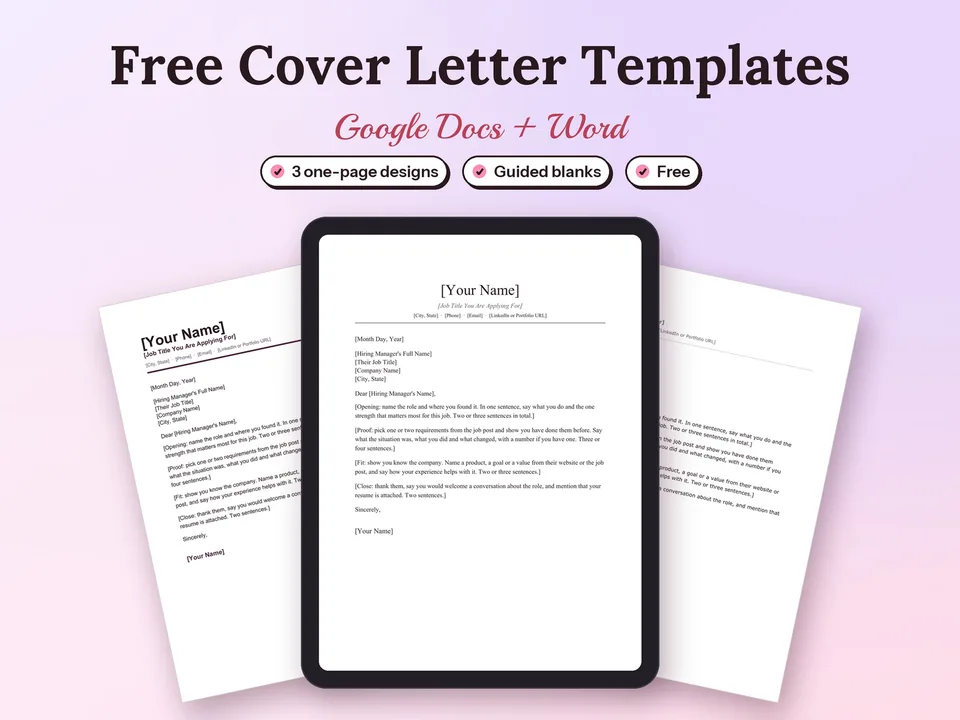
The sample letter on our free cover letter templates follows this same four-paragraph pattern, with a [bracket] in each line telling you what goes there, so the word budget is built into the page.
Why shorter letters get read
Hiring managers read cover letters after, or alongside, the resume, and they read them fast. A short letter survives that skim because its one strong example sits near the top of the page. A long letter makes the reader hunt.
There’s a mechanical reason too. A cover letter shares its space with a resume that already lists your jobs and skills. Every sentence that repeats a resume line adds words without adding information, and repetition is where most letters get long. The four-paragraph budget forces the letter to do what the resume can’t: connect one specific result to this specific job, and say why you want to work there.
Email, attachment or text box: the length changes
The 250-to-400-word range assumes a letter attached as a PDF or Word file. Two other formats call for shorter versions.
Cover letter in the body of an email. When the email itself is the cover letter, cut it to about 150 to 200 words. Keep the opening, the proof paragraph and a one-line close, and drop the formal header with addresses. Put the job title in the subject line so the first sentence can go straight to your best reason.
Online application text box. Many application portals swap the upload for a box with a character limit instead of a word limit. A useful conversion: the sample letter in our cover letter builder is four paragraphs, 147 words and 887 characters with spaces, so about six characters per word. Using that ratio, a 250-word letter runs near 1,500 characters and a 400-word letter near 2,400. When the box shows its limit, divide by six to find your word budget, then paste plain text and check that paragraph breaks survived.
Attached letter. This is where the full one-page format fits: header, greeting, three or four paragraphs and a sign-off. Save it as a PDF unless the posting asks for Word, and name the file with your name and the company.
When a longer cover letter is expected
Academic faculty jobs. University teaching and research positions are the big exception. Purdue OWL’s academic cover letter guide puts the typical letter at “one and a half to two pages long, but not more than two,” or about five to eight paragraphs, because the letter has to cover research, teaching and service. Academic applications also use a CV rather than a resume; our guide to resume vs CV explains the difference.
Federal and government jobs. For federal roles, the job announcement is the rulebook. Check its required documents list: some announcements list a cover letter as required, and others leave it optional. When one is requested, the one-page standard holds, and the space goes to matching your experience to the qualifications in the announcement, using its wording.
Postings with their own limit. If a job post gives a word count, page limit or character count, that number replaces every general rule here. Hitting the employer’s stated length shows you read the instructions.
How to cut a long cover letter
Most first drafts come in at 450 to 600 words. These cuts, in this order, usually bring a letter under 400 without losing anything that matters:
- Delete the throat-clearing opening. Lines like “I am writing to express my interest in” spend 10 words saying what the letter obviously is. Start with the role and your best reason in the same sentence.
- Keep one proof story. Two or three examples compete with each other. Pick the one that matches the first requirement in the job post and give it a number.
- Cut anything the resume already says. Job titles, dates and skill lists belong on the resume. The letter only needs the context the resume can’t show.
- Shorten the close to two sentences. Thanks, a request for a conversation, and a note that your resume is attached. That’s 25 to 40 words.
- Trim adjectives and stacked phrases. “Highly motivated, detail-oriented and passionate team player” can go entirely; your example already proves it.
- Check the page, not just the count. Keep 1-inch margins and 12-point type. If it still spills onto a second page, cut more words instead of shrinking the font.
In our experience, steps 2 and 3 do most of the work. A letter with one well-told result and nothing repeated from the resume rarely needs the other cuts.
Write a one-page cover letter in four paragraphs
So how long should a cover letter be? One page: three or four paragraphs, 250 to 400 words, and closer to 250 for most jobs. Give the proof paragraph the biggest share, shorten the letter for email bodies and text boxes, and save two pages for academic applications.
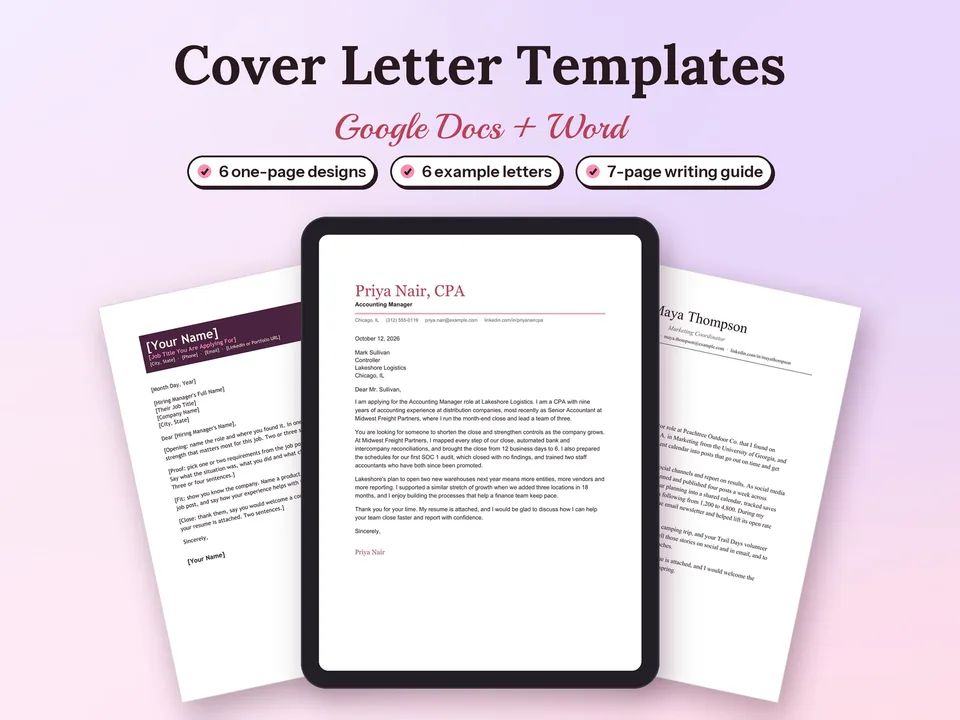
To write it without counting by hand, open our free cover letter builder. It walks you through the four guided paragraphs in a one-page design, counts your words as you type, flags the moment the letter runs past one page, and downloads it as a Word file or PDF. For six designs, six finished example letters and a guide to tailoring each one, see the cover letter templates for Google Docs.
Questions people ask
Is 400 words too long for a cover letter?
400 words is the top of the usual range, so it's acceptable but long. It still fits on one page in 12-point type with 1-inch margins. If your letter sits at 400, check whether each paragraph does one job. Cutting a second example or a restated resume line usually brings it to 300 words and makes it easier to read.
Is a 600 word cover letter too long?
Yes, for most jobs. At 600 words the letter spills past one page or needs tiny type and narrow margins to fit. Recruiters skim, so the strongest example gets buried. Cut it to 250 to 400 words by keeping one proof story, dropping repeated resume details and shortening the opening and close. Academic faculty letters are the main exception.
Is a 2 page cover letter too long?
For business, nonprofit and most government jobs, yes. The standard is one page or less. Two pages is normal in one place: academic faculty applications, where letters often run one and a half to two pages to cover research and teaching. Outside academia, a second page usually means the letter repeats the resume.
Is 150 words too short for a cover letter?
150 words is short for an attached letter, but it can work as an email body or in an application text box. Below 150 words there's rarely room for a real example with a result. If you can, grow it to about 200 to 250 words by adding one specific achievement that matches the job post and a sentence on why this company.
How many paragraphs should a cover letter have?
Three or four. A four-paragraph letter gives each paragraph one job: the opening names the role and your best reason, the proof paragraph shows one result, the fit paragraph explains why this company, and the close thanks the reader and asks for a conversation. Merge fit and close for a three-paragraph version.
Is a cover letter necessary?
Send one when the posting asks for it, when the application has an optional upload, or when you're changing careers and need to explain the switch. A short, tailored letter of about 250 words takes little time and gives a hiring manager a reason to read your resume closely. When a posting says no cover letter, follow that instruction.
What should be included in a cover letter?
Your contact details, the date, a greeting to the hiring manager by name if you can find it, the job title you're applying for, one or two achievements that match the job post, a reason you want this company, and a short close with a next step. Keep it to one page in the same font as your resume.
How do you end a cover letter?
Close with one or two sentences: thank the reader, say you'd welcome a conversation about the role, and mention that your resume is attached. Then add a sign-off such as Sincerely or Best regards and your full name. Keep the closing paragraph to about 25 to 40 words.